“Humans are not physically normal in the absence of hard physical effort.”
― Mark Rippetoe, Starting Strength
Want bigger, stronger arms? Barbells are still the gold standard. Unlike dumbbells or cables, they let you lift heavier, apply progressive overload, and hit your biceps and triceps with maximum tension — the key driver of muscle growth.
In this article, we’ll cover the three best barbell arm exercises for targeting the biceps and triceps, explaining their biomechanical benefits, execution cues, programming recommendations, and the supporting science.
Why Barbells Build Arms Faster
Barbells facilitate progressive overload more effectively than most tools. They enable you to load the muscles heavily through full ranges of motion. Studies show that mechanical tension is one of the primary stimuli for muscle growth (Schoenfeld, 2010). Additionally, barbell exercises recruit more motor units due to bilateral coordination, which helps strengthen both arms evenly.
Unlike machines or cables, barbell movements also encourage core and postural engagement, enhancing systemic adaptations. For bodybuilders and strength athletes alike, barbells provide unmatched stimulus-to-fatigue ratios for hypertrophic and strength development.
1. Barbell Curl

Barbell Curl: The Classic Mass Builder
The barbell curl is a foundational exercise for biceps development. It primarily targets the biceps brachii, with synergistic support from the brachialis and brachioradialis. This movement excels at generating mechanical tension and muscular damage—two key hypertrophy drivers.
Execution
- Stand tall with feet shoulder-width apart, holding a barbell with a supinated (underhand) grip. Hands should be just outside hip-width.
- Engage your core and retract your scapulae to stabilize the upper body.
- Curl the bar upward while keeping the elbows close to the sides.
- Avoid swinging the bar or leaning backward.
- Squeeze the biceps at the top of the movement.
- Lower the bar under control until elbows are fully extended.
Programming
- Sets: 3-5
- Reps: 6-12
- Rest: 60-90 seconds between sets
Scientific Rationale
Research by Oliveira et al. (2009) found that free-weight biceps curls elicited significantly more muscle activation than machine-based versions. Additionally, increased grip width can modulate biceps short head (wide grip) versus long head (narrow grip) recruitment (Youdas et al., 2010). The barbell curl is also superior for total volume loading due to its bilateral nature.
2. Close-Grip Barbell Bench Press
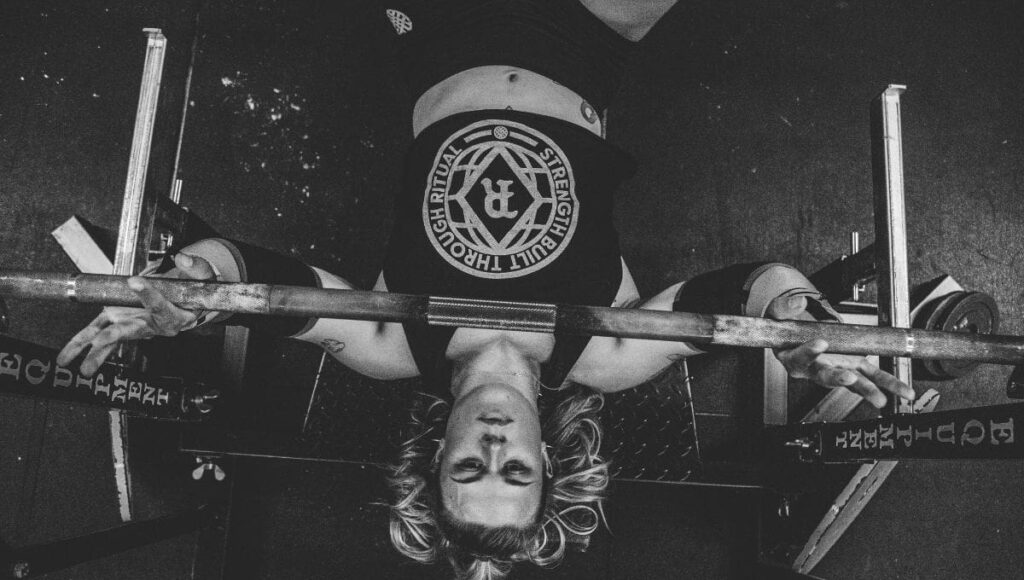
Close-Grip Bench Press: Heavy Triceps Growth
The close-grip barbell bench press is not just a chest variation. With a narrower grip, the movement shifts the emphasis from the pectorals to the triceps brachii, particularly the long head. This variation allows for heavy loading and compound joint movement, making it one of the most effective triceps mass-builders.
Execution
- Lie flat on a bench and grip the barbell with hands shoulder-width apart.
- Unrack the bar and lower it slowly to your lower chest, keeping elbows tucked at about 45 degrees.
- Press the bar back up until arms are fully extended.
- Focus on triceps extension and control the eccentric phase.
Programming
- Sets: 4-6
- Reps: 5-10
- Rest: 90-120 seconds
Scientific Rationale
A study by Lehman (2005) showed that a narrower grip significantly increases triceps activation compared to a traditional bench press grip. Furthermore, compound movements like this allow for higher mechanical loads, enhancing muscle fiber recruitment in all three triceps heads. Schick et al. (2010) noted that elbow position (tucked versus flared) influences triceps contribution, and tucking the elbows promotes greater long head involvement.
3. Barbell Drag Curl
Barbell Drag Curl: The Long Head Secret
The barbell drag curl is a lesser-known but incredibly effective biceps variation. Unlike standard curls, the drag curl minimizes anterior deltoid involvement and emphasizes the long head of the biceps by altering the shoulder and elbow joint mechanics.
Execution
- Stand upright holding a barbell with a shoulder-width underhand grip.
- Instead of curling the bar straight up, drag the bar up your torso by pulling your elbows backward.
- Keep the bar close to the body throughout.
- Squeeze at the top and slowly lower.
Programming
- Sets: 3-4
- Reps: 10-15
- Rest: 45-60 seconds
Scientific Rationale
Drag curls reduce anterior deltoid recruitment and isolate the biceps more effectively (Contreras & Schoenfeld, 2011). They also modify the resistance curve, challenging the biceps in a different part of the range of motion than standard curls. This varied loading enhances muscle fiber recruitment and adaptation, which is critical for well-rounded hypertrophy.
Maximizing Results with These Movements
Exercise Order and Frequency
When designing an arm-specific session, consider placing the compound movement (close-grip bench press) first, followed by isolation-focused curls. This sequencing adheres to principles of prioritization and pre-fatigue management.
Train arms 1-2 times per week depending on volume and recovery capacity. Studies show that training a muscle group twice per week yields superior hypertrophy compared to once weekly (Schoenfeld et al., 2016).
Progressive Overload and Volume Management
Gradually increase the weights or reps each week to continue stimulating muscle adaptation. However, beware of excessive volume. Total weekly sets per muscle group should range between 10-20 depending on experience level and intensity (Schoenfeld, 2010).
Tempo and Time Under Tension
Manipulating tempo (e.g., 3-second eccentrics) increases time under tension, a known hypertrophic stimulus (Burd et al., 2012). Use controlled negatives to emphasize muscle damage and enhance growth.
Avoiding Common Mistakes
- Using momentum during curls reduces biceps tension and shifts load to other muscle groups.
- Flaring elbows in close-grip presses recruits more deltoids and chest, diminishing triceps activation.
- Incomplete range of motion shortchanges potential hypertrophy.
- Neglecting proper warm-up can impair performance and increase injury risk.
Conclusion
Barbells remain unmatched for arm size and strength. Add curls, close-grip presses, and drag curls into your routine, train with progressive overload, and you’ll see your arms grow thicker and stronger week by week.
The barbell curl, close-grip bench press, and barbell drag curl provide a comprehensive mix of mechanical tension, muscle activation, and progressive overload potential. When programmed effectively, these exercises can yield massive improvements in arm size and strength. Train smart, prioritize technique, and apply progressive overload—your arms will thank you.
Bibliography
Burd, N.A., Andrews, R.J., West, D.W.D., Little, J.P., Cochran, A.J., Hector, A.J., Cashaback, J.G., Gibala, M.J., Potvin, J.R. and Baker, S.K., 2012. Muscle time under tension during resistance exercise stimulates differential muscle protein sub-fractional synthetic responses in men. Journal of Physiology, 590(2), pp.351-362.
Contreras, B. and Schoenfeld, B.J., 2011. To crunch or not to crunch: an evidence-based examination of spinal flexion exercises, their potential risks, and their applicability to program design. Strength & Conditioning Journal, 33(4), pp.8-18.
Lehman, G.J., 2005. The influence of grip width and forearm pronation/supination on upper-body myoelectric activity during the flat bench press. Journal of Strength and Conditioning Research, 19(3), pp.587-591.
Oliveira, L.F., Matta, T.T., Alves, D.S., Garcia, M.A. and Vieira, T.M., 2009. Effect of the shoulder position on the biceps brachii EMG in different dumbbell curls. Journal of Sports Science & Medicine, 8(4), p.503.
Schick, E.E., Coburn, J.W., Brown, L.E., Judelson, D.A., Khamoui, A.V., Tran, T.T., Uribe, B.P. and Uribe, Z., 2010. A comparison of muscle activation between a Smith machine and free weight bench press. Journal of Strength and Conditioning Research, 24(3), pp.779-784.
Schoenfeld, B.J., 2010. The mechanisms of muscle hypertrophy and their application to resistance training. Journal of Strength and Conditioning Research, 24(10), pp.2857-2872.
Schoenfeld, B.J., Ogborn, D. and Krieger, J.W., 2016. Effects of resistance training frequency on measures of muscle hypertrophy: a systematic review and meta-analysis. Sports Medicine, 46(11), pp.1689-1697.
Youdas, J.W., Amundson, C.L., Cicero, K.S., Hahn, J.J., Harezlak, D.T. and Hollman, J.H., 2010. Surface electromyographic activation patterns and elbow joint motion during a biceps curl performed with three different forearm positions. Journal of Strength and Conditioning Research, 24(5), pp.1239-1244.