Developing a well-defined six-pack is a goal shared by many fitness enthusiasts, but it’s one that requires precision, consistency, and science-backed methods. Contrary to popular belief, achieving a six-pack isn’t about endlessly crunching away at the gym—it’s about targeting the abdominal muscles with high-impact exercises, managing body fat through nutritional strategies, and integrating a full-body training plan to support fat loss and muscular definition.
In this article, we’ll focus exclusively on the three best exercises for building a defined six-pack, grounded in scientific evidence and real-world effectiveness.
[wpcode id=”229888″]Understanding the Anatomy of the Abdominal Muscles
Before diving into the exercises, it’s important to understand what constitutes a six-pack. The visible “six-pack” refers primarily to the rectus abdominis, a paired muscle that runs vertically on each side of the anterior wall of the human abdomen.
This muscle is segmented by tendinous intersections, creating the six (or eight) pack appearance. However, the core is not just the rectus abdominis—it also includes the internal and external obliques, the transversus abdominis, and deeper stabilizing muscles.
To get visible abs, two factors are essential:
- Muscle development through progressive overload and strategic resistance training.
- Low body fat to allow the underlying muscle to become visible.
The Criteria for a “Best” Six-Pack Exercise
For an exercise to qualify as one of the best for developing a defined six-pack, it must:
- Recruit the rectus abdominis to a high degree.
- Create mechanical tension through resistance or instability.
- Be scalable and progressive.
- Be supported by electromyographic (EMG) analysis or clinical evaluation.
With this in mind, let’s examine the top three.
1. Ab Wheel Rollout
Why It’s Effective
The ab wheel rollout has consistently ranked among the top abdominal exercises due to its superior muscle activation and capacity to create mechanical tension across the entire anterior core. Unlike traditional crunches, which mostly target the upper section of the rectus abdominis, rollouts engage the entire length of the muscle, along with the transversus abdominis and even the lats and deltoids as stabilizers.
An EMG analysis conducted by Escamilla et al. (2010) demonstrated that rollout variations produced significantly higher rectus abdominis and oblique activity than many traditional core exercises, including sit-ups and crunches. The long-lever mechanics of the movement create a large moment arm, increasing the muscular demand and making it an ideal tool for developing the visible six-pack.
How to Perform It
- Start on your knees with an ab wheel in your hands placed directly below your shoulders.
- Slowly roll the wheel forward while maintaining a straight line from shoulders to knees.
- Keep your core braced to prevent your lower back from sagging.
- Roll out as far as you can while maintaining control, then return to the start.
Progression
- Beginners: Limit range of motion to reduce risk of lumbar extension.
- Advanced: Perform standing rollouts or weighted rollouts.
Scientific Support
The study by Youdas et al. (2008) confirmed that the ab wheel rollout resulted in higher abdominal muscle activity compared to standard curl-up variations. EMG readings indicated peak activation in both upper and lower rectus abdominis regions.
2. Hanging Leg Raise
Why It’s Effective
The hanging leg raise effectively targets the lower portion of the rectus abdominis—an area often under-stimulated in many ab routines. This exercise also engages the hip flexors, particularly the iliopsoas, which adds complexity and intensity. What sets the hanging leg raise apart is the dynamic resistance imposed by body weight and gravity, challenging both abdominal strength and endurance.
A study by Parkhouse and Ball (2011) used EMG analysis to measure core activation during various leg raise techniques. Results showed that hanging leg raises elicited significantly higher rectus abdominis activation than bent-knee sit-ups, and even surpassed the classic crunch in muscle recruitment.
How to Perform It
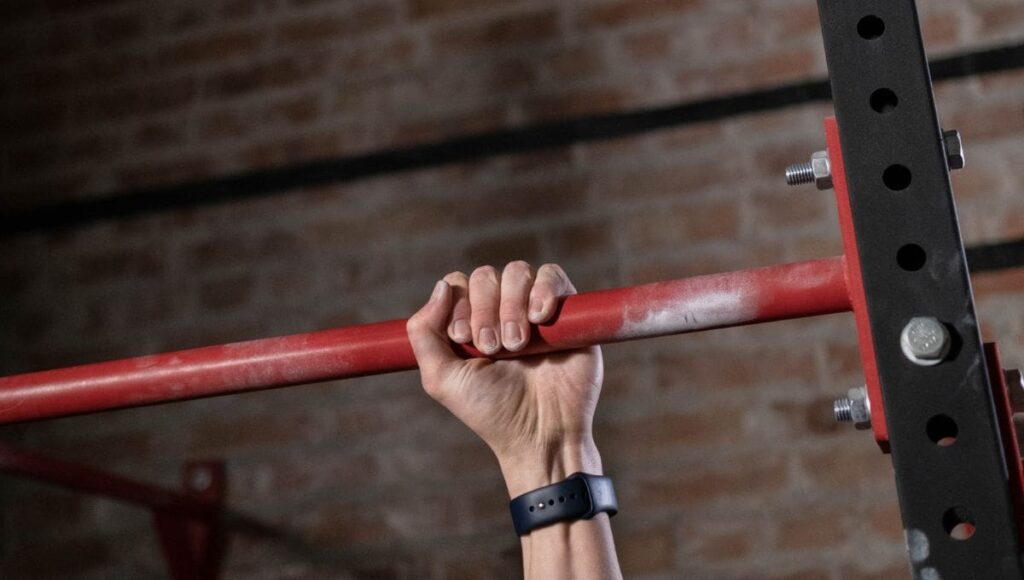
- Hang from a pull-up bar with your arms fully extended and legs straight.
- Without swinging, lift your legs until they are parallel with the ground or higher.
- Control the descent without letting your body swing.
Progression
- Beginners: Perform bent-knee raises.
- Intermediate: Execute toes-to-bar raises.
- Advanced: Add ankle weights or perform L-sit holds at the top.
Scientific Support
According to research by Andersson et al. (1997), leg raises cause greater activation of the lower abdominal fibers and require strong neuromuscular control, making them a staple for developing lower abdominal visibility.
3. Cable Crunch
Why It’s Effective
The cable crunch allows for progressive overload, a principle often neglected in abdominal training. By using a cable stack, you can incrementally increase resistance, which is crucial for hypertrophy of the rectus abdominis. This movement mimics the spinal flexion pattern that the rectus abdominis is primarily responsible for.
A 2013 EMG study by Schick et al. showed that weighted crunch variations, especially those performed with cable resistance, significantly enhanced both upper and lower rectus abdominis activation compared to bodyweight exercises. Importantly, these gains were seen even in trained individuals, highlighting the movement’s scalability.
How to Perform It
- Attach a rope to a high pulley on a cable machine and kneel about a foot away from the stack.
- Hold the rope with both hands near your ears and brace your core.
- Flex your spine to bring your elbows toward your thighs while exhaling.
- Slowly return to the starting position with control.
Progression
- Increase weight as you get stronger.
- Vary tempo to include slow eccentrics for increased muscle tension.
Scientific Support
The biomechanical review by Clark et al. (2003) emphasized the importance of loaded spinal flexion for stimulating abdominal hypertrophy, concluding that exercises like the cable crunch are vital for developing muscular thickness and definition.
Integrating the Three Movements into a Weekly Program
To maximize results, these exercises should be part of a broader hypertrophy and fat-loss strategy. Ideally, train abs 2–3 times per week with at least one of the exercises featured in each session. Pair these with compound lifts (deadlifts, squats, overhead presses) and a calorie-controlled diet to enhance muscle visibility.
Sample Weekly Split
Day 1 (Push Focus + Core)
Cable Crunch: 4 sets of 12 reps
Day 3 (Pull Focus + Core)
Ab Wheel Rollout: 3 sets of 10 reps
Day 5 (Legs + Core)
Hanging Leg Raise: 4 sets to failure
Additional Considerations: Nutrition and Body Fat
No abdominal workout will make your six-pack visible if it’s hidden under body fat. For men, visibility often occurs below 12% body fat, while for women it typically appears below 18%. Caloric deficit, protein-rich diets, and resistance training are the cornerstones of fat loss. A review by Thomas et al. (2019) emphasized that exercise-induced energy deficits are best achieved with a combination of resistance training and moderate aerobic activity, rather than cardio alone.
Avoiding Common Mistakes
- Neglecting progressive overload: Abdominal muscles require resistance to grow. Relying solely on bodyweight will stall progress.
- Training abs daily: Like all muscles, abs need recovery to grow. Overtraining can lead to diminished returns and injury risk.
- Using improper form: Especially in hanging leg raises and ab rollouts, lumbar extension can cause lower back strain. Maintain a neutral spine and engage the core throughout.
Conclusion
While there are countless abdominal exercises available, only a few stand out for their ability to build a defined, functional, and symmetrical six-pack.
The ab wheel rollout, hanging leg raise, and cable crunch each offer unique benefits, and their efficacy is strongly supported by scientific research. When paired with a strategic training plan and proper nutrition, these exercises can form the foundation of a high-performance core routine.
References
Andersson EA, Ma Z, Thorstensson A. (1997). ‘Relative contributions of the leg and trunk muscles during sit-ups and leg-raises’, European Journal of Applied Physiology and Occupational Physiology, 76(3), pp. 183–190.
Clark, D. R., Lambert, M. I., and Hunter, A. M. (2003). ‘Trunk muscle activation during dynamic weight-training exercises and isometric instability activities’, Journal of Strength and Conditioning Research, 17(4), pp. 629–635.