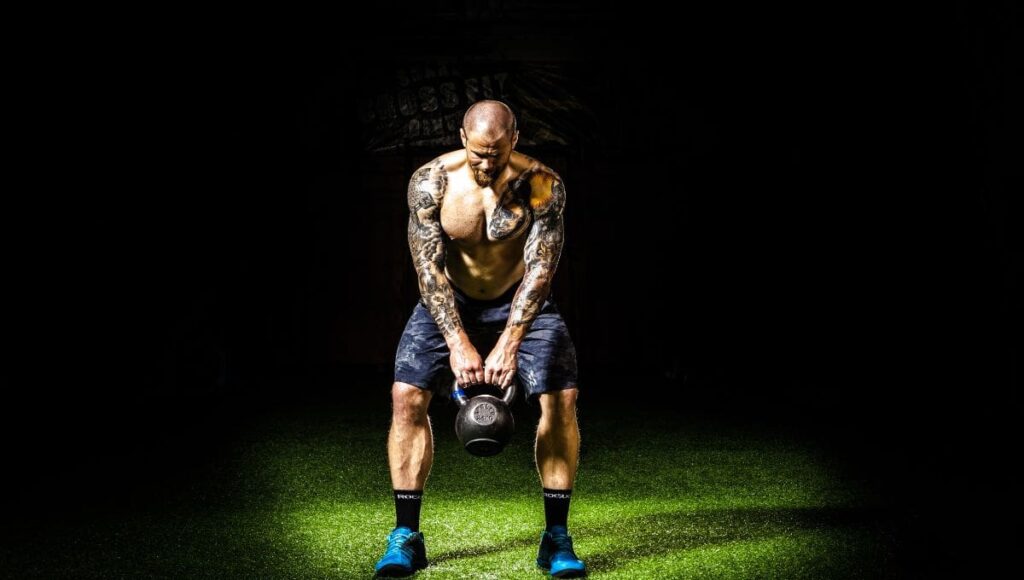
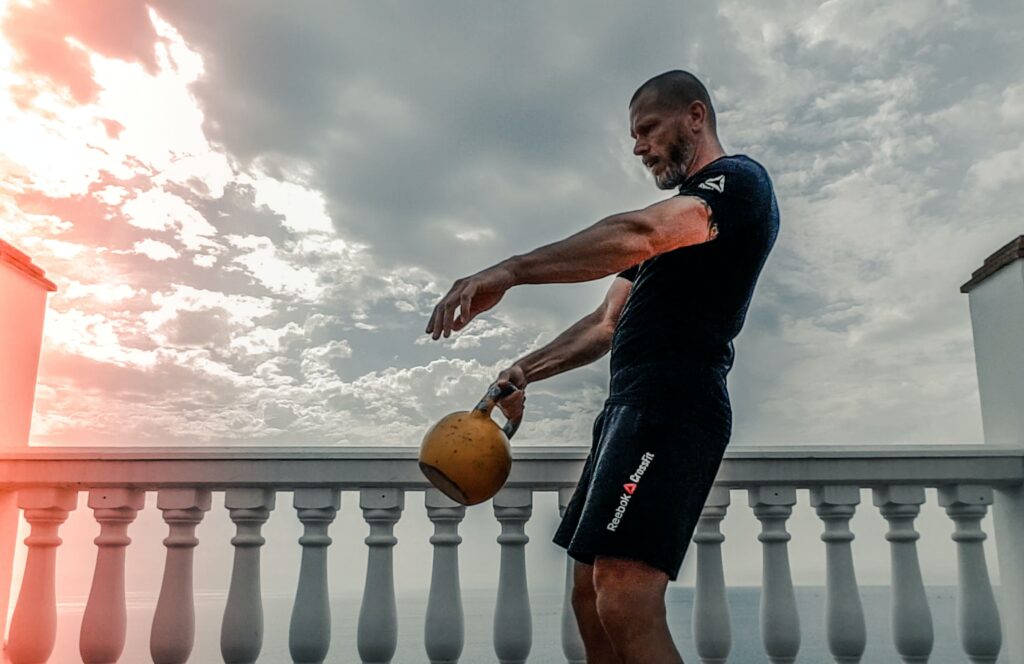
Unilateral kettlebell exercises—movements where you train one side of the body at a time—are one of the most efficient and accessible ways to grow upper body muscle fast.
Many lifters focus almost entirely on bilateral lifts like barbell pressing or pull-ups, but unilateral kettlebell work brings unique muscle-building benefits that directly support hypertrophy, strength, balance and joint health.
This article breaks down why unilateral kettlebell training is so effective, the science behind it, and the three best unilateral kettlebell exercises to build upper body muscle quickly. You will also learn how to perform each exercise, how to program them, and how to apply progressive overload so you continue making gains week after week.
Why Unilateral Kettlebell Exercises Are So Effective
Unilateral vs Bilateral Training: What the Science Says
Unilateral training simply means loading and training one limb at a time. Bilateral training loads both limbs simultaneously.
Research shows that unilateral and bilateral resistance training produce similar levels of muscle hypertrophy when training volume and intensity are matched. A major systematic review found no meaningful difference in growth outcomes between the two methods. This means unilateral training is just as effective for building muscle as bilateral training, despite using lighter loads.
Other research also demonstrates that unilateral training can increase unilateral strength more effectively due to the principle of specificity—the body adapts to the exact movement performed.
In short: unilateral work is not inferior for building muscle, and in some cases it offers unique benefits that bilateral lifts cannot.
Why Kettlebells Improve the Stimulus
Kettlebells offer benefits that dumbbells and barbells do not, especially when used unilaterally:
- The offset centre of mass forces your stabilising muscles to work harder.
- You must control the kettlebell’s pull toward the outside of your body.
- The grip demands are higher due to the thick handle.
- Your core fights rotation throughout each rep.
This creates a full-body tension system, meaning your shoulders, lats, serratus, obliques, and trunk all work together. More muscle involvement equals more hypertrophy stimulus.
How Unilateral Loading Stimulates Muscle Growth
Unilateral kettlebell exercises support upper body growth through:
- Increased stabiliser activation
Your core and shoulder stabilisers fire more intensely to prevent twisting and leaning. This increases total muscle recruitment. - Better mind-muscle connection
Focusing on one limb at a time improves your ability to feel and contract the target muscles. - Balanced development
Many lifters are stronger on one side. Unilateral work prevents the dominant side from taking over. - Improved joint mechanics
Because the load path is more natural, unilateral kettlebell exercises often feel better on the shoulders and elbows. - Greater range of motion in certain movements
Some unilateral variations allow deeper positions than bilateral barbell lifts. - Reduced injury risk while maintaining overload
Training one side at a time allows for heavy loading without the spinal compression of heavy bilateral barbell work.
Put simply: unilateral kettlebell exercises give you the same benefits as traditional lifts while adding stability, symmetry and control challenges that help you build muscle faster and more safely.
Principles for Muscle Growth With Unilateral Kettlebell Training
Before you get into the specific exercises, it helps to understand the core principles that drive muscle growth. These principles are the same for any form of weight training, but they are easier to apply when training unilaterally.
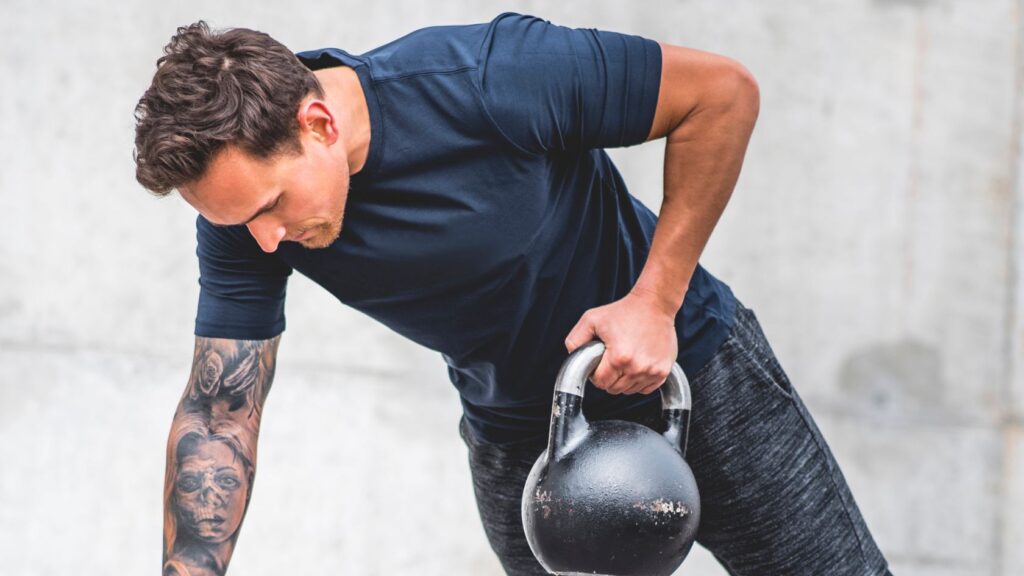
Progressive Overload
Muscle growth requires progressively increasing the stress placed on the muscle. You can overload with:
- Heavier kettlebells
- More reps
- More sets
- Slower eccentrics
- Longer pauses
- Increased total weekly volume
You don’t need huge jumps—small, steady increases lead to the best long-term growth.
Repetition Ranges
For hypertrophy, aim for:
- 6–12 reps for pressing
- 8–12 reps for rowing
- 8–12 reps for floor press or half-kneeling press
This rep range allows heavy enough loading while giving enough time-under-tension within each set.
Rest Times
For best muscle growth:
- Rest 60–90 seconds between sets
- Extend rest slightly (up to ~2 minutes) on heavy sets
Short rest times that leave you gassed can reduce performance and limit volume.
Frequency
Most people grow best with:
- 2 upper-body sessions per week
- Or 3 if recovery is strong
You can rotate between bilateral and unilateral training for balanced development.
Quality of Movement
Because unilateral kettlebell training demands extra stability, form is critical:
- Brace your core
- Keep ribs down
- Avoid leaning or twisting to cheat the weight up
- Control the eccentric phase
When in doubt, slow the movement down. Slow reps build more muscle.
The 3 Best Unilateral Kettlebell Exercises for Rapid Upper Body Muscle Growth
Below are the three most effective unilateral kettlebell exercises for building upper body muscle. Each exercise targets major upper body muscle groups, stimulates stabilisers and allows progression over time.
1. Single-Arm Kettlebell Overhead Press
Why This Exercise Builds Muscle Fast
The single-arm kettlebell overhead press builds:
- Deltoids
- Triceps
- Serratus anterior
- Upper chest
- Rotator cuff
- Core and trunk stabilisers
Pressing a kettlebell unilaterally challenges the shoulder far more than a bilateral press because:
- Your obliques contract hard to prevent side bending.
- The kettlebell’s offset weight forces extra wrist, forearm and shoulder stabilisation.
- Each shoulder works independently, eliminating compensation.
For hypertrophy, this creates a perfect combination of tension, range of motion, and stability demand.
How to Perform It
- Clean the kettlebell into the front-rack position.
- Stand tall with your core braced.
- Press the kettlebell straight overhead, finishing with your biceps near your ear.
- Lower the kettlebell under slow control.
- Avoid leaning to the opposite side—stay tall.
- Complete all reps on one side, then switch.
Sets & Reps
- 3–4 sets of 6–10 reps per arm
Hypertrophy Tips
- Use a slow eccentric (2–3 seconds).
- Keep your elbow under the kettlebell—don’t flare too wide.
- Press in a straight line, not a curved path.
- If your weaker shoulder struggles, start every session with that side.
2. Single-Arm Kettlebell Row
Why This Exercise Builds Muscle Fast
The single-arm kettlebell row is one of the best exercises for back thickness and strength. It targets:
- Lats
- Rhomboids
- Middle and lower traps
- Rear delts
- Biceps
- Obliques (anti-rotation control)
Unilateral rowing forces your core to resist twisting, which increases overall muscle activation. It also eliminates dominant-side pulling, ensuring balanced back development.
How to Perform It
- Place the kettlebell between your feet or slightly in front.
- Hinge at the hips and keep your spine straight.
- Grab the kettlebell with one hand.
- Pull it toward your lower ribs while squeezing your shoulder blade back.
- Lower it slowly under control.
- Keep your hips square—don’t twist as you row.
Sets & Reps
- 3–4 sets of 8–12 reps per arm
Hypertrophy Tips
- Pause and squeeze at the top for 1 second.
- Let the kettlebell stretch your lat at the bottom of each rep.
- Use straps only if grip fatigue limits back training.

3. Single-Arm Kettlebell Floor Press
(or Half-Kneeling Kettlebell Press if you prefer a greater range of motion)
Why This Exercise Builds Muscle Fast
Many lifters overlook the kettlebell floor press, yet it is one of the safest and most effective unilateral chest exercises. It works:
- Chest (especially mid and upper fibres)
- Triceps
- Anterior delts
- Shoulder stabilisers
- Obliques and trunk muscles
Because it is unilateral, this lift forces your core to stabilise and prevents your stronger side from dominating.
The floor also protects your shoulders by limiting extreme extension, making this exercise ideal for lifters with shoulder discomfort.
How to Perform It (Floor Press)
- Lie on your back with knees bent.
- Bring the kettlebell into the rack position.
- Press straight up until your arm is extended.
- Lower until your triceps gently touch the floor.
- Keep your ribs down and core engaged.
- Repeat for all reps before switching sides.
Sets & Reps
- 3–4 sets of 8–12 reps per arm
Hypertrophy Tips
- Use a 2–3 second eccentric phase.
- Keep your forearm vertical—don’t let the kettlebell drift behind your elbow.
- For more core activation, try the half-kneeling version.
Sample Unilateral Upper Body Kettlebell Workout
Try this session once or twice a week for rapid upper-body development.
| Exercise | Sets | Reps per side | Rest |
|---|---|---|---|
| Single-Arm Kettlebell Overhead Press | 4 | 6–10 | 60–90 sec |
| Single-Arm Kettlebell Row | 3 | 8–12 | 60–90 sec |
| Single-Arm Kettlebell Floor Press | 3 | 8–12 | 60–90 sec |
| Optional: Single-Arm Kettlebell Carry | 2 | 20–30 sec | 45–60 sec |
How to Progress Weekly
Choose one method per week:
- Add 1–2 reps per set.
- Add 1 kg (or the next kettlebell size).
- Add a fourth set to one exercise.
- Slow the eccentric on all reps.
Small improvements every week add up quickly.
Final Thoughts
Unilateral kettlebell exercises are a highly effective and accessible way to build upper body muscle. They challenge stabilisers, improve symmetry, increase joint health and allow heavy loading without the risks associated with heavy barbells.
Because research shows unilateral and bilateral training produce similar hypertrophy outcomes when volume is matched, unilateral kettlebell work stands as a legitimate and powerful muscle-building method.
The three best unilateral kettlebell exercises for rapid upper body muscle growth are:
- Single-Arm Kettlebell Overhead Press
- Single-Arm Kettlebell Row
- Single-Arm Kettlebell Floor Press
Incorporate these movements consistently, apply progressive overload and maintain good technique—you’ll be rewarded with stronger, more symmetrical and visibly improved upper-body development.
Key Takeaways
| Key Point | What It Means |
|---|---|
| Unilateral training is as effective as bilateral for hypertrophy | Research shows no significant difference in muscle growth when volume is equal |
| Kettlebells add unique stability challenges | The offset load increases core and shoulder stabilisation |
| Each exercise trains major upper-body muscles | Pressing, pulling and horizontal pressing cover all key areas |
| Progressive overload drives growth | Add weight, reps or sets gradually |
| Balance improves naturally | Both sides must work independently, reducing strength imbalances |
Bibliography
- Kassiano, W., et al. (2024) ‘Comparison of Muscle Growth and Dynamic Strength Adaptations Induced by Unilateral and Bilateral Resistance Training: A Systematic Review and Meta-Analysis’, Sports Medicine.
- Selland, Z.O., Erickson, J.M. and Frost, J.M. (2023) ‘Assessing the Impact of Unilateral and Bilateral Resistance Training on Strength Development and Bilateral Index’, International Journal of Resistance Exercise Physiology.
- Abelsson, A. (2024) ‘Unilateral vs. Bilateral Strength Training for Strength and Muscle Growth’, StrengthLog.
- Croskery, M. (2025) ‘Examining Unilateral and Bilateral Strength Training Exercises’, Simplifaster.
- Rideout, C. (2025) ‘How to Build Muscle with Kettlebells: The Complete Hypertrophy Guide’, Dr. Muscle.