The holiday season is one of the hardest times of year to stay consistent with training. Gyms may be closed, travel disrupts routines, and motivation often takes a hit. Despite this, research consistently shows that maintaining even a modest level of physical activity during periods of disruption helps preserve strength, cardiovascular fitness, metabolic health, and mental well-being.
Bodyweight training is uniquely suited to holidays. It requires no equipment, minimal space, and can be adapted to any fitness level. Importantly, science shows that bodyweight exercises can meaningfully improve strength, muscle endurance, aerobic capacity, and insulin sensitivity when programmed correctly.
This article presents three complete holiday bodyweight workouts you can do at home. Each workout is built around well-established physiological principles and supported by peer-reviewed research. You will also learn why each workout works, how to scale it, and how to use it effectively during short or inconsistent training windows.
Why Bodyweight Training Works
Strength and Muscle Maintenance Without Weights
Muscle does not inherently require external load to adapt. It responds to mechanical tension, metabolic stress, and sufficient motor unit recruitment. Studies show that low-load resistance training performed to or near muscular failure can stimulate muscle hypertrophy comparable to traditional heavy lifting, especially when volume is controlled.
Bodyweight exercises like push-ups, squats, lunges, and planks can generate high levels of muscle activation when performed with proper technique, tempo manipulation, unilateral loading, or reduced rest periods. Electromyography studies consistently demonstrate that variations of push-ups and squats produce substantial activation of the chest, triceps, quadriceps, glutes, and core musculature.
During short training breaks, maintaining muscle activation frequency appears more important than maintaining maximal load. Research on detraining indicates that even one to two weekly resistance sessions can significantly slow strength and muscle loss during periods of reduced training.
Cardiovascular and Metabolic Benefits
Bodyweight circuits elevate heart rate and oxygen consumption, especially when exercises are sequenced with minimal rest. High-intensity bodyweight circuits have been shown to improve VO₂ max, blood glucose control, and insulin sensitivity in both trained and untrained individuals.
Short bouts of vigorous activity also improve mitochondrial function and endothelial health. This is particularly relevant during holidays, when caloric intake tends to increase and daily movement often decreases.
Mental Health and Stress Regulation
Exercise plays a well-documented role in reducing stress, anxiety, and depressive symptoms. This effect is mediated through changes in neurotransmitters, endorphin release, and reductions in systemic inflammation.
During holidays, stress levels often increase due to social obligations, disrupted sleep, and travel. Maintaining consistent exercise, even in short sessions, has been shown to improve mood regulation and perceived stress levels.
Workout 1: The Full-Body Holiday Circuit
This workout is designed to train every major movement pattern while elevating heart rate. It balances lower body, upper body pushing and pulling mechanics, and trunk stabilization.
How the Workout Works
The structure relies on compound movements performed in circuit format. Circuit training has been shown to improve muscular endurance and cardiovascular fitness simultaneously. When rest intervals are short, oxygen consumption remains elevated throughout the session, producing a significant metabolic stimulus.
Perform the following circuit 3 to 5 times depending on time and fitness level.
Exercises
Bodyweight Squats
Reps: 20
Tempo: Controlled descent, fast ascent
Bodyweight squats primarily target the quadriceps, gluteus maximus, and adductors. Research shows that squats also activate trunk stabilizers when performed with upright posture and controlled depth.
Push-Ups
Reps: 12 to 20
Push-ups activate the pectoralis major, anterior deltoids, triceps brachii, and core musculature. Variations such as incline or knee push-ups can reduce load, while tempo control and deficit push-ups increase difficulty.
Reverse Lunges
Reps: 10 per leg
Reverse lunges reduce shear stress at the knee compared to forward lunges while maintaining high glute and quadriceps activation. Unilateral movements also improve balance and address side-to-side strength asymmetries.
Pike Push-Ups
Reps: 8 to 12
Pike push-ups emphasize the shoulders and upper chest. EMG studies show they significantly activate the anterior deltoids, making them an effective overhead pressing substitute.
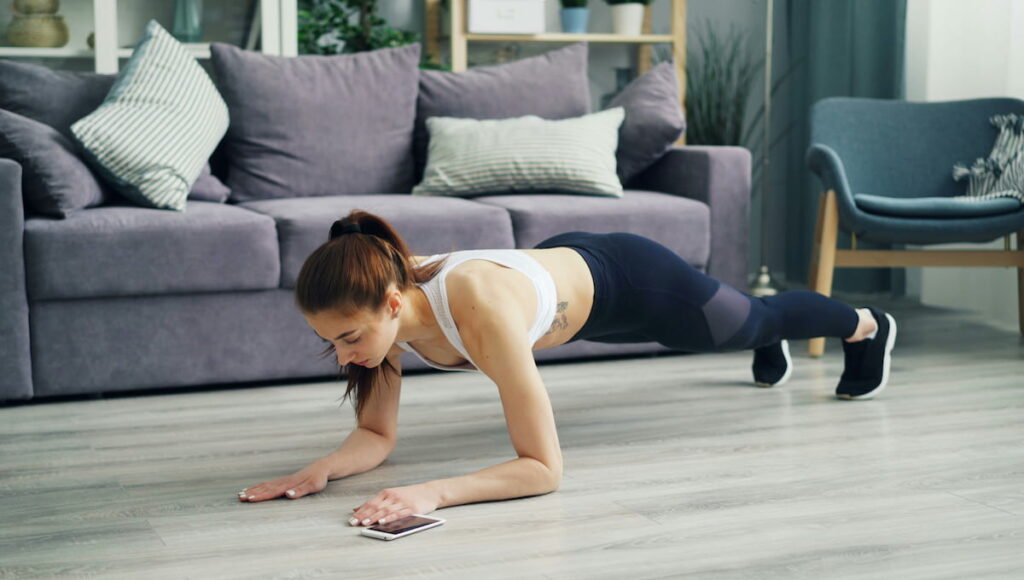
Forearm Plank
Time: 40 to 60 seconds
Plank variations produce high activation of the transverse abdominis, rectus abdominis, and spinal stabilizers. Isometric core training has been shown to improve trunk endurance and spinal stiffness, both important for injury prevention.
Rest
Rest 60 to 90 seconds between rounds.
Why This Workout Is Effective

This workout uses moderate repetitions, short rest periods, and compound movements to generate mechanical tension and metabolic stress. Studies on circuit training indicate improvements in aerobic capacity comparable to traditional cardio when intensity is sufficient.
The combination of unilateral and bilateral exercises also enhances neuromuscular coordination, which tends to decline during periods of inactivity.
Workout 2: The Holiday HIIT Bodyweight Burner
This workout emphasizes intensity, time efficiency, and cardiovascular conditioning. It is ideal for days when time is limited or motivation is low.
Why HIIT Works With Bodyweight Exercises
High-intensity interval training improves cardiovascular fitness by challenging the heart’s ability to deliver oxygen rapidly. Research consistently shows that HIIT can produce similar or greater improvements in VO₂ max compared to longer steady-state exercise, even with shorter total workout duration.
Bodyweight HIIT also improves insulin sensitivity and lipid metabolism. This is especially relevant during periods of increased caloric intake, such as holidays.
Workout Structure
Work for 30 seconds, rest for 15 seconds. Complete all exercises in order, then rest 2 minutes. Repeat for 3 to 4 rounds.
Exercises
Jump Squats
Jump squats develop lower-body power and elevate heart rate rapidly. Plyometric training improves neuromuscular efficiency and rate of force development, even without external load.
Mountain Climbers
Mountain climbers combine hip flexion, core stabilization, and shoulder endurance. They produce high oxygen consumption and significantly elevate heart rate.
Burpees
Burpees engage nearly every major muscle group. Research shows burpees elicit high metabolic demand and cardiovascular stress, making them highly efficient for conditioning.
Alternating Step-Back Lunges
This movement reduces impact while maintaining high muscular demand. It allows partial recovery while keeping heart rate elevated.
High Plank Shoulder Taps
This exercise challenges core stability under dynamic load. Anti-rotational core training improves spinal control and transfer of force between the upper and lower body.
Why This Workout Is Effective
Short work intervals performed near maximal effort increase anaerobic and aerobic capacity. Studies show that HIIT improves mitochondrial density and glucose transport proteins, enhancing metabolic health.
Importantly, HIIT also preserves lean mass more effectively than steady-state cardio during caloric surplus or deficit, which is relevant during holiday eating patterns.
Workout 3: The Low-Impact Strength and Mobility Session
Not every holiday workout needs to be maximal. This session focuses on joint health, muscle activation, and movement quality. It is ideal for recovery days, travel days, or periods of poor sleep.
The Science Behind Low-Impact Training
Low-impact resistance training improves muscle endurance and joint range of motion while minimizing mechanical stress. Research shows that controlled, slow-tempo bodyweight exercises improve tendon stiffness and joint stability.
Maintaining mobility and joint function reduces injury risk when returning to heavier training after a break.
Workout Structure
Perform each exercise slowly and deliberately. Rest as needed.
Exercises
Tempo Squats
Reps: 12
Tempo: 5 seconds down, 2 seconds up
Slow eccentric training increases time under tension, which is a key driver of muscular adaptation. Eccentric-focused training has been shown to enhance muscle strength and connective tissue resilience.
Glute Bridges
Reps: 15
Glute bridges activate the posterior chain, particularly the gluteus maximus. Strong glutes reduce lower back stress and improve hip stability.

Wall Push-Ups
Reps: 15 to 20
Wall push-ups reduce joint stress while maintaining upper-body muscle activation. They are useful for maintaining pressing strength during recovery-focused sessions.
Bird Dogs
Reps: 10 per side
Bird dogs improve spinal stability and coordination. Research supports their use in reducing lower back pain and improving trunk control.
Side Plank
Time: 20 to 40 seconds per side
Side planks emphasize the obliques and quadratus lumborum. Lateral core strength is strongly associated with reduced injury risk and improved athletic performance.
Why This Workout Is Effective
This workout supports connective tissue health, posture, and neuromuscular control. Studies show that maintaining low-load strength training during breaks preserves motor patterns and reduces performance decline when normal training resumes.
It also promotes parasympathetic nervous system activity, aiding recovery and stress regulation.
How to Program These Workouts During the Holidays
Frequency
Research suggests that two to four training sessions per week are sufficient to maintain strength and cardiovascular fitness over short periods. Even single weekly sessions can meaningfully reduce detraining effects.
A simple approach is:
- One full-body circuit workout
- One HIIT workout
- One low-impact strength and mobility session
Duration
Most of these workouts can be completed in 20 to 40 minutes. Studies show that shorter, higher-quality sessions are more effective than longer, inconsistent workouts.
Progression Without Equipment
Progression can be achieved by:
- Increasing repetitions or rounds
- Reducing rest time
- Slowing tempo
- Using unilateral variations
- Increasing range of motion
These methods are supported by research showing that mechanical tension and metabolic stress can be manipulated independently of load.
Common Mistakes to Avoid
Skipping Warm-Ups
Even short workouts benefit from a brief warm-up. Dynamic warm-ups improve muscle performance and reduce injury risk.
Training to Exhaustion Every Session
Chronic fatigue impairs recovery and immune function. Research shows that alternating high-intensity and low-intensity sessions improves long-term adherence and outcomes.
Ignoring Technique
Poor movement quality increases injury risk. Bodyweight training is only effective when exercises are performed with proper alignment and control.
Final Thoughts
The holidays do not need to derail your fitness. Science consistently shows that short, well-structured bodyweight workouts are sufficient to maintain strength, cardiovascular health, and mental well-being during periods of disruption.
These three workouts offer flexibility, efficiency, and evidence-based effectiveness. By understanding why they work and how to use them, you can stay active without sacrificing time, recovery, or enjoyment during the holiday season.
References
- American Journal of Physiology – Regulatory, Integrative and Comparative Physiology: Gibala, M.J. et al., 2012. Physiological adaptations to low-volume, high-intensity interval training in health and disease.
- Journal of Strength and Conditioning Research: Calatayud, J. et al., 2014. Muscle activation during push-ups with different suspension training systems.
- European Journal of Applied Physiology: Schoenfeld, B.J., 2010. The mechanisms of muscle hypertrophy and their application to resistance training.
- Sports Medicine: Weston, M. et al., 2014. Effects of low-volume high-intensity interval training on fitness in adults.