Adhering to a diet can often feel overwhelming, especially when balancing work, family, and other responsibilities. Many people struggle not because of a lack of motivation but because their approach is unsustainable.
This article outlines three minimum-effort strategies backed by science to help you stay on track with your diet in 2025 without feeling deprived or overwhelmed.
Tip 1: Focus on Protein-Rich Foods to Promote Satiety and Prevent Overeating
Protein is essential for muscle repair and growth, but its benefits extend beyond physical performance. Research shows that high-protein diets increase satiety, helping individuals naturally consume fewer calories throughout the day.

A study published in The American Journal of Clinical Nutrition found that participants on high-protein diets reported feeling fuller and experienced reduced food cravings compared to those on lower-protein diets (Paddon-Jones et al., 2008). Incorporating protein-rich foods such as lean meats, eggs, dairy, legumes, and plant-based proteins into your meals can help regulate hunger and make sticking to your calorie goals more manageable.
Furthermore, protein has a higher thermic effect of food (TEF) than carbohydrates or fats, meaning your body burns more calories digesting and metabolising it. According to a review published in The Journal of Nutrition, TEF accounts for roughly 20-30% of the energy consumed from protein compared to 5-10% for carbohydrates and 0-3% for fats (Westerterp, 2004). By prioritising protein-rich meals, you naturally reduce the temptation to snack on less nutritious, calorie-dense foods, simplifying adherence to your diet.
Practical Application
- Include a source of protein in every meal, such as chicken breast, tofu, eggs, or Greek yoghurt.
- Use protein snacks like hard-boiled eggs or protein bars to curb hunger between meals.
- Aim for at least 1.6-2.2 grams of protein per kilogram of body weight daily, as recommended by the International Society of Sports Nutrition (Phillips & Van Loon, 2011).
Tip 2: Create an “Effortless” Meal Environment to Reduce Decision Fatigue
The modern world is filled with food choices, and making decisions about what to eat multiple times a day can lead to decision fatigue.
This phenomenon, where the quality of decisions deteriorates after a prolonged period of decision-making, often results in poor dietary choices. A study published in Psychological Science highlighted how decision fatigue can lead to impulsive behaviours, including the consumption of high-calorie foods (Vohs et al., 2008). One way to counter this is by creating a structured and simplified meal environment.

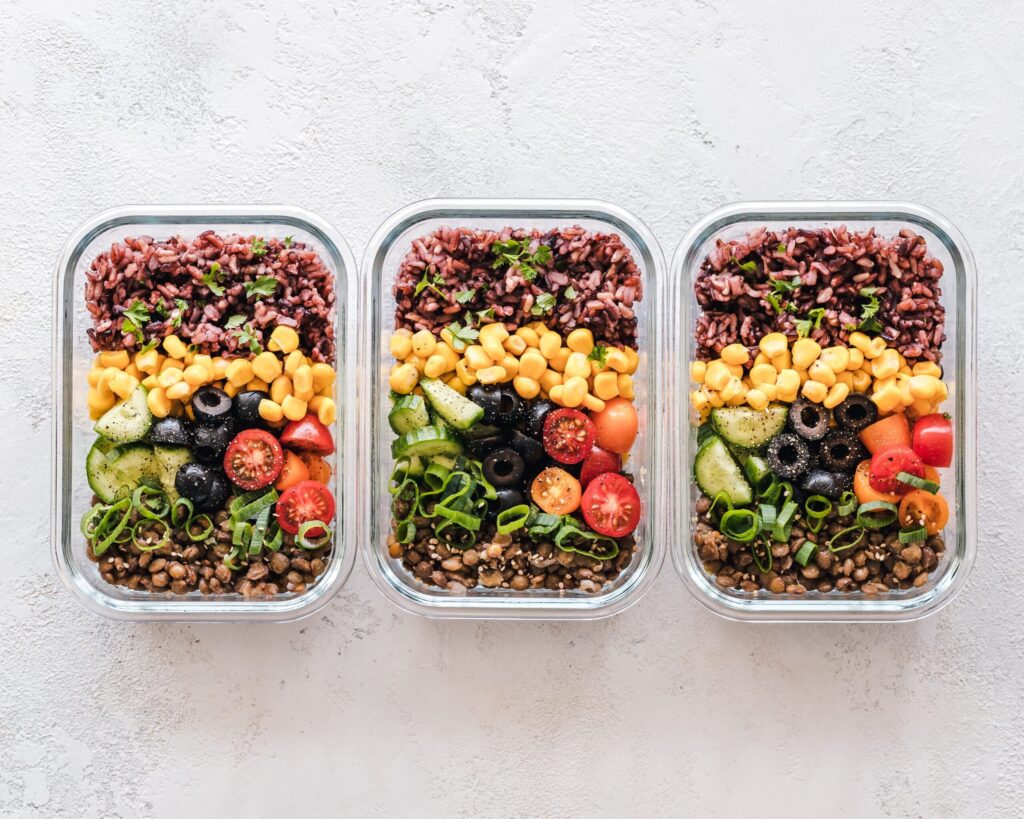
Meal prepping is a proven strategy to reduce decision fatigue. Research published in Appetite found that individuals who meal-prepped consumed healthier diets and reported better adherence to nutritional goals (Fischler & Masson, 2019). Prepping meals in advance eliminates the need to decide what to eat during busy days, making it easier to stick to your diet.
Practical Application
- Set aside one day per week to prepare meals in bulk and store them in portioned containers.
- Keep your kitchen stocked with healthy, pre-portioned snacks such as cut fruits, nuts, and vegetables.
- Use a standardised meal rotation (e.g., three to four dinner options per week) to minimise the mental load of constant decision-making.
Tip 3: Leverage the Power of Mindful Eating to Stay in Control
Mindful eating is a simple yet powerful practice that involves paying attention to the sensory experiences and physical cues associated with eating. Studies have shown that mindful eating can significantly reduce binge eating episodes, emotional eating, and overeating (Kristeller & Wolever, 2011). A review published in Obesity Reviews noted that individuals who practised mindful eating were more likely to control portion sizes and avoid impulsive food choices (Mason et al., 2016).
Mindful eating encourages you to slow down, chew thoroughly, and savour each bite, allowing your brain to register feelings of fullness before overeating occurs. It also helps identify emotional triggers for eating, enabling you to address the underlying issue rather than resorting to food for comfort.
Practical Application
- Turn off distractions such as TV or smartphones during meals to focus on the eating experience.
- Take smaller bites and chew each mouthful thoroughly.
- Pause between bites to assess whether you are still hungry or eating out of habit.
Conclusion
Sticking to a diet doesn’t have to be complicated or require an enormous amount of willpower. By focusing on protein-rich foods, simplifying your meal environment, and practising mindful eating, you can create a sustainable approach to nutrition that fits seamlessly into your lifestyle.
Each of these tips is supported by scientific evidence and designed to minimise effort while maximising results. Incorporating these habits into your daily routine can make 2025 the year you finally achieve your dietary goals without unnecessary stress or deprivation.
Bibliography
Fischler, C., & Masson, E., 2019. Appetite and dietary decision-making: A qualitative review. Appetite, 140, pp.37-45.
Kristeller, J.L., & Wolever, R.Q., 2011. Mindful eating practices to reduce binge eating: A systematic review. The Journal of Behavioral Medicine, 34(1), pp.28-41.
Mason, A.E., et al., 2016. Mindful eating interventions for obesity-related eating behaviours: A systematic review. Obesity Reviews, 17(6), pp.460-479.
Paddon-Jones, D., et al., 2008. Protein, weight management, and satiety. The American Journal of Clinical Nutrition, 87(5), pp.1558S-1561S.
Phillips, S.M., & Van Loon, L.J., 2011. Dietary protein for athletes: From requirements to optimal adaptation. Journal of Sports Sciences, 29(sup1), pp.S29-S38.
Vohs, K.D., et al., 2008. Making choices impairs subsequent self-control: A limited-resource account of decision making. Psychological Science, 19(6), pp.546-552.
Westerterp, K.R., 2004. Diet-induced thermogenesis. The Journal of Nutrition, 134(1), pp.1848-1850.
Key Takeaways Table
| Key Takeaway | Details |
|---|---|
| Focus on Protein-Rich Foods | Protein increases satiety and has a higher thermic effect, helping reduce calorie intake. |
| Create an Effortless Meal Environment | Meal prepping and simplifying choices reduce decision fatigue and improve adherence. |
| Practise Mindful Eating | Paying attention to hunger cues and the eating process prevents overeating and emotional eating. |