


The bench press is a staple exercise in strength training routines, known for building upper body strength and muscle mass. However, many lifters hit plateaus that can be frustrating and difficult to overcome. This article delves into three scientifically-backed training secrets to enhance your bench press performance. Whether you are a beginner or an experienced lifter, these strategies can help you break through your limits and achieve new personal bests.

Understanding the Bench Press Mechanics
Before diving into the secrets, it’s crucial to understand the mechanics of the bench press. This exercise primarily targets the pectoralis major, anterior deltoids, and triceps brachii. Proper form is essential for maximising efficiency and minimising the risk of injury. Ensure you:
- Lie flat on a bench with feet firmly on the ground.
- Grip the barbell slightly wider than shoulder-width.
- Lower the barbell to your chest, keeping elbows at a 45-degree angle.
- Press the barbell upwards until your arms are fully extended.
Now, let’s explore the three training secrets to boost your bench press strength.
Secret 1: Progressive Overload with Optimal Volume
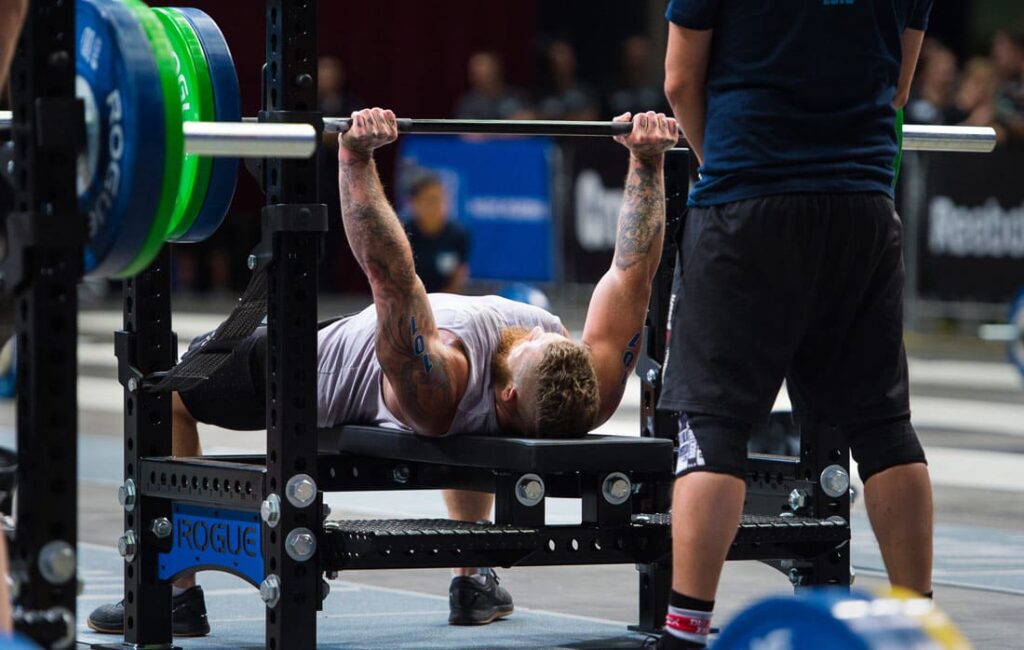
The Science Behind Progressive Overload
Progressive overload is the gradual increase of stress placed upon the body during exercise training. This principle is fundamental for muscle hypertrophy and strength gains. A study published in the Journal of Strength and Conditioning Research highlighted that progressive overload is crucial for continuous strength improvements (Peterson et al., 2008).
Implementing Progressive Overload
To effectively apply progressive overload in your bench press routine:
- Increase Weight Gradually: Aim to increase the weight by 2.5-5 kg when you can complete all your sets and reps comfortably.
- Adjust Repetitions and Sets: Manipulate the volume by increasing the number of sets or repetitions. For example, if you usually perform 3 sets of 8 reps, try 4 sets of 8 reps or 3 sets of 10 reps.
- Incorporate Advanced Techniques: Techniques like pyramid sets, where you increase weight and decrease reps each set, can also be effective.
Optimal Volume for Strength Gains
Volume, the total amount of weight lifted in a session, is critical. Research indicates that higher training volumes are associated with greater strength gains. A meta-analysis in the Sports Medicine journal found that performing multiple sets per exercise leads to significantly greater strength gains compared to single sets (Ralston et al., 2017). Aim for a weekly volume of 10-20 sets for the chest, divided across 2-3 sessions.
Secret 2: Utilise Accessory Exercises

Importance of Accessory Exercises
Accessory exercises target the supporting muscles and improve overall bench press performance. They help address muscle imbalances, enhance stability, and increase strength in the primary muscles involved in the bench press.
Key Accessory Exercises
- Incline Bench Press: Targets the upper chest and anterior deltoids. A study in the Journal of Strength and Conditioning Research found that the incline bench press activates the upper pectoralis major more effectively than the flat bench press (Barnett et al., 1995).
- Close-Grip Bench Press: Focuses on the triceps. Research shows that this variation significantly increases triceps activation, which is crucial for the lockout phase of the bench press (Lehman, 2005).
- Dumbbell Flyes: Enhance pectoral muscle activation and improve range of motion. A study in the Journal of Sports Science and Medicine demonstrated that dumbbell flyes effectively target the pectoralis major (Schoenfeld et al., 2015).
Incorporating Accessory Exercises
Integrate 2-3 accessory exercises into your bench press routine, performing 3-4 sets of 8-12 reps each. Ensure these exercises complement your main lifts without causing excessive fatigue.
Secret 3: Perfect Your Technique and Form
The Role of Technique in Strength
Proper technique maximises muscle engagement and reduces injury risk. A study in the International Journal of Sports Physical Therapy emphasised the importance of correct form in preventing shoulder injuries and enhancing bench press performance (Reeser et al., 2013).
Key Technique Tips
- Grip Width: A medium grip (hands placed at 1.5 times shoulder width) is optimal for balancing pectoral and triceps activation (Clemons & Aaron, 1997).
- Elbow Position: Maintain a 45-degree angle between your elbows and body to reduce shoulder stress and maximise power.
- Leg Drive: Use your legs to generate force and stabilise your body. Plant your feet firmly and drive through your heels during the lift.
Practicing Technique
Spend time practising your technique with lighter weights or even just the barbell. Video recording your lifts can provide valuable feedback. Additionally, consider working with a coach or experienced lifter to refine your form.
Integrating the Secrets into Your Training
Sample Bench Press Program
Here’s a sample program incorporating these secrets:
Day 1: Heavy Bench Press Day
- Warm-up: Dynamic stretches and light sets
- Bench Press: 5 sets of 5 reps (increase weight progressively)
- Incline Bench Press: 3 sets of 8 reps
- Close-Grip Bench Press: 3 sets of 10 reps
- Dumbbell Flyes: 3 sets of 12 reps
Day 2: Volume Bench Press Day
- Warm-up: Dynamic stretches and light sets
- Bench Press: 4 sets of 8-10 reps (moderate weight)
- Incline Dumbbell Press: 3 sets of 10 reps
- Tricep Dips: 3 sets of 12 reps
- Cable Crossovers: 3 sets of 15 reps
Day 3: Technique and Accessory Day
- Warm-up: Dynamic stretches and light sets
- Technique Work: 5 sets of 5 reps with lighter weight (focus on form)
- Floor Press: 3 sets of 8 reps
- Dumbbell Pullover: 3 sets of 10 reps
- Band Pull-Aparts: 3 sets of 20 reps
Conclusion
Boosting your bench press strength requires a multifaceted approach involving progressive overload, accessory exercises, and impeccable technique. By understanding and implementing these three training secrets, you can break through plateaus and achieve new levels of strength. Remember, consistency and dedication are key. Track your progress, adjust your program as needed, and stay committed to your goals.
References
- Barnett, C., Kippers, V., & Turner, P. (1995). Effects of Variations of the Bench Press Exercise on the EMG Activity of Five Shoulder Muscles. Journal of Strength and Conditioning Research, 9(4), 222-227.
- Clemons, J. M., & Aaron, C. (1997). Effect of Grip Width on the Myoelectric Activity of the Prime Movers in the Bench Press. Journal of Strength and Conditioning Research, 11(2), 82-87.
- Lehman, G. J. (2005). The Influence of Grip Width and Forearm Pronation/Supination on Upper-Body Myoelectric Activity During the Flat Bench Press. Journal of Strength and Conditioning Research, 19(3), 587-591.
- Peterson, M. D., Rhea, M. R., & Alvar, B. A. (2008). Applications of the Dose-Response for Muscular Strength Development: A Review of Meta-Analytic Efficacy and Reliability for Designing Training Prescription. Journal of Strength and Conditioning Research, 22(5), 1781-1789.
- Ralston, G. W., Kilgore, L., Wyatt, F. B., & Baker, J. S. (2017). The Effect of Weekly Set Volume on Strength Gain: A Meta-Analysis. Sports Medicine, 47(12), 2585-2601.
- Reeser, J. C., Biswas, S., & Roach, K. (2013). Shoulder Injuries in Sport: Pathogenesis, Treatment, and Prevention. International Journal of Sports Physical Therapy, 8(5), 496-508.
- Schoenfeld, B. J., Contreras, B., Tiryaki-Sonmez, G., Wilson, J. M., Kolber, M. J., & Peterson, M. D. (2015). Regional Differences in Muscle Activation During the Bench Press. Journal of Sports Science and Medicine, 14(4), 705-710.
Key Takeaways
| Training Secret | Description |
|---|---|
| Progressive Overload | Gradually increase weight, reps, and sets to continuously challenge muscles. |
| Utilise Accessory Exercises | Incorporate exercises like incline bench press, close-grip bench press, and flyes to target supporting muscles. |
| Perfect Your Technique and Form | Ensure proper grip width, elbow position, and leg drive for optimal performance and injury prevention. |
By following these evidence-based strategies, you can effectively enhance your bench press strength and overall upper body power.


