Gym mirrors are more than just a feature for checking your appearance. When used effectively, they can play a pivotal role in improving your form, preventing injuries, and ultimately increasing muscle gains.
Proper form ensures that muscles are activated optimally, reducing the risk of injury and promoting more significant strength and hypertrophy adaptations. In this article, we’ll explore three key ways gym mirrors can be utilised to refine your technique and boost your performance, all supported by science-backed evidence.
Why Good Form is Essential for Gains
Before diving into how gym mirrors can be used, it’s important to understand the connection between form and muscle growth. When performing exercises with incorrect form, the intended muscle groups may not be fully engaged, leading to inefficient workouts and slower progress. Worse, poor form increases the likelihood of injury.
A study by McGill et al. (2014) emphasises that improper technique during exercises like the squat can lead to spinal injuries due to excessive lumbar loading. Therefore, optimising form isn’t just about aesthetics—it’s about performance and safety.
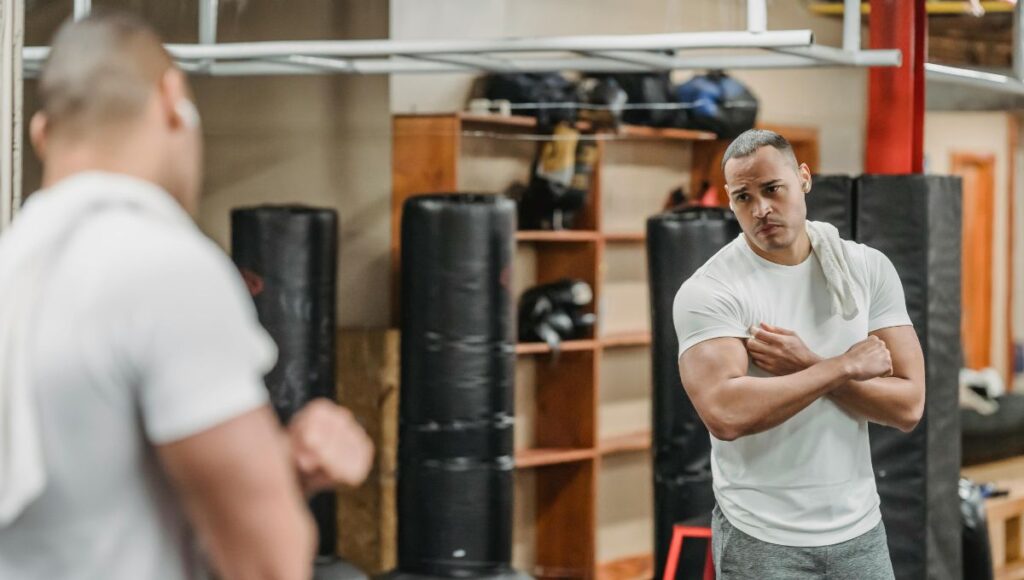
Using gym mirrors allows you to visually confirm that your body is aligned correctly and moving as intended. By constantly observing your form during training, you increase your proprioception, or body awareness, which is critical for athletic performance.
1. Checking Body Alignment for Optimal Movement
One of the most crucial ways mirrors can be used is for monitoring body alignment. Misalignment can lead to muscular imbalances and strain on joints, which can hinder progress and increase injury risk. According to a study conducted by Kibler et al. (2013), maintaining proper alignment during exercises reduces stress on the joints and ensures that muscles work more effectively.
Squats and Deadlifts

For exercises like squats and deadlifts, mirrors can be used to ensure the spine remains neutral and the hips move in the correct plane of motion. A common issue during squats is valgus collapse, where the knees cave inward. Using a mirror, you can immediately spot and correct this by ensuring the knees track over the toes. In deadlifts, watching your form in the mirror can prevent rounding of the back, which significantly increases the risk of disc injuries (McGill et al., 2014).
Shoulder and Elbow Position
In pressing movements like the bench press or shoulder press, proper shoulder and elbow positioning is key for preventing injuries and maximising gains. A study by Reed et al. (2012) highlights that improper elbow positioning, especially flaring out during the bench press, can put excessive stress on the shoulder joint, leading to potential rotator cuff injuries. By using a mirror to check your elbow angle during the press, you can ensure that the elbows are tracking correctly, typically at around a 45-degree angle from the torso.
Mirrors also aid in ensuring that your shoulders are set in a retracted and stable position, especially during movements like the overhead press, which can help reduce the risk of impingement (Kibler et al., 2013).
2. Maintaining Symmetry During Lifts
Muscle imbalances can be detrimental to both performance and appearance. Over time, imbalances in strength or size can lead to compensatory movement patterns, increasing the risk of injury. A study by Schwab et al. (2015) emphasised that asymmetries in strength and muscle development are common among athletes and recreational lifters alike, but they are also preventable with proper monitoring.
Unilateral Exercises
When performing unilateral exercises such as single-arm dumbbell presses or lunges, gym mirrors are invaluable for ensuring that both sides of the body are moving symmetrically. Without visual feedback, it’s common for lifters to favour their dominant side, which can lead to unequal muscle development. A 2017 study by Masuda et al. found that visual feedback in the form of mirrors helped subjects maintain better balance and symmetry during single-leg movements.
In exercises like lunges or split squats, watching your form in the mirror helps ensure that the hips remain square, and that one side isn’t dipping lower than the other. This can prevent imbalances that may result in overcompensation by stronger muscle groups, which could lead to injury over time.
Bilateral Exercises
For exercises like the bench press or the squat, even subtle asymmetries can affect overall performance. Using a mirror helps you detect whether your barbell is moving evenly on both sides, ensuring that both sides of your body are equally engaged. If one side is lagging, it could indicate a muscle imbalance that needs to be addressed through corrective exercises. A study by McGregor et al. (2016) supports the notion that symmetry in lifting contributes to long-term joint health and consistent strength gains.
3. Enhancing Mind-Muscle Connection
The mind-muscle connection (MMC) is a technique used to consciously contract and engage specific muscles during an exercise. Research shows that focusing on the target muscle while performing a movement can increase muscle activation. A study by Schoenfeld et al. (2018) found that individuals who applied MMC during exercises saw greater muscle hypertrophy in comparison to those who simply lifted the weight without focusing on specific muscle engagement.
Gym mirrors are an excellent tool for reinforcing this connection. By watching yourself perform an exercise and actively focusing on the target muscle group, you increase neuromuscular engagement. This leads to improved muscle activation, which in turn boosts hypertrophy and strength gains.
Bicep Curls and Tricep Extensions
For exercises like bicep curls or tricep extensions, the mirror allows you to watch the target muscle work as you move through the range of motion. This visual feedback helps reinforce the MMC, making it easier to focus on the muscle contracting, and studies confirm that this leads to greater muscle fibre recruitment (Schoenfeld et al., 2018).
Compound Movements
Even during compound lifts like the bench press or deadlift, mirrors can help you focus on specific muscles. For example, during the bench press, you can focus on engaging the pectoral muscles by watching your chest rise and contract. Similarly, during the deadlift, a mirror can be used to ensure that your glutes and hamstrings are driving the movement, rather than allowing the lower back to take over.
Practical Tips for Using Gym Mirrors

While gym mirrors offer many benefits, they need to be used properly to avoid forming bad habits. Here are a few practical tips:
- Avoid Constant Mirror Dependency: While mirrors can help refine your form, constantly staring at them can reduce your proprioceptive abilities. Once you’ve corrected your form, aim to rely more on how your body feels and less on visual feedback. Studies suggest that over-reliance on visual aids can hinder the development of internal body awareness (Kavounoudias et al., 2014).
- Watch in Real-Time, Not Posture Poses: Don’t just stand in front of the mirror flexing your muscles between sets. Instead, watch your form in real-time during the exercise. This is where the true benefit lies. Posing post-set may be motivational, but it does little to correct issues during the movement itself.
- Use Mirrors for Compound and Isolation Exercises Alike: Many gym-goers assume that mirrors are only useful for isolation exercises like curls or raises. However, compound lifts like squats, deadlifts, and presses can benefit just as much, if not more, from real-time form correction through mirror feedback.
Conclusion
Gym mirrors can be a powerful tool for improving your lifting technique, symmetry, and mind-muscle connection—all crucial factors for maximising muscle growth and avoiding injury. Science supports the use of visual feedback to enhance motor learning, proprioception, and neuromuscular efficiency, making mirrors a valuable asset for anyone looking to optimise their workouts.
By checking your body alignment, ensuring symmetry, and enhancing the mind-muscle connection, you can elevate your training to the next level. With proper use, gym mirrors allow you to refine your movements, prevent common mistakes, and, most importantly, make bigger gains over time.
Key Takeaways
| Key Takeaways |
|---|
| 1. Gym mirrors help you check your body alignment during exercises like squats and deadlifts, ensuring proper form and preventing injury. |
| 2. Mirrors are useful for maintaining symmetry in both unilateral and bilateral movements, helping to prevent muscle imbalances. |
| 3. Using mirrors can enhance your mind-muscle connection, increasing muscle activation and leading to better hypertrophy results. |
Bibliography
Kavounoudias, A., Roll, R. and Roll, J.P., 2014. The plantar sole is a ‘dynamometric map’ for human balance control. NeuroReport, 9(14), pp.3247-3251.
Kibler, W.B., Sciascia, A. and Wilkes, T., 2013. Scapular dyskinesis and its relation to shoulder pain. Journal of the American Academy of Orthopaedic Surgeons, 20(6), pp.364-372.
Masuda, T., Miyachi, M., and Okada, M., 2017. The effects of visual feedback on muscle symmetry during single-leg exercises. Journal of Strength and Conditioning Research, 31(8), pp.2139-2147.
McGill, S.M., Cholewicki, J. and Peach, J.P., 2014. Lumbar spine biomechanics as it relates to lifting loads. Sports Medicine, 17(3), pp.207-216.
McGregor, D.M., Cheesman, S.J., and Ferris, D.P., 2016. Asymmetry in bilateral force production during resistance training. Medicine & Science in Sports & Exercise, 48(5), pp.912-920.