There are some exercises that have been in the Open more than once and even more than twice.
These 7 exercises have been featured in every Open since it began!


If you have trouble with any of these movements, now is the time to really try and master them if you want to finish the Open and be proud of your performances!
The CrossFit Open workouts are posted every Thursday and you must perform the workout in front of a judge or videotape it and send in the results before Monday night.
- 18.1- Feb. 22-26
- 18.2- March 1-5
- 18.3- March 8-12
- 18.4- March 15-19
- 18.5- March 22-26
These workouts have the most participants. The people that get the highest ranking after participating in the Open earn the right to partake in the Regionals. You are ranked using your age, sex and of course Region. Most Open workouts have been Couplets or Triplets, which means that there have been two or three elements in each workout. For example:
4 rounds of
- 20 toes to bar
- 30 wall balls
Open Movements (number of times seen, in order):
Ben from WODprep put together this excellent list showing how often certain exercises have appeared in Dave Castro’s programming.
- Double Unders – 7
- Muscle Ups (bar or ring) – 7
- Toes To Bar – 7
- Wall Balls – 7
- Thrusters – 7
- Chest To Bar Pull Ups – 7
- Snatch (Full / Power) – 7
- Deadlifts – 6
- Burpees (any kind) – 6
- Box Jumps – 5
- Cleans (Power/Full/DB) – 5
- Calorie Row – 4
- Shoulder To Overhead – 3
- Overhead Squats – 3
- HSPU – 3
- Clean and Jerks – 2
- Walking Lunges – 2
- Dumbbell Snatches – 1
- Push Ups – 1
This year’s teaser from Dave Castro, Director of The CrossFit Games and creator of the workouts, hinted at dumbbells. That indicates maybe dumbbell snatches, dumbbell cleans or even some step ups or lunges including the dumbbells. But nothing is ever 100% certain with Dave Castro.
7 EXERCISES THAT HAVE BEEN FEATURED IN EVERY CROSSFIT OPEN
Double Unders
If you can perform those well just keep that up. If not keep reading, this is an exercise many people struggle with. It can get very frustrating to hit yourself so many times, but don’t give up. If you want to do the WOD RX you must try to perform the movement correctly.
The double under is like a normal jump rope but you rotate the rope twice under your legs in one jump.
- First: The jump must be high enough and efficient, not using too much energy to drain yourself too quickly. Double unders and single unders mostly use your calve muscles, not any other.
- Second: The wrists must do all the rope turning, not the shoulders. That is a common mistake, if you engage your shoulders too much they will lift the rope higher, resulting in the band hitting your legs, because the circle it makes doesn’t reach all the way down after the shoulders have lifted them higher.
- Third: Use your own jump rope, that has the perfect length for your height, you are used to and know the weight of. New jumping ropes are not ideal for every time.
- Fourth: Listen to the rope. When the rope hits the ground, it makes a noise. Find the rhythm and jump according to it. If you cannot hear the rope hit the ground, you must lower your shoulders.
If you have all these points in your head, you should be able to do at least a couple of D.U.´s in a row. If you have these points but are not getting the movement, make your friend watch you and see if they can see the faults you are making. You might be putting either elbow too far out to the side.
Muscle Up
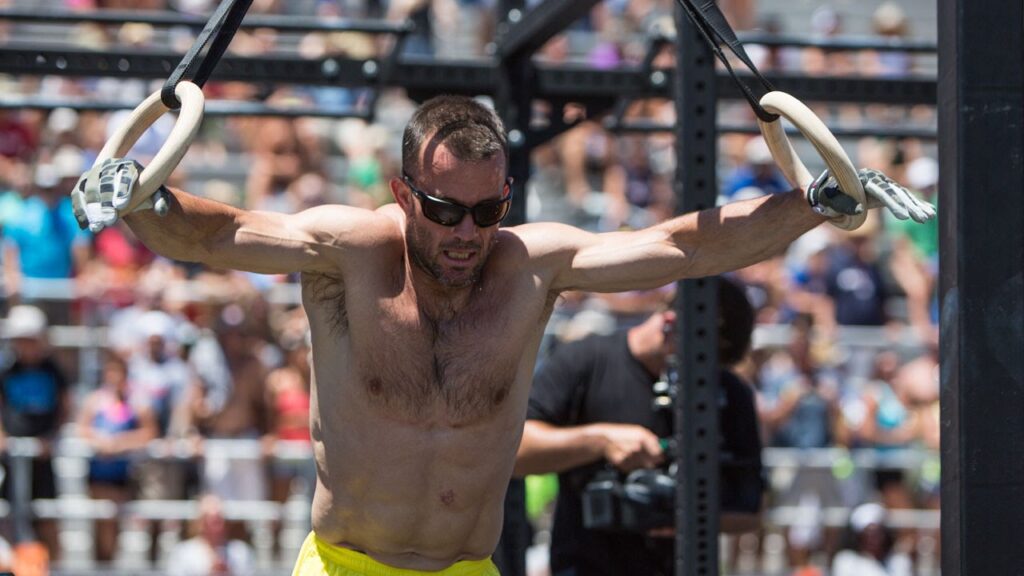
This exercise requires strength and good gymnastics skills and co-ordination. The muscle up is like a combination of pull-ups, sit-ups and dips.
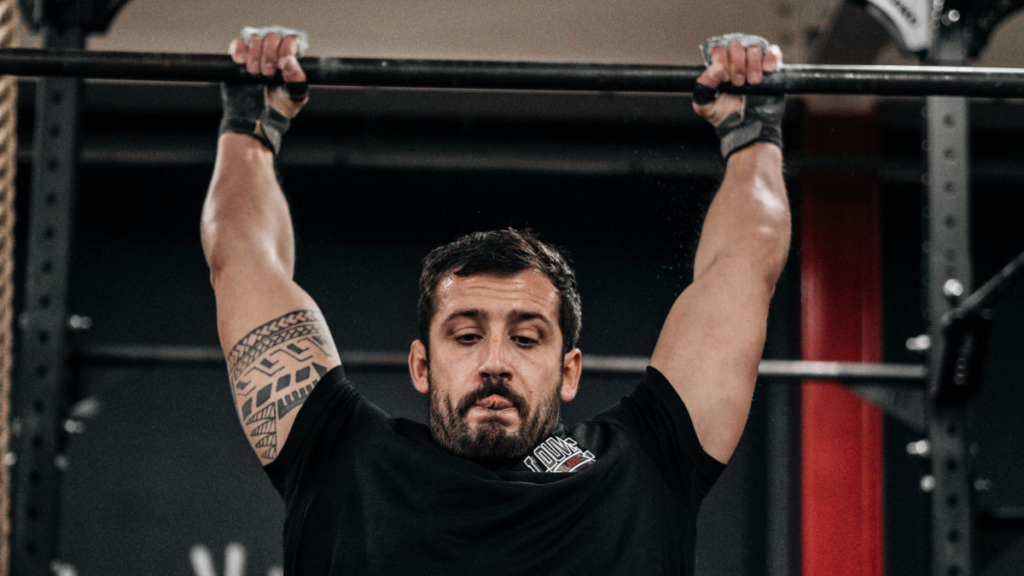
Many people struggle with this exercise, but as always, never give up. Work on the pull up and chest to bar and dips, to work up strength. Important thing for this is the kip or gymnastic swing. You can work up the kipping swing with toes to bar movement.
To heave your body all the way up you must use the whole body to help.
- Get momentum from your legs up to the hips to swing the hips up to the rings or the bar.
- Then do a sit up to turn your upper body over the bar/rings.
- Finish with straightening your elbows like in a dip.
Of course, these two exercises have the same aim, from hanging position to hips over the bar/rings. But they differ a lot in their execution.
Toes to Bar
To swing your legs up to the bar, while hanging is a great core and grip exercise. The scaled version is to raise your knees to your chest or even your elbows. The knee to elbow version makes the kip understandable.
The first thing to tire in this exercise is often the grip, at least in my case. To make each rep count you must let your legs bend behind you and then lift them up to the bar. The feet must touch the bar. You also get more momentum from the legs if you let them swing up and down.
To protect the shoulders, it is crucial to have some tension in them and make sure you are not just hanging inert. If you perform the kipping toe to bar correctly you elevate your upperbody to make the distance for the legs shorter.
If the toes to bar movement is to be performed in the rings the legs must be raised to finish at ring height between the hands.
Wall Balls
You grab a ball, guys 9 kg, girls 6 kg and head to a wall. Most gyms have a line or a target market to the certain height. The guys must hit the 3-m mark while the girls must hit 2,7 m.
- The ball must go over the line each time for the rep to count.
- You also have to do a deep squat, knees under 90 degrees.
- As you stand up, use the momentum from the hip flex to get the ball up to the target.
The problem with wallballs is that they always appear in a high rep scheme. Never just 10 wallballs, always at least 30 and up to 150.
This exercise uses every joint and muscle in the body, legs in the squat and core to be stable, upper body to throw and hold the ball. This is more stamina then strength, unless that you have heavy wallballs, 14 kg guys, 9 kg girls.
Soon the athletes tires from the fast movement so it is necessary to pace yourself if the reps are high and plan ahead.
To release tension in the shoulders some athletes let their arms rest after throwing the ball, but be careful to have the arms ready again to catch the ball when it falls down. Otherwise it will likely hit you in the face.
Thrusters
The heavier version of wall balls.
Grab a bar and clean it up to a front rack position or grab it from a rack at the proper height. Perform a front squat, but as you stand up again bring the bar over your head as you would for a push press. Use the muscles in your legs to raise the bar higher then in a usual front squat.
If you have to begin the movement with the bar on the floor you should always aim for a squat clean, so you don’t have to lower yourself later on with the weight of the bar on your shoulders.
This movement also targets your whole body, upper, lower body and core.
If you are going to rest during thrusters it is best to rest with the bar overhead in an upright position, then bring yourself down at the same time as the bar. It is a waste of time to bring the bar down to your shoulders and then do the squat. Try to perform it at the same time and then straight back up.
Keep the bar in the front rack position while the bar is close to the body. Don´t tire out your arms by using them to hold the bar unless to move the bar over head.
Chest to Bar Pull Up
Unlike regular pull ups, the chest to bar movement requires more swing (when kipping) and strength. Since you must achieve a higher body position.
Many athletes struggle with getting their chest up to the bar because the whole movement differs a regular pull up. When kipping, you must push your swing higher and pull yourself to the bar at the right time.
The gymnastic swing with the arch and hollow positions benefits all the hanging exercises, with a strong core and upper body you must learn how to swing the right way.
Snatch
The snatch is a complex Olympic Weightlifting movement with a barbell. It can be done with kettlebells and dumbbells, but that is a whole other kind of exercise.
The aim is to get the bar from the ground to overhead in one swift movement. There are three types of snatches with a barbell in CrossFit.
- Power snatch: One movement from ground to overhead. Starting position on the ground, then high pull it all the way up, then end with the bar over head but knees slightly bent like in a jerk, then finalize the move by standing up straight.
- Squat snatch: Starting position is the same, bar on the ground. Next pull the bar up in a straight line but lower your body and catch the bar in a squat position. Your hips must be lower then you knees. Then stand up.
- Hang snatch: It has the same goal but the starting position is standing up with the bar at hip or knee height. Then lower it by leaning forward, until the bar reaches the knees, then use the same hip pop movement to raise the bar all the way over head.
An important thing to think about with a snatch is hand position on the bar. You need much wider grip than in cleans or push presses. Use the same grip as your over head squat. Otherwise the balance and mobility will not let you go the right way when you get the bar overhead.
Good luck in the Open!