Double-unders are a staple in CrossFit. If you still struggle, this article is for you. Check out hands, arms and wrists mistakes on double-unders to finally master this exercise.
Double-unders are a type of exercise commonly used in fitness and conditioning programmes, particularly in sports like CrossFit. The term “double-under” refers to the action of passing a skipping rope under the feet twice with a single jump. It requires a higher level of coordination, timing, and speed compared to a regular single-under, where the rope passes under the feet once per jump.


Double-unders are a great cardio exercise that is hard to master and it is common for people to fail to complete more than a couple unbroken, especially in the beginning. If this is the case, you could be making mistakes in hand, arm, and wrist movements.
Here’s a breakdown of double-unders:
- Skipping Rope Technique:
- During a double-under, the participant jumps off the ground while spinning the skipping rope under their feet twice before landing.
- The rope needs to clear the ground quickly to allow two rotations within one jump.
- Coordination and Timing:
- Achieving double-unders requires precise coordination between the jump and the rope rotation.
- The jumper must time the second rotation to allow the rope to clear under their feet before landing.
- Speed and Endurance:
- Double-unders are often incorporated into high-intensity workouts to challenge cardiovascular endurance.
- The exercise demands speed and efficiency to perform a significant number of repetitions without excessive fatigue.
- Challenges:
- Beginners may find double-unders challenging initially, and it may take time to develop the coordination required.
- Mistimed rotations or insufficient jumping height can result in the rope catching on the feet, making continuous double-unders difficult.
- Workout Integration:
- Double-unders are often incorporated into various fitness routines, including CrossFit workouts, circuit training, and interval training.
- They can be part of a structured workout or used as a standalone exercise for conditioning.
Related: How to Combine HIIT and LISS to Lose Fat Faster
That should not keep you from trying to excel at double-unders. After all, there are numerous reasons to keep jumping that rope on a regular basis:
- Cardiovascular Endurance:
- Double-unders elevate the heart rate rapidly, providing an effective cardiovascular workout.
- Improved cardiovascular endurance enhances the efficiency of the heart and lungs, leading to better overall fitness.
- Calorie Burn:
- The high-intensity nature of double-unders contributes to increased calorie expenditure during workouts.
- This makes the exercise beneficial for those aiming to burn calories and manage body weight.
- Full-Body Engagement:
- Double-unders engage various muscle groups, including the legs, core, shoulders, and arms.
- The full-body activation promotes balanced muscle development and functional fitness.
- Coordination and Agility:
- Mastering double-unders requires precise coordination between jumping and rope rotation.
- Regular practice enhances coordination and agility, crucial components of athletic performance.
- Improved Timing and Rhythm:
- Consistent practice of double-unders helps individuals develop better timing and rhythm.
- Improved timing is transferable to other activities and sports, enhancing overall motor skills.
- Enhanced Cognitive Function:
- The need for focused attention on timing and coordination during double-unders contributes to improved cognitive function.
- Engaging both the body and mind fosters mental sharpness and concentration.
- Versatile Workout Integration:
- Double-unders can be incorporated into various workout formats, such as high-intensity interval training (HIIT), circuit training, or CrossFit workouts.
- Their versatility allows for creative and challenging workout routines.
- Time-Efficient Exercise:
- Double-unders offer a time-efficient way to achieve a cardiovascular workout, making them suitable for individuals with busy schedules.
- Short, intense sessions of double-unders can yield significant fitness benefits.
- Stress Reduction:
- Engaging in rhythmic and repetitive activities, such as skipping with double-unders, can have stress-reducing effects.
- The physical activity stimulates the release of endorphins, promoting a positive mood.
- Portability and Accessibility:
- Skipping ropes are portable and require minimal space, making double-unders accessible for home workouts or travel.
- The simplicity of the equipment allows for effective training with minimal resources.
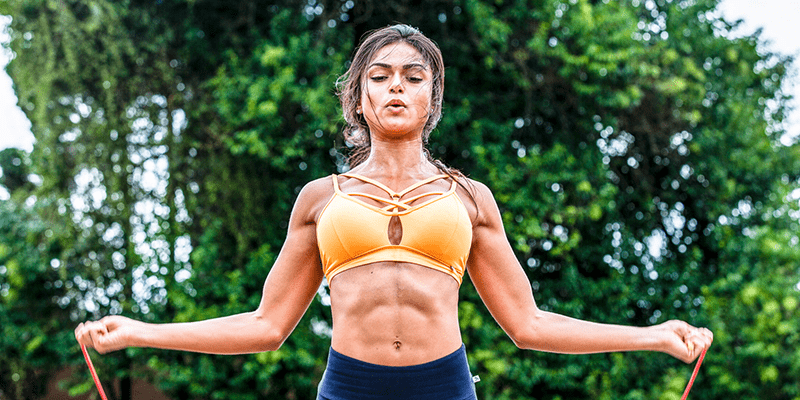
The benefits of switching from single-unders to double-unders are motivating as well. As obvious as it seems, double-unders are two times more effective at burning calories in the same amount of time as a single-under.
So while skipping rope sounds promising, why aren’t you doing it more often? Is it because you keep whipping yourself with the cables? Perhaps your form is not optimal. Hint: it has nothing to do with your feet positioning or your jumps.
Mistakes on Double-Unders
BOXROX has selected a few common mistakes when doing double-unders and how to properly fix them.
Read more: 20 CrossFit Double-Unders Workouts to Build Unstoppable Endurance
1. Hand position
The first thing to look out for is the positioning of the hands. If the hands are too high, the rope will eventually hit your legs, as it increases the distance between the rope and the ground.
CrossFit athlete Dan Bailey explains that the optimum place to keep the hands while doing double-unders is the same height as the waistline:
“Wrist is below the elbow. Hands just a little bit in front of your body.”
Read Also: What Are the Minimum Steps You Should Walk Every Day for Health Benefits (Not 10K)
2. Arm position
Much like the hands, the position of the arms is responsible for most of the issues and difficulties when doing double-unders.
In short, keep your elbows tucked in and close to your body at all times. “If your arms go wide, the rope gets shorter and that’s gonna trip it up,” says Chris Spealler, a veteran CrossFit athlete from CrossFit Park City.
Former CrossFit athlete and now YouTuber Craig Richey shared a valuable tip to maintain your arms and elbows tucked-in to perfect the double-under. “Just put a band around the upper arm, around the humerus.”
This way you keep shoulders, elbows and arms relaxed in order to focus on the important part of your body that will be responsible for the movement of the rope: the wrists.
3. It’s All About the Wrists
You know where your hands and arms should be positioned, staying tucked-in at all times. It’s up to the wrists to make the rope pass under your legs twice while you jump.
Budy Lee, U.S. Olympic wrestler and jump rope training educator, says that once you do a first jump, the rope will continue on its trajectory. “There is no need to do much effort, so I’m just making small circles with the wrists.”
If you stick by these three principles – focus on hand position, keep your elbows tucked in, and pay attention on the wrist movements – we guarantee you will get better and better with double-unders.
30 Minutes Of Jump Rope Every Day For 30 Days – What Happens to Your Body?
How Often Should You Do Double-Unders?
The frequency of incorporating double-unders into a workout routine can vary based on individual fitness goals, fitness levels, and overall training plans. However, there are some general guidelines that individuals can consider when including double-unders in their exercise regimen:
- Skill Level:
- Beginners may need more time for skill development and coordination. Starting with 2-3 sessions per week allows for practice without excessive fatigue.
- Advanced practitioners may include double-unders more frequently, even on a daily basis, as part of their conditioning or warm-up routines.
- Recovery:
- Like any high-intensity exercise, double-unders can contribute to muscle fatigue and impact recovery.
- It’s advisable to allow at least one or two days of rest between sessions that heavily feature double-unders, particularly for beginners or those with less conditioning.
- Integration into Workouts:
- Consider incorporating double-unders into existing workout routines rather than isolating them into separate sessions.
- For example, including them in a high-intensity interval training (HIIT) workout or a CrossFit-style workout can be an effective way to add variety.
- Duration and Intensity:
- The duration and intensity of double-under sessions also influence how often they can be performed.
- Shorter, more intense sessions may be suitable for more frequent inclusion, while longer sessions may require more recovery time.
- Skill Development:
- Individuals aiming to improve their double-under proficiency may benefit from consistent practice.
- Regular, focused practice sessions (2-3 times per week) dedicated to skill development can expedite progress.
- Listen to the Body:
- Pay attention to how the body responds to double-unders. If there are signs of excessive fatigue, joint discomfort, or overtraining, it’s crucial to allow for additional rest.
- Modifying the frequency based on individual recovery rates and physical condition is essential.
- Balanced Training:
- Balance double-under sessions with a well-rounded fitness routine that includes strength training, flexibility work, and other cardiovascular exercises.
- Avoid overemphasizing one particular exercise at the expense of overall fitness.
- Varied Workouts:
- Incorporate variety into workouts to prevent monotony and potential overuse injuries associated with repetitive movements.
- Mixing double-unders with other exercises can contribute to a more comprehensive training approach.
Ultimately, there is no one-size-fits-all answer to how often someone should do double-unders. It depends on individual fitness goals, current fitness levels, and how well the body responds to this type of exercise. Consulting with a fitness professional or a coach can provide personalised guidance based on specific needs and objectives.