This is probably the most underrated muscle-building principle you need to know about.
No pain, no gain. That is what a lot of people say nowadays. This means that you need to train hard to see results. When it comes to gaining muscle mass, understanding the underlying principles of training is crucial.


And here is a crash course on “how to build muscle” for beginners:
- Train each muscle group at least twice a week
- Mechanical tension is what stimulates your muscles to grow
- Do not train the same muscle two days in a row
- Sleep enough to recover properly
- Keep hydrated and eat enough proteins to build stronger muscle tissue
And that is basically it!
Related: 15 Muscle Building Mistakes You Could be Making
However, as one can imagine, the path to building muscle is not straightforward. Or at least, it is, but there are many roads that lead to the same objective. That is why training to change your body and become a better version of yourself is so fascinating.
Some other factors that come into play on whether you build muscle or not, or how fast you can get stronger include how heavy you lift, how often you lift, exercise selection, which exercises you do first in a workout, genetics,
There is never a one-size-fits-all when it comes to training. However, some things have solid background information in scientific research that it is worth trying out to see if you become successful and achieve the results you are looking for.

In a video shared by the House of Hypertrophy, a less-known principle about building muscle is discussed that we think you should know about: neuromechanical matching.
This concept has significant implications for selecting exercises in a regimen designed to maximize muscle development.
The Most Underrated Muscle-Building Principle You Need To Know About
To grasp neuromechanical matching, it’s essential to first understand its cousin, the Henneman’s Size Principle. As you lift progressively heavier weights or fatigue during repetitions with a lighter load, more muscle fibres get recruited. This principle states that motor units, composed of a single motor neuron and multiple muscle fibres, are recruited in sequential order based on the demands imposed on the muscle.
Slow motor units, or low-threshold motor units, consist of small neurons supplying slow-twitch muscle fibres, which are fatigue-resistant. Fast motor units, or high-threshold motor units, consist of large neurons supplying fast-twitch muscle fibres, which produce high forces but fatigue quickly. The recruitment of these motor units follows a sequential order depending on the force requirements of the muscle.
This principle explains why a wide range of loads, from 30% to 80% of one-repetition maximum (1RM), can produce similar muscle growth when repetitions are performed to or close to failure. Heavier loads readily recruit many motor units, including both slow and fast motor units, leading to muscle growth. Lighter loads predominantly recruit slow motor units initially but progressively recruit fast motor units as fatigue sets in, resulting in comparable muscle growth.
How to Make Muscle Gains At Every Level
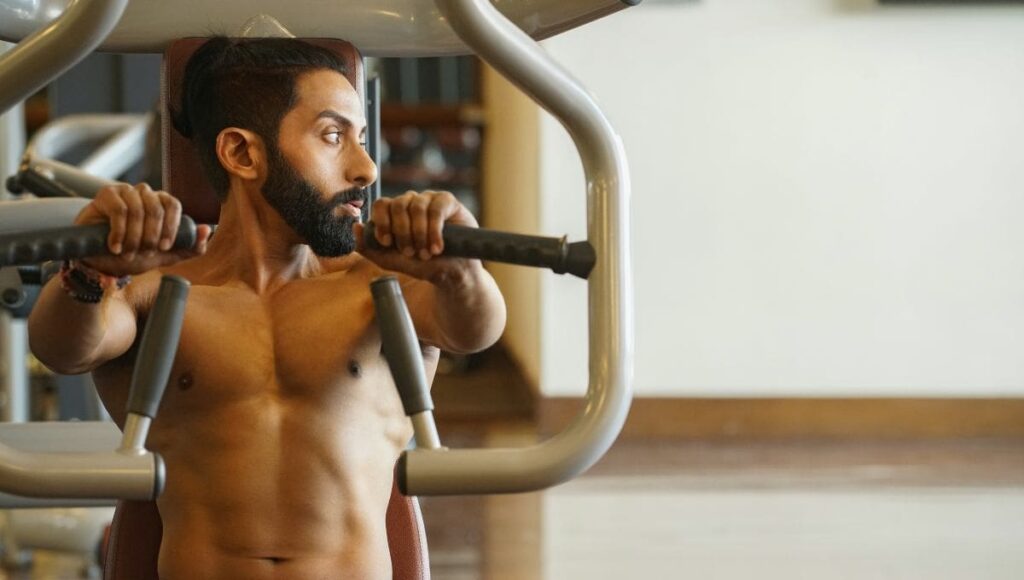
Neuromechanical Matching Explained:
Neuromechanical matching goes a step further by considering subgroups of motor units within muscles. These subgroups do not have identical functions; rather, they are recruited based on specific movements. For example, within the biceps, there may be subgroups of motor units dedicated to elbow flexion, supination, or a combination of both.
The purpose of these multi-unit subgroups is likely related to neuromechanical matching. Each subgroup contains muscle fibres with different mechanical advantages for specific movements. This diversity ensures efficient force production during various exercises.
Regional Hypertrophy and Neuromechanical Matching:
Recent evidence supports the concept of regional hypertrophy, where muscle growth is uneven across different regions of a muscle. Neuromechanical matching provides a plausible explanation for this phenomenon. The regions that experience the most growth likely contain muscle fibres that are mechanically advantageous for the specific exercise performed.
How to Burn Fat Without Losing Muscle
Practical Applications:
Understanding neuromechanical matching has practical implications for designing effective training regimens. To maximize overall muscle growth, it’s advisable to select exercises that biomechanically differ for a given muscle. For example:
- Biceps and Triceps: Vary shoulder angles during training.
- Hamstrings: Include both hip extension and knee flexion exercises.
- Back: Incorporate vertical and horizontal pulling variations.
- Quadriceps: Include different knee extension exercises.
In conclusion, incorporating the concept of neuromechanical matching into your muscle-building journey can significantly impact the effectiveness of your training regimen. By recognizing that muscles consist of subgroups of motor units with specific functions, you gain insights that go beyond traditional training principles.
The evidence supporting regional hypertrophy further emphasizes the importance of understanding neuromechanical matching. Not all regions of a muscle respond equally to a single exercise, and acknowledging the diversity of muscle fibres within a muscle group becomes crucial.
Practical applications of neuromechanical matching involve diversifying your exercise selection for a particular muscle. Instead of relying on a single movement pattern, incorporating variations that target different motor unit subgroups enhances the likelihood of stimulating a more comprehensive range of muscle fibres.
14 Exercise Myths Debunked by Physical Therapists
For instance, when training the biceps and triceps, experimenting with various shoulder angles ensures that you engage different subgroups of motor units. Similarly, including both hip extension and knee flexion exercises when training the hamstrings caters to the mechanical advantages of distinct muscle fibre subgroups.

The implications of neuromechanical matching extend to back training, where combining vertical and horizontal pulling variations can offer a more holistic approach. In the case of quadriceps development, incorporating different knee extension exercises allows for the activation of diverse motor unit subgroups.
Ultimately, the goal is to create a well-rounded and tailored training program that considers the nuanced aspects of muscle anatomy and function. This not only enhances overall muscle growth but also addresses potential limitations associated with uneven regional hypertrophy.
Incorporating neuromechanical matching principles into your training routine is a strategic approach to optimizing muscle development. It adds a layer of sophistication to your workouts, moving beyond the conventional one-size-fits-all approach and acknowledging the intricate interplay between neural recruitment and mechanical advantage within muscles. By embracing these principles, you can sculpt a physique that reflects a deeper understanding of the science behind muscle growth and maximize your efforts in the pursuit of strength and aesthetics.
Watch the video below for more information.
New Study Suggests You Don’t Need a Big Caloric Surplus to Build Muscle