Find out what are the movement standards for CrossFit Open workout 24.3 in the paragraphs below.
The CrossFit Open workout 24.3 has now been unveiled, and it’s essential to familiarise yourself with the movement standards to ensure that your efforts are recognised and you avoid receiving a ‘no rep’ from the judge.


Understanding these standards is crucial as they serve as the guidelines that will be used to assess your performance during the workout. Ensuring that you adhere to these criteria not only validates your effort but also enhances your overall performance in the competition.
It’s important to remember that strict adherence to these movement standards is key to achieving a fair and accurate assessment of your abilities, as well as maintaining the integrity of the competition. So, take the time to review and understand these standards thoroughly to maximise your performance and success in CrossFit Open workout 24.3.
If you missed out on the action, you can see the live announcement of 24.3 here.
But before we understand what are the movement standards for CrossFit Open 24.3, let’s remember what exactly is the workout.
CrossFit Open 24.3 Workout
For Time
5 rounds of:
- 10 thrusters
- 10 chest-to-bar pull-ups
1 minute rest
Then 5 rounds of:
- 7 thrusters
- 7 bar muscle ups
You can check out how to scale the exercise here.
What Are the Movement Standards for CrossFit Open Workout 24.3?
There are a total of 3 different movements for you to remember how to perform correctly. These are the movements standards for CrossFit Open workout 24.3 according to the official statement by CrossFit HQ and how you will be judged.
- Start under the pull-up bar.
- At “Go,” move to the barbell and complete 10 thrusters at the lighter weight.
- Then complete 10 chest-to-bar pull-ups. Repeat this couplet for 5 rounds.
- After completing the final chest-to-bar pull-up in round 5, rest for no less than 1 minute.
- Return under the pull-up bar. After the 1-minute rest, move to the barbell.
- Complete 5 rounds of 7 thrusters at the heavier weight and 7 bar muscle-ups.
- Time stops at the completion of the last bar muscle-up.
A few notes to know:
- Start the timer at “Go.” The timer DOES NOT STOP during the 1-minute rest.
- The barbell MUST be placed at least 5 feet away from the pull-up bar for safety.
- Athletes may have assistance changing the barbell load or two bars may be used.
- If time-capped, your score will be the total number of reps completed.
- A tiebreak time will be recorded after you complete 5 rounds of thrusters and chest-to-bar pull-ups. If you do not complete the workout before the time cap, this is your tiebreak time. The athlete who completed the first 5 rounds the fastest wins the tie.
- If the workout is completed before the time cap, there is no tiebreaker.
Movement Standards for the Thrusters
- The crease of the hips must clearly pass below the top of the knees in the bottom position (below parallel). 2.
- The rep is credited when:
- Hips, knees, and arms are fully extended.
- The bar is directly over, or behind, the middle of the body when viewed from the side.
NOTE: Each round of thrusters begins with the barbell on the ground. A squat clean is allowed, but not required, to start a set.
Below you will find a few common mistakes when performing the barbell thruster:
- Squatting to parallel or above parallel (the hip crease is at or above the knee).
- Lowering the barbell before reaching full extension of the knees, hips, or arms
- Finishing with the barbell in front of the body.
NOTE: Performing a front squat followed by any style of jerk (rebending the hips and/or legs) is NOT allowed.
Movement Standards for the Chest-to-Bar Pull-Ups
- Start each rep with arms fully extended and feet off the ground.
- Any style of grip is permitted.
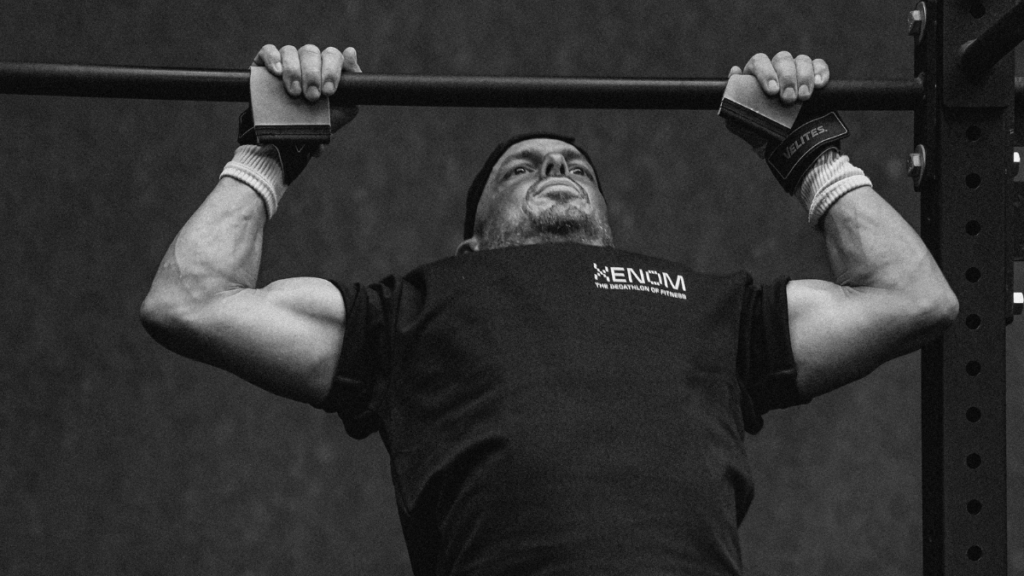
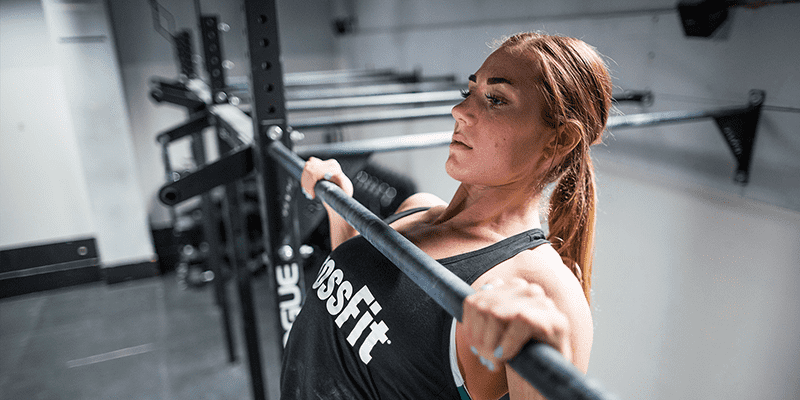
- The rep is credited when the chest clearly contacts the bar at or below the collarbone.
NOTE: Any style of pull-up is permitted as long as the criteria above are met.
Here are a few common mistakes of the chest-to-bar pull-up that will get you a “no rep.”
- Starting a rep without full extension of the arms.
- Making contact with the bar above the collarbone (neck or throat).
- Missing contact with the pull-up bar.
Movement Standards of the Bar Muscle-Up
- Start each rep with arms fully extended and feet off the ground.
- Pass through some portion of a dip before locking out over the bar.
- The rep is credited when:
- Arms are fully extended in the support position.
- Shoulders are directly over, or slightly in front of, the bar when viewed from the side.
And these are the mistakes you should avoid to get cruising through the CrossFit Open workout 24.3.
- Starting a rep without full extension of the arms.
- The feet rising above the pull-up bar during the kip.
- Any part of the arm (besides the hands) touching the bar during the rep.
- Lowering before reaching full extension of the arms at lockout (top of each rep).
- Removing the hands and resting on the torso while above the bar.
NOTE: Any other gymnastics movements are NOT allowed (e.g., uprises or rolls to support).
Movements Standards for the 24.3 Scaled Versions
The scaled versions of CrossFit Open 24.3 workout involve two different exercises: chin-over-bar pull-up and the jumping chest-to-bar pull-up.
Movement Standards of the Chin-Over-Bar Pull-Up
- Start each rep with arms fully extended and feet off the ground.
- Any style of grip is permitted.
- The rep is credited when the chin clearly breaks the horizontal plane of the bar.
NOTE: Any style of pull-up is permitted as long as the criteria above are met.
Common no reps:
- Starting a rep without full extension of the arms.
- Not breaking the horizontal plane of the pull-up bar with the chin.
Movement Standards of the Jumping Chest-To-Bar Pull-Up
- The bar must be at least 6 inches (15 centimeters) above the top of the head when the athlete is standing tall.
- Plates or other stable platforms may be used to decrease the distance between the top of the head and the bar.
- At the start of each rep, lower until the arms are fully extended.
- The rep is credited when the chest clearly comes into contact with the bar at or below the collarbone.
Common mistakes of the exercise are:
- Starting a rep without full extension of the arms.
- Making contact with the bar above the collarbone (neck or throat).
- Missing contact with the pull-up bar.
For more information, check out the official scorecard of 24.3 CrossFit Open workout here.
More About the CrossFit Open
One of the most compelling aspects of the Open is that it’s open to anyone, regardless of fitness level or experience. Participants range from professional athletes aiming for a spot in the CrossFit Games to fitness enthusiasts looking to challenge themselves and be part of a global community.
Format
The Open usually spans five weeks, with a new workout announced each week. These workouts are designed to be inclusive yet challenging, testing a range of fitness domains including strength, endurance, flexibility, and skill. Participants have several days to complete the workout and submit their scores online.
What Common Exercises Are Often Found in CrossFit Open Workouts?
The CrossFit Open workouts are known for their variety, intensity, and ability to test multiple facets of an athlete’s fitness, including strength, endurance, agility, and skill. Over the years, certain exercises have become staples within these workouts, appearing frequently due to their effectiveness in assessing a competitor’s fitness level. Here are some common exercises often found in CrossFit Open workouts:
1. Barbell Movements
- Snatches and Clean & Jerks: Olympic lifting movements that test power, speed, and coordination.
- Deadlifts: Measure raw strength, particularly in the posterior chain.
- Thrusters: A combination of a front squat and push press, testing endurance, strength, and coordination.
2. Gymnastics Movements
- Pull-ups (including kipping and butterfly pull-ups): Test upper body strength and endurance.
- Toes-to-Bar: Require core strength and agility to swing the legs up to touch the pull-up bar.
- Muscle-ups (bar and ring): Advanced exercises that test upper body strength and gymnastics skill.
- Handstand Push-ups: Measure shoulder strength and control in an inverted position.
3. Monostructural Movements
- Double-unders: Skipping rope exercise requiring coordination and cardiovascular endurance.
- Rowing: Tests cardiovascular endurance and power output over distances or time.
- Running: Occasionally included, especially in workouts that can be performed outside a gym.
4. Bodyweight Movements
- Burpees (including variations like bar-facing burpees): Test cardiovascular and muscular endurance.
- Air Squats: Assess leg strength and endurance.
- Push-ups: Measure upper body strength and endurance.
5. Weightlifting with Dumbbells or Kettlebells
- Dumbbell Snatches: Test power and coordination with a focus on unilateral strength.
- Kettlebell Swings: Measure power, endurance, and ability to maintain form under fatigue.
6. High-Skill Conditioning
- Wall Balls: Require strength, endurance, and accuracy, throwing a medicine ball to a target height on a wall.
- Box Jumps: Test leg power and endurance, requiring athletes to jump onto a specified height box.
These exercises are combined in various ways to create challenging workouts that test different energy systems and physical abilities. The inclusion of such a wide range of movements ensures that the Open is a comprehensive test of fitness, pushing athletes to excel across all areas of physical capability. The specific combination of exercises in each workout is designed to be inclusive yet challenging, allowing athletes of all levels to participate while also distinguishing the most well-rounded and skilled competitors.
Read More: 2024 Rogue Invitational Taking Place in Scotland
Workouts and Judging
Workouts (often referred to as WODs – Workouts of the Day) are typically announced via a live broadcast, and athletes worldwide have until the following Monday to complete the workout and submit their scores. Workouts can be done at a local CrossFit affiliate, where they can be officially judged, or in any gym space, with a video submission for verification in some cases.

Community Aspect
- Engagement: The Open is not just a competition; it’s a global event that brings the CrossFit community together. Participants share their experiences, challenges, and achievements, fostering a sense of camaraderie and mutual support.
- Local Competitions: Many CrossFit gyms (affiliates) host their own versions of the Open, turning each workout release into an event where members gather to compete, cheer each other on, and celebrate their fitness journey.
Advancing to Higher Competition
For elite athletes, the Open is the first step towards qualifying for the CrossFit Games, the ultimate test of fitness in the CrossFit community. The top performers in the Open in various categories and regions can advance to the next stages of the competition, which, before changes in the structure, included Regionals and now may involve Sanctionals or directly qualifying for the Games based on their performance.
Why Participate?
Beyond the competitive aspect, the Open is a way for individuals to test their fitness against previous years, set new personal benchmarks, and see where they stand on a global scale. It’s also a motivational push that encourages participants to train harder, improve their skills, and perhaps most importantly, come together with their local and the global CrossFit community to celebrate fitness.
The CrossFit Open is an annual celebration of fitness, community, and personal achievement, making it a cornerstone event in the CrossFit calendar.
Read More: Why CrossFit Athlete Mal O’Brien Is NOT Competing in 2024