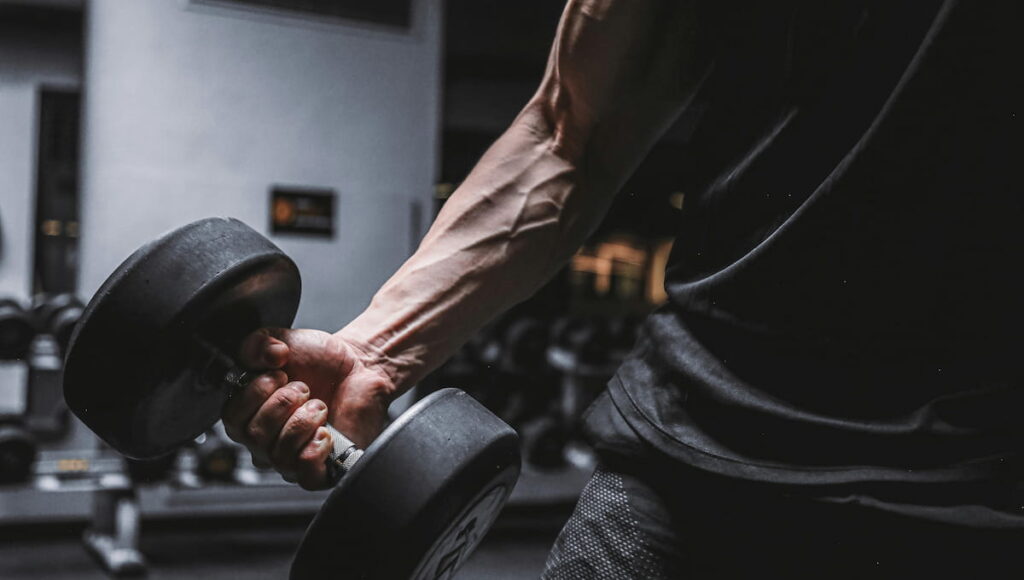
Building a well-developed chest is one of the most sought-after goals in men’s fitness. Dumbbells are a versatile tool for targeting the chest muscles, and they offer several benefits over other equipment like barbells or machines.
They provide a greater range of motion and help improve muscle symmetry by allowing each side of the body to work independently, which is key for avoiding muscle imbalances. Below, we’ll discuss three of the best dumbbell exercises for rapid chest muscle growth. Backed by scientific evidence, these exercises are time-tested and effective for maximising chest hypertrophy and strength gains.


How Muscle Growth Works
Before diving into the exercises, it’s important to understand the basics of muscle hypertrophy. Muscle growth occurs primarily through two mechanisms: mechanical tension and muscle damage. Mechanical tension refers to the force applied to the muscle fibres during resistance training, while muscle damage occurs when fibres are broken down and then repaired stronger and larger during recovery.
According to research published in Frontiers in Physiology, progressive overload—continually increasing the demands placed on the muscles—is key for hypertrophy, as it enhances both mechanical tension and muscle damage during workouts (Schoenfeld, 2010).
Benefits of Dumbbell Chest Exercises
Dumbbell exercises are beneficial for chest development because they offer several key advantages:
- Increased Range of Motion: Dumbbells allow for a greater stretch at the bottom of the movement compared to barbells, which can lead to enhanced muscle activation and growth.
- Unilateral Training: Dumbbells train each side of the body independently, which can correct strength imbalances and reduce injury risk.
- Stabiliser Muscle Engagement: Using dumbbells requires more stability, which engages smaller stabiliser muscles, further increasing strength and muscle growth.
Let’s explore the top three dumbbell exercises for chest muscle growth, complete with variations and scientific backing.
1. Dumbbell Bench Press
The dumbbell bench press is a staple in any chest-building routine. It primarily targets the pectoralis major while also recruiting the anterior deltoids and triceps.
Execution
- Lie flat on a bench with a dumbbell in each hand.
- Position the dumbbells near your shoulders, with your palms facing forward.
- Push the dumbbells upward until your arms are fully extended but not locked.
- Lower the weights slowly, allowing a deep stretch in your chest at the bottom of the movement.
- Repeat for 8-12 reps for muscle hypertrophy.
Why It Works
The dumbbell bench press provides a greater range of motion than its barbell counterpart, allowing the chest muscles to stretch and contract more fully, which is a key driver of hypertrophy. A study published in the Journal of Strength and Conditioning Research found that dumbbell presses activate more muscle fibres in the chest compared to the barbell bench press due to the increased range of motion and the independent nature of the movement (Saeterbakken & Fimland, 2013).
Key Tips
- Focus on a slow eccentric (lowering) phase of about 3-4 seconds, as the eccentric phase has been shown to cause more muscle damage and growth (Schoenfeld, 2010).
- Avoid locking your elbows at the top to maintain constant tension on the chest muscles.
Variations
- Incline Dumbbell Bench Press: Targets the upper chest (clavicular head of the pectoralis major) to create a fuller, more balanced chest.
- Decline Dumbbell Bench Press: Targets the lower chest, which is often underdeveloped in many lifters.
2. Dumbbell Fly
The dumbbell fly is an isolation exercise that stretches the chest fibres and places significant tension across the entire muscle, which can help stimulate growth. While compound movements like presses are essential for overall development, isolation exercises like the dumbbell fly play a crucial role in maximising hypertrophy.
Execution
- Lie flat on a bench with a dumbbell in each hand.
- Extend your arms straight above your chest, palms facing each other.
- With a slight bend in your elbows, slowly lower the dumbbells out to your sides, creating a wide arc.
- Stop when you feel a stretch in your chest, then bring the dumbbells back together at the top.
- Keep your arms slightly bent throughout the movement to reduce strain on your shoulders.
Why It Works
Dumbbell flies focus on stretching the muscle fibres of the chest, which can lead to significant muscle damage—a crucial factor for hypertrophy. The wider arc and stretch help activate chest muscles that might not be fully engaged during presses. A study in The Journal of Applied Physiology showed that muscle stretch under tension leads to enhanced muscle fibre growth and strength (McMahon et al., 2014).
Key Tips
- Avoid going too heavy on this exercise, as it can put undue strain on the shoulder joints. Focus on controlled movements with moderate weight.
- Keep constant tension on the chest by not allowing the dumbbells to touch at the top.
Variations
- Incline Dumbbell Fly: Shifts emphasis to the upper chest for more balanced development.
- Cable Fly: Offers continuous tension on the muscle throughout the entire range of motion.
3. Dumbbell Pullover
Though often considered a back exercise, the dumbbell pullover also targets the chest, particularly the pectoralis major. This compound movement not only helps build the chest but also works the serratus anterior and the lats.
Execution
- Lie perpendicular on a flat bench, with only your upper back and shoulders making contact.
- Hold a dumbbell with both hands above your chest, arms extended but slightly bent.
- Lower the dumbbell slowly behind your head, stretching the chest muscles.
- Pull the dumbbell back to the starting position over your chest, engaging the chest and back muscles.
Why It Works
The dumbbell pullover stretches and engages the pectoralis major, contributing to muscle growth. It also enhances ribcage expansion, which can give the appearance of a larger chest. According to a study in The Journal of Sports Medicine and Physical Fitness, compound movements like the dumbbell pullover that target multiple muscles at once lead to greater hormonal responses (such as increased testosterone) compared to isolation exercises, which can further enhance muscle growth (Beardsley, 2016).
Key Tips
- Control the eccentric phase to maximise stretch and muscle activation.
- Maintain a slight bend in the elbows to protect the shoulder joints.
Variations
- Barbell Pullover: A variation that allows you to lift heavier weights but offers less flexibility compared to dumbbells.
- Straight-arm Cable Pullover: Focuses more on the latissimus dorsi but still engages the chest muscles.
Progressive Overload and Programming
To maximise chest muscle growth, it’s crucial to progressively overload your muscles over time. This means either increasing the weight, the number of reps, or reducing rest times between sets. Research has consistently shown that progressive overload is one of the key principles for hypertrophy. A study published in Sports Medicine confirmed that increasing training volume leads to greater muscle growth (Krieger, 2010). Aim to train your chest 2-3 times per week with sufficient rest in between sessions to allow for recovery.
Here’s a sample workout program using the three exercises discussed:
Sample Workout
- Dumbbell Bench Press: 4 sets of 8-12 reps.
- Dumbbell Fly: 3 sets of 10-12 reps.
- Dumbbell Pullover: 3 sets of 10-12 reps.
- Incline Dumbbell Bench Press (Optional): 3 sets of 8-10 reps.
Incorporating progressive overload into this routine by gradually increasing the weight or volume will ensure continuous muscle growth.
Rest and Recovery
While intense training is essential for hypertrophy, rest and recovery are equally important. Muscle growth occurs during the recovery phase, and without adequate rest, you risk overtraining, which can hinder progress. The National Strength and Conditioning Association (NSCA) recommends 48-72 hours of rest between training sessions for the same muscle group (Haff & Triplett, 2016).
Adequate sleep, nutrition, and hydration are also critical. Ensure that you are consuming sufficient protein—around 1.6 to 2.2 grams per kilogram of body weight daily—to support muscle repair and growth. A study published in The American Journal of Clinical Nutrition suggests that a high-protein diet enhances muscle hypertrophy when combined with resistance training (Morton et al., 2018).
Conclusion
For men looking to build a bigger chest, dumbbells offer an effective, versatile option for targeting the pectoral muscles. The dumbbell bench press, fly, and pullover are three of the best exercises for achieving rapid chest muscle growth. They provide a greater range of motion, target the chest from multiple angles, and engage stabiliser muscles, making them more effective than many machine-based or barbell exercises. Incorporating progressive overload, proper rest, and a high-protein diet will further optimise results.
Key Takeaways
| Exercise | Primary Muscles Worked | Benefits | Key Tips |
|---|---|---|---|
| Dumbbell Bench Press | Pectoralis Major, Deltoids, Triceps | Builds overall chest mass, engages stabiliser muscles | Focus on slow eccentric phase, avoid locking elbows |
| Dumbbell Fly | Pectoralis Major | Stretches chest muscles, isolates pectorals | Keep constant tension, avoid heavy weights to prevent shoulder strain |
| Dumbbell Pullover | Pectoralis Major, Lats | Engages chest and back, enhances ribcage expansion | Control the eccentric phase, maintain a slight bend in elbows |
Bibliography
Beardsley, C. (2016). Compound Exercises and Hormonal Response in Resistance Training. The Journal of Sports Medicine and Physical Fitness, 56(1), 44-53.
Haff, G.G., & Triplett, N.T. (2016). Essentials of Strength Training and Conditioning. 4th ed. National Strength and Conditioning Association (NSCA).
Krieger, J.W. (2010). Single vs. Multiple Sets of Resistance Exercise for Muscle Hypertrophy: A Meta-Analysis. Sports Medicine, 40(9), 697-706.
McMahon, G.E., Morse, C.I., & Winwood, K. (2014). Stretch-Induced Muscle Growth and Strength Gains. The Journal of Applied Physiology, 117(9), 915-924.
Morton, R.W., Murphy, K.T., & McKellar, S.R. (2018). A Systematic Review, Meta-Analysis, and Meta-Regression of the Effect of Protein Supplementation on Resistance Training-Induced Gains in Muscle Mass and Strength. The American Journal of Clinical Nutrition, 108(1), 107-117.
Saeterbakken, A.H., & Fimland, M.S. (2013). Muscle Activation in Free-Weight and Machine Chest Press. Journal of Strength and Conditioning Research, 27(6), 1469-1476.
Schoenfeld, B.J. (2010). The Mechanisms of Muscle Hypertrophy and Their Application to Resistance Training. Frontiers in Physiology, 1, 145.