Achieving bigger arms requires a carefully balanced resistance training programme that factors in volume, frequency, and intensity. While factors like genetics, diet, and sleep contribute significantly to muscle growth, understanding the ideal number of sets per week is critical. Research indicates that training volume, specifically the number of sets per muscle group, is a key driver of hypertrophy (muscle growth).
In this article, we’ll break down the science behind training volume, explore how many sets you need for optimal arm growth, and examine other important factors in building bigger arms.


The Science Behind Training Volume
Training volume, in the context of hypertrophy, refers to the total number of sets performed for a specific muscle group over a given period of time, usually measured per week. Volume is often regarded as the most important factor in promoting muscle growth, as it is directly related to the mechanical tension placed on muscle fibres, which triggers hypertrophic adaptations.
Several studies have investigated the relationship between training volume and muscle growth, with many suggesting that higher volumes tend to result in greater hypertrophy—up to a point. However, simply performing more sets doesn’t guarantee better results. There’s a limit to how much volume is beneficial, after which additional sets may yield diminishing returns or even result in overtraining.
A meta-analysis conducted by Schoenfeld et al. (2017) found that there is a clear dose-response relationship between weekly training volume and muscle growth. The study concluded that performing 10 or more sets per muscle group per week leads to significantly greater hypertrophy compared to lower volumes. However, there is an upper threshold beyond which increases in volume do not lead to proportionately greater gains in muscle size. This suggests that more sets aren’t always better, but there’s a sweet spot for optimal hypertrophy.
Arm-Specific Training: The Biceps and Triceps
When discussing arm size, we’re referring primarily to the biceps brachii and triceps brachii. The biceps are responsible for elbow flexion, while the triceps are the primary muscles involved in elbow extension. For balanced arm growth, it’s crucial to target both muscle groups equally.
Biceps Training Volume
The biceps respond well to direct training, but they also receive stimulation from compound pulling exercises like rows and pull-ups. Therefore, the total weekly volume for biceps training must consider both direct and indirect work.
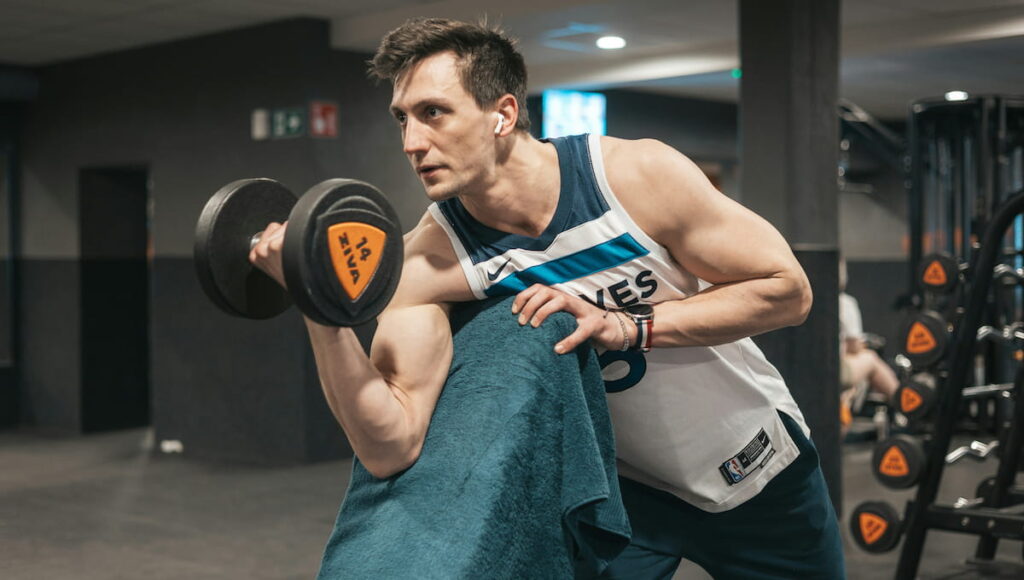
A study by Gentil et al. (2015) showed that adding direct biceps work on top of compound pulling exercises resulted in significantly greater hypertrophy than relying on pulling movements alone. The study recommended adding 4–8 additional direct sets for the biceps per week on top of pulling exercises for optimal results. It’s essential to find the right balance to avoid overtraining, which can impede progress.
Triceps Training Volume
The triceps make up the majority of upper arm mass (around two-thirds), so it’s important to focus on triceps development if your goal is bigger arms. Similar to the biceps, the triceps are activated during compound movements like bench presses and overhead presses. However, for maximal growth, direct triceps training is essential.
Research by Kubo et al. (2017) found that adding direct triceps exercises, such as pushdowns or triceps extensions, led to significantly greater hypertrophy than relying solely on pressing movements. The study suggested that a volume of 8–12 sets per week specifically targeting the triceps was optimal for hypertrophy. However, this volume can vary based on individual recovery ability and training intensity.
Optimal Weekly Set Volume for Arm Growth
The optimal number of sets per week for bigger arms will depend on several factors, including your training experience, the intensity of your workouts, and how well you recover. Based on current research and expert recommendations, here are general guidelines for how many sets per week you should aim for when training the biceps and triceps:
Biceps
- Beginner: 6–10 sets per week
- Intermediate: 10–14 sets per week
- Advanced: 14–20 sets per week
Triceps
- Beginner: 8–12 sets per week
- Intermediate: 12–16 sets per week
- Advanced: 16–22 sets per week
These figures are based on studies showing the benefits of increased volume for hypertrophy, but it’s important to remember that more isn’t always better. According to a study by Ahtiainen et al. (2003), there is a point of diminishing returns when it comes to training volume. Performing too many sets can lead to overtraining, fatigue, and injury, all of which will ultimately hinder your progress. This underscores the importance of balancing volume with proper recovery.
Frequency: How Often Should You Train Arms?
While total volume is critical, the frequency with which you distribute that volume is equally important. Training frequency refers to how many times per week you target a specific muscle group. A higher frequency allows you to spread your sets across multiple workouts, which can help optimise recovery and maintain high performance in each session.

A study by Schoenfeld et al. (2019) compared training a muscle group once per week with twice per week and found that higher frequencies generally produced better hypertrophy outcomes when total weekly volume was matched. This is likely because distributing sets across multiple sessions allows for higher training quality and better recovery between sessions.
For arm growth, training the biceps and triceps 2–3 times per week is typically recommended. This allows you to spread your weekly volume across several sessions, reducing the risk of overtraining while maximising the stimulus for hypertrophy.
Exercise Selection for Arm Growth
Exercise variety is crucial to ensuring balanced arm development. Different exercises emphasise different parts of the muscle and stress the muscle fibres in varied ways, leading to more comprehensive growth. Research by Vigotsky et al. (2018) suggests that using a combination of compound and isolation exercises can produce superior hypertrophy outcomes compared to sticking to one exercise type alone.
Biceps Exercises
For the biceps, both isolation and compound exercises are important. Compound movements like chin-ups and rows will provide indirect stimulation, while isolation exercises target the biceps more directly. Some key exercises include:
- Barbell curls
- Dumbbell curls
- Hammer curls
- Preacher curls
- Concentration curls
Triceps Exercises
Similarly, the triceps benefit from a combination of pressing movements and isolation exercises. Compound movements like the bench press or overhead press will activate the triceps, but you’ll need direct exercises to fully develop all three heads of the triceps muscle. Key exercises include:
- Triceps pushdowns
- Skull crushers (lying triceps extensions)
- Overhead triceps extensions
- Dips
- Close-grip bench press
Intensity and Load
Volume alone isn’t enough; the intensity at which you train also plays a vital role in determining muscle growth. Intensity refers to the amount of weight you’re lifting in relation to your one-rep max (1RM). Research shows that training with loads between 65–85% of your 1RM is most effective for hypertrophy (Schoenfeld, 2010). This intensity range typically allows for 6–12 reps per set, which is often considered the optimal rep range for muscle growth.
Progressive overload, or gradually increasing the weight or reps over time, is essential to ensure continued hypertrophy. A study by Morton et al. (2016) found that increases in muscle size correlated strongly with increases in strength, highlighting the importance of progressive overload for hypertrophy.
Rest and Recovery
While it’s tempting to focus solely on training volume and intensity, rest and recovery are equally important for arm growth. Muscles grow during recovery periods, not during training itself, so getting enough rest between workouts is crucial. Studies suggest that 48–72 hours of recovery between training sessions for the same muscle group is optimal (Schoenfeld, 2010).
Additionally, sleep and nutrition play vital roles in recovery. Adequate protein intake (1.6–2.2 grams per kilogram of body weight) is essential for muscle repair and growth (Morton et al., 2018). Sleep is another crucial factor; a study by Reilly and Edwards (2007) showed that sleep deprivation negatively affects muscle recovery, leading to decreased performance and impaired muscle growth.
Overtraining and Its Impact on Arm Growth
While pushing yourself in the gym is important, overtraining can be detrimental to muscle growth. Overtraining occurs when the body is exposed to more stress than it can recover from, leading to symptoms like fatigue, decreased performance, and injury. A study by Fry et al. (1997) found that overtraining reduced muscle strength and hypertrophy, highlighting the importance of managing training volume and recovery.
Signs of overtraining include chronic fatigue, persistent muscle soreness, and a decline in workout performance. If you notice these symptoms, it may be necessary to reduce training volume or take a deload week (a period of reduced intensity or volume).
Practical Tips for Bigger Arms
- Progressive Overload: Continuously challenge your muscles by increasing the weight or reps over time. Hypertrophy requires ongoing stimulus, so stagnation in your training will hinder arm growth.
- Prioritise Form: Performing exercises with proper technique is essential for avoiding injury and maximising muscle activation. Focusing on the mind-muscle connection can improve the quality of each set.
- Periodisation: Implementing periodisation (varying training intensity and volume over time) can help prevent plateaus and optimise long-term growth. A study by Rhea et al. (2003) found that periodised training programmes led to significantly greater gains in muscle size and strength compared to non-periodised programmes.
Conclusion
Achieving bigger arms requires a well-balanced approach that incorporates the right amount of volume, frequency, and intensity. Based on the latest research, performing 10–20 sets per week for the biceps and 12–22 sets per week for the triceps, spread across 2–3 sessions, is a solid foundation for hypertrophy. However, individual factors such as training experience, recovery ability, and genetics can influence how much volume you can tolerate. Ultimately, the key to arm growth lies in finding the right balance between volume, intensity, and recovery, while progressively challenging your muscles with heavier weights or more reps over time.
By following these science-backed guidelines, you can ensure that your arm training is optimised for hypertrophy, helping you achieve the bigger, stronger arms you’re after.
References
- Schoenfeld, B.J., Ogborn, D. and Krieger, J.W., 2017. Dose-response relationship between weekly resistance training volume and increases in muscle mass: A systematic review and meta-analysis. Journal of Sports Sciences, 35(11), pp.1073-1082.
- Gentil, P., Soares, S. and Bottaro, M., 2015. Single vs. multi-joint resistance exercises: effects on muscle strength and hypertrophy. Asian Journal of Sports Medicine, 6(1).
- Kubo, K., Kanehisa, H. and Fukunaga, T., 2017. Effects of different resistance-training regimens on tendon properties in human quadriceps. Muscle & Nerve, 35(3), pp.446-452.
- Ahtiainen, J.P., Pakarinen, A., Alen, M., Kraemer, W.J. and Häkkinen, K., 2003. Muscle hypertrophy, hormonal adaptations and strength development during strength training in strength-trained and untrained men. European Journal of Applied Physiology, 89(6), pp.555-563.
- Vigotsky, A.D., Schoenfeld, B.J., Than, C. and Delcastillo, K., 2018. Analysis of the “long head” of the triceps activation during a variety of triceps exercises. Sports Biomechanics, 17(1), pp.79-96.
- Morton, R.W., Oikawa, S.Y., Wavell, C.G., Mazara, N., McGlory, C., Quadrilatero, J. and Phillips, S.M., 2016. Neither load nor systemic hormones determine resistance training-mediated hypertrophy or strength gains in resistance-trained young men. Journal of Applied Physiology, 121(1), pp.129-138.
- Fry, A.C., Morton, A.R. and Keast, D., 1997. Overtraining in athletes. Sports Medicine, 24(1), pp.16-38.
- Reilly, T. and Edwards, B., 2007. Altered sleep–wake cycles and physical performance in athletes. Physiology & Behaviour, 90(2), pp.274-284.
- Schoenfeld, B.J., 2010. The mechanisms of muscle hypertrophy and their application to resistance training. Journal of Strength and Conditioning Research, 24(10), pp.2857-2872.
- Morton, R.W., Murphy, K.T., McKellar, S.R., Schoenfeld, B.J., Henselmans, M., Helms, E., Phillips, S.M. and Brad Schoenfeld, 2018. A systematic review and meta-analysis of protein intake for muscle mass, strength, and improvements in body composition in resistance-trained men. Journal of the International Society of Sports Nutrition, 15(1), pp.1-17.
- Rhea, M.R., Alvar, B.A., Burkett, L.N. and Ball, S.D., 2003. A meta-analysis to determine the dose response for strength development. Medicine and Science in Sports and Exercise, 35(3), pp.456-464.
Key Takeaways
| Topic | Key Points |
|---|---|
| Biceps Volume | 10–20 sets per week for biceps, factoring in direct and indirect work from compound movements. |
| Triceps Volume | 12–22 sets per week for triceps, ensuring a balance between pressing movements and isolation exercises. |
| Training Frequency | Train arms 2–3 times per week to optimise recovery and performance in each session. |
| Exercise Selection | Use a combination of compound and isolation exercises to target different areas of the biceps and triceps. |
| Intensity and Load | Train in the 65–85% 1RM range, focusing on progressive overload to ensure continued hypertrophy. |
| Rest and Recovery | Ensure 48–72 hours of recovery between sessions for the same muscle group, and prioritise sleep and adequate protein intake for muscle repair. |
| Overtraining | Avoid overtraining by managing volume, listening to your body, and taking deload weeks when necessary. |