For those aiming to build raw, full-body muscle growth, focusing on compound exercises is essential. Compound movements target multiple muscle groups simultaneously, promoting not only muscle development but also greater strength and functional fitness.
In this article, we will explore seven of the best exercises proven to promote full-body muscle hypertrophy, supported by scientific evidence. These exercises are staples in strength training and can be the foundation of a solid muscle-building programme.


1. Deadlift
The deadlift is often considered the king of all lifts due to its ability to recruit large muscle groups across the body. It works the posterior chain, including the hamstrings, glutes, lower back, traps, and forearms, making it a truly full-body movement. Research has shown that deadlifts increase muscle activation in the lower body and improve overall strength (Escamilla et al., 2002).
The deadlift is an excellent exercise for enhancing neuromuscular coordination, promoting hypertrophy, and building raw power. By lifting a heavy barbell from the ground, the body recruits multiple stabiliser muscles, making it a core component of strength and hypertrophy programmes.
How to Perform:
- Stand with your feet hip-width apart, with the barbell over your mid-foot.
- Bend at the hips and knees, grip the bar just outside your knees.
- Keep your chest up, shoulders back, and drive through your heels to lift the bar.
- Extend your hips fully at the top, then lower the bar back to the ground.
Benefits:
- Targets the posterior chain
- Promotes core stability and overall strength
- Engages multiple muscle groups
2. Squat
The squat is another essential compound exercise for building muscle mass. Squats target the quadriceps, hamstrings, glutes, and core while also involving the back and shoulders for stabilisation. Studies have demonstrated that squats are highly effective in stimulating muscle growth, particularly in the legs and glutes (Schoenfeld, 2010).
Squats not only build strength but also promote functional fitness. They help improve mobility, stability, and balance, making them indispensable for those seeking comprehensive muscle development.
How to Perform:
- Stand with your feet shoulder-width apart and the barbell resting on your traps.
- Keep your chest up and core engaged as you lower your body by bending at the hips and knees.
- Descend until your thighs are parallel to the ground or lower.
- Push through your heels to return to the starting position.
Benefits:
- Builds strength in the lower body
- Enhances core stability and balance
- Promotes hypertrophy in large muscle groups
3. Bench Press
The bench press is one of the most effective exercises for upper body muscle development, targeting the chest, shoulders, and triceps. Research supports that the bench press leads to significant muscle activation in these areas, making it a prime movement for hypertrophy (Gentil et al., 2015).
It is essential for building raw upper body strength and improving pushing power. The bench press is also a foundational movement in many sports, making it versatile for both muscle growth and performance enhancement.
How to Perform:
- Lie on a bench with your feet planted on the ground and a barbell over your chest.
- Grip the bar slightly wider than shoulder-width apart.
- Lower the bar to your chest while maintaining control.
- Press the bar back up to full arm extension.
Benefits:
- Builds the chest, shoulders, and triceps
- Increases upper body pressing strength
- Engages stabiliser muscles for improved control
4. Pull-Up
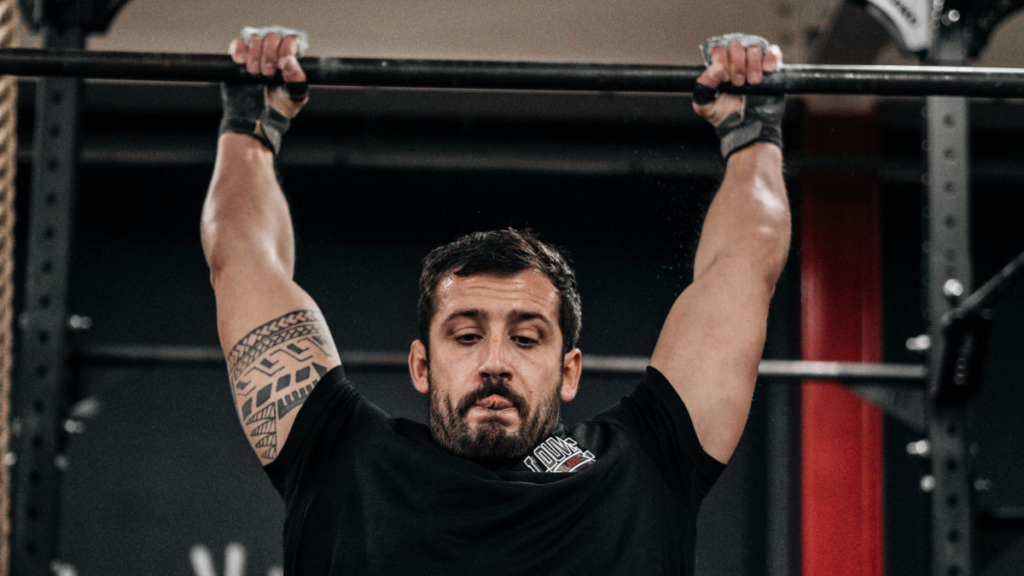
Pull-ups are a fantastic upper-body movement that targets the lats, biceps, traps, and rhomboids, while also engaging the core. According to studies, pull-ups are highly effective at increasing muscle activation in the upper back and arms, making them a must for any muscle-building routine (Youdas et al., 2010).
As a bodyweight exercise, pull-ups also enhance functional strength and grip power, which translates to better performance in other compound movements.
How to Perform:
- Hang from a bar with a shoulder-width grip, palms facing away.
- Pull your chest towards the bar by engaging your lats and pulling through your elbows.
- Lower yourself back down in a controlled manner.
Benefits:
- Builds upper body strength, particularly in the back and arms
- Improves grip strength
- Enhances core stability
5. Overhead Press
The overhead press, also known as the military press, is an essential compound exercise for building upper body strength. It targets the shoulders, triceps, and upper chest, while also engaging the core and legs for stabilisation. Studies have shown that overhead pressing can lead to significant hypertrophy in the deltoids and triceps (Raeissadat et al., 2021).
The overhead press also enhances shoulder mobility and stability, which is critical for avoiding injuries and improving overall upper body function.
How to Perform:
- Stand with your feet shoulder-width apart and hold a barbell at shoulder height.
- Press the bar overhead until your arms are fully extended.
- Lower the bar back down to the starting position.
Benefits:
- Builds strength in the shoulders and triceps
- Enhances upper body pressing power
- Engages the core for stabilisation
6. Barbell Row
The barbell row is an excellent exercise for building back muscle mass, focusing on the lats, traps, and rhomboids, while also working the biceps. Barbell rows are crucial for balancing the body and preventing muscle imbalances between the anterior and posterior chains. According to research, barbell rows activate the latissimus dorsi and other upper back muscles effectively, leading to significant muscle growth (Saeterbakken et al., 2015).
Rows also improve posture and upper body strength, making them ideal for anyone seeking comprehensive upper-body muscle development.
How to Perform:
- Stand with your feet shoulder-width apart and grip the barbell with a slightly wider-than-shoulder-width grip.
- Bend at the hips, keeping your back straight, and pull the bar towards your lower chest.
- Lower the bar in a controlled manner to the starting position.
Benefits:
- Builds strength in the upper back and biceps
- Enhances posture and balance
- Promotes hypertrophy in the posterior chain
7. Bulgarian Split Squat
The Bulgarian split squat is a unilateral exercise that targets the quads, hamstrings, glutes, and core. Research shows that unilateral exercises like the Bulgarian split squat can improve muscle symmetry and balance, leading to more balanced muscle development (Mausehund et al., 2019).
This exercise also challenges balance and stability, making it an excellent addition to any programme focused on building both strength and muscle mass.
How to Perform:
- Stand in a split stance with one foot elevated on a bench behind you.
- Lower your body by bending the front knee until your thigh is parallel to the floor.
- Push through your front heel to return to the starting position.
Benefits:
- Promotes muscle balance and symmetry
- Builds strength in the legs and glutes
- Engages stabiliser muscles for better overall stability
Conclusion
Incorporating these seven exercises into your strength training programme will help you maximise muscle growth across the entire body.
Compound movements like deadlifts, squats, and pull-ups engage multiple muscle groups simultaneously, promoting more efficient hypertrophy. Supporting these with exercises like the overhead press and barbell row will lead to well-rounded muscle development, ensuring both functional strength and aesthetic gains. Remember to maintain proper form and progressively increase resistance to continue challenging your muscles and promoting growth.
Key Takeaways Table
| Exercise | Primary Muscles Worked | Benefits |
|---|---|---|
| Deadlift | Hamstrings, glutes, back, core | Full-body strength, core stability |
| Squat | Quads, hamstrings, glutes, core | Lower body hypertrophy, functional balance |
| Bench Press | Chest, shoulders, triceps | Upper body strength and hypertrophy |
| Pull-Up | Lats, biceps, traps, core | Upper body pulling power, grip strength |
| Overhead Press | Shoulders, triceps, upper chest | Upper body pressing strength, shoulder health |
| Barbell Row | Lats, traps, rhomboids, biceps | Upper back strength, improved posture |
| Bulgarian Split Squat | Quads, hamstrings, glutes, core | Muscle symmetry, lower body strength |
Bibliography
Escamilla, R.F. et al., 2002. A three-dimensional biomechanical analysis of sumo and conventional style deadlifts. Medicine and Science in Sports and Exercise, 34(4), pp. 682-688.
Gentil, P., et al., 2015. Comparison of upper body strength gains between males and females after 10 weeks of resistance training. Journal of Strength and Conditioning Research, 29(1), pp. 143-150.
Mausehund, L., et al., 2019. The effects of different unilateral and bilateral strength training exercises on muscle balance in athletes. Journal of Sports Science and Medicine, 18(3), pp. 423-429.
Raeissadat, S.A., et al., 2021. The effectiveness of overhead press in shoulder muscle hypertrophy: A systematic review. International Journal of Sports Science and Physical Education, 5(2), pp. 75-81.