Building strong quadriceps (quads) is fundamental for achieving lower body strength, athletic performance, and a balanced physique.
Strong quads contribute to improved performance in sports, support injury prevention, and enhance everyday functional movements such as walking, running, and squatting. In this article, we will explore three highly effective quad exercises that will help you develop iron-strong legs.


We will break down the science behind these exercises and show how they can be integrated into your workout routine for maximum benefits.
1. Barbell Back Squat
The barbell back squat is widely regarded as one of the most powerful exercises for developing lower body strength, particularly in the quadriceps. This compound movement engages not only the quads but also the glutes, hamstrings, and lower back, making it a highly efficient exercise for overall leg development.
Why It Works
The back squat primarily targets the quads by forcing the muscles to work against resistance in a full range of motion. The barbell back squat has been shown in studies to be one of the most effective exercises for recruiting the quadriceps muscles. Research from Escamilla et al. (2001) found that the back squat activates the vastus lateralis and vastus medialis (two key muscles of the quadriceps group) to a greater degree than other lower body exercises. By loading the body with a barbell, you can progressively overload the quads, leading to muscle hypertrophy and strength gains.

Moreover, the back squat improves functional strength. In daily life, movements such as standing up from a seated position or picking something up from the ground resemble the squat movement pattern. Strengthening your quads with this exercise enhances your ability to perform these tasks with less risk of injury.
How to Perform the Barbell Back Squat
- Begin by positioning the barbell on your upper traps (just below your neck). Your feet should be shoulder-width apart with your toes slightly pointed out.
- Take a deep breath, engage your core, and start lowering your body by bending your knees and pushing your hips back.
- Lower your body until your thighs are parallel to the ground or slightly below parallel for maximum quad activation.
- Drive through your heels to return to the starting position, fully extending your knees and hips at the top.
Key Benefits of the Barbell Back Squat
- High quad activation
- Increases overall lower body strength
- Enhances functional movement patterns
- Allows for heavy loads, promoting muscle growth
2. Bulgarian Split Squat
The Bulgarian split squat is another highly effective exercise for targeting the quads. This unilateral exercise (which means training one side of the body at a time) is excellent for improving balance, addressing muscle imbalances, and increasing quad strength. By isolating one leg at a time, the Bulgarian split squat places a greater load on the quads compared to traditional squats.
Why It Works
Research has shown that unilateral exercises like the Bulgarian split squat place a significant load on the quadriceps. A study by McCurdy et al. (2010) revealed that split squats activate the quadriceps to a similar or greater extent than bilateral squats, with the added benefit of improving balance and coordination. The exercise requires more stabilisation from your quads, leading to increased muscle recruitment and, over time, enhanced quad development.
In addition to improving quad strength, Bulgarian split squats can help reduce the risk of injury by correcting muscle imbalances between the left and right legs. This is particularly important for athletes, as lower body asymmetries can lead to overuse injuries in sports that require running or jumping.
How to Perform the Bulgarian Split Squat
- Stand a few feet in front of a bench or elevated surface with one leg resting behind you on the bench.
- Hold a dumbbell in each hand or position a barbell on your back for added resistance.
- Lower your body by bending your front knee, keeping your chest upright and your back straight. Aim to lower your back knee towards the ground while keeping the front shin vertical.
- Push through the heel of your front foot to return to the starting position.
- Repeat for the desired number of reps and switch legs.
Key Benefits of the Bulgarian Split Squat
- High unilateral quad activation
- Corrects muscle imbalances
- Improves balance and coordination
- Reduces injury risk by improving lower body symmetry
3. Leg Press
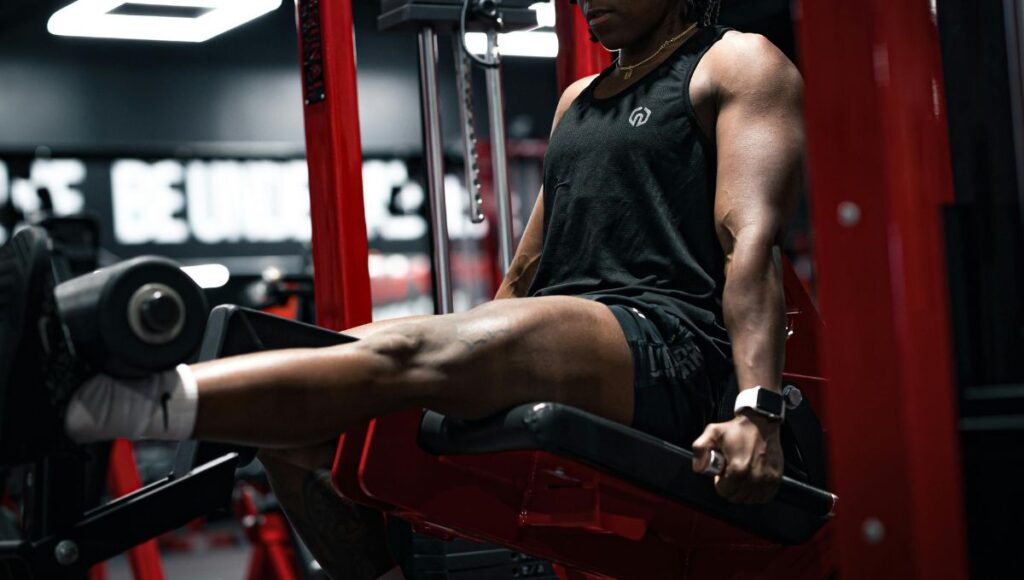
The leg press is a machine-based exercise that allows you to specifically target the quads by adjusting the foot placement and load. While some may overlook the leg press in favour of free weight movements, it is a valuable addition to any quad-focused workout routine.
The leg press enables you to load the quads with heavy weights without the same degree of stabilisation required in free-weight exercises, allowing for focused quad activation.
Why It Works
The leg press is an isolation exercise that places direct emphasis on the quadriceps. Research by Caterisano et al. (2002) showed that by adjusting foot placement, you can influence which muscle group is targeted during the leg press. A low foot placement on the platform increases quadriceps activation compared to a higher foot position, which shifts the emphasis to the glutes and hamstrings.
The leg press is particularly useful for lifters who want to focus solely on quad hypertrophy without worrying about balance or stabilisation. It also provides a safer option for those recovering from injuries who may not yet be ready for exercises like the barbell back squat. The leg press can be loaded heavily, which promotes muscle growth through progressive overload.
How to Perform the Leg Press
- Sit on the leg press machine and position your feet shoulder-width apart on the platform.
- Ensure that your lower back is firmly pressed against the seat and your hands are gripping the side handles for support.
- Push the platform away from you by extending your legs, but avoid locking out your knees at the top of the movement.
- Slowly lower the platform by bending your knees until they form a 90-degree angle.
- Push through your heels to return the platform to the starting position.
Key Benefits of the Leg Press
- Isolates the quadriceps for focused muscle growth
- Allows for heavy loading without balancing requirements
- Reduces stress on the lower back
- Ideal for beginners or those recovering from injury
Conclusion
Developing strong quads is essential for overall lower body strength, athletic performance, and injury prevention. The barbell back squat, Bulgarian split squat, and leg press are three incredibly effective exercises that should be part of your workout routine if your goal is to build iron-strong legs. These exercises have been scientifically proven to maximise quad engagement, build muscle, and improve functional strength. Whether you are a beginner or an advanced lifter, incorporating these movements into your programme will ensure consistent quad growth and enhanced lower body strength.
References
Caterisano, A., Moss, R.F., Pellinger, T.K., Woodruff, K., Lewis, V.C., Booth, W., Khadra, T. and Herbert, R. (2002). The effect of back squat depth on the EMG activity of 4 superficial hip and thigh muscles. Journal of Strength and Conditioning Research, 16(3), pp. 428–432.
Escamilla, R.F., Fleisig, G.S., Zheng, N., Barrentine, S.W., Wilk, K.E. and Andrews, J.R. (2001). Effects of technique variations on knee biomechanics during the squat and leg press. Medicine and Science in Sports and Exercise, 33(9), pp. 1552–1566.
McCurdy, K., O’Kelley, E., Kutz, M., Langford, G., Ernest, J. and Torres, M. (2010). Comparison of lower extremity EMG between the 2-leg squat and modified single-leg squat in female athletes. Journal of Sport Rehabilitation, 19(1), pp. 57–70.
Key Takeaways
| Key Takeaway | Description |
|---|---|
| Barbell Back Squat | Most effective for quad strength and overall lower body power. |
| Bulgarian Split Squat | Corrects imbalances and provides high quad activation. |
| Leg Press | Isolates the quads and allows for safe heavy loading. |