Travelling offers a unique opportunity to explore new places and cultures, but it can be a challenge to maintain fitness routines on the go. Whether you’re on a business trip or a backpacking adventure, keeping fit is not only important for maintaining physical health, but it also helps reduce stress, improve mood, and enhance energy levels.
You don’t need access to a fully equipped gym to stay in shape while travelling; with a bit of creativity and determination, your backpack can be the only tool you need. This article explores how to stay fit while travelling using just a backpack, backed by science and supported by studies.


Why Staying Fit While Travelling is Important
Physical activity is essential for maintaining cardiovascular health, muscle tone, and overall wellbeing. A study published in the American Journal of Epidemiology found that a sedentary lifestyle is associated with an increased risk of cardiovascular disease, type 2 diabetes, and mortality, even in active individuals who otherwise exercise regularly (Ekelund et al., 2016). When you’re travelling, long periods of sitting, irregular meals, and a disrupted schedule can lead to weight gain and decreased fitness levels. Engaging in regular exercise helps combat these risks, keeping your body and mind sharp.
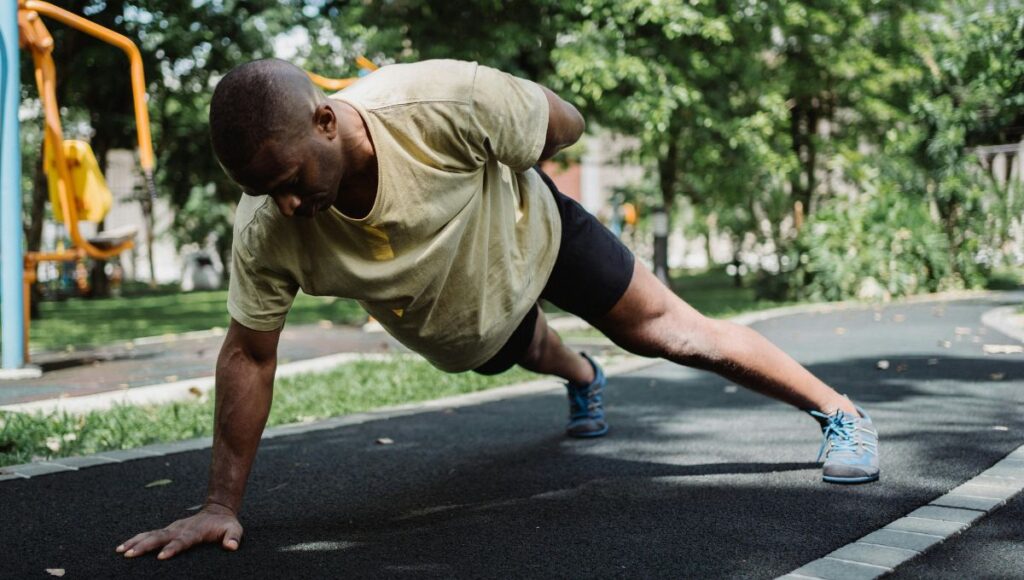
Exercise is also known to improve mental clarity and reduce stress, which is particularly important when travelling in unfamiliar environments. The Journal of Sports Science & Medicine highlights that even short bursts of exercise can trigger the release of endorphins, enhancing mood and reducing symptoms of anxiety and depression (Biddle et al., 2000).
How to Use Your Backpack for Resistance
Your backpack can function as a portable, adjustable weight. By loading it with items like water bottles, books, or clothing, you can vary its weight to suit different exercises. Resistance training is crucial for maintaining muscle mass, especially when you’re on the road and potentially engaging in less physical activity than usual. According to research from the Journal of Strength and Conditioning Research, resistance training increases muscle strength and size through hypertrophy, promoting muscle growth and fat loss (Schoenfeld, 2010).
Backpack Squats
Squats are a fundamental lower-body exercise that engages the quadriceps, hamstrings, glutes, and core. Adding weight to the movement with your backpack enhances its effectiveness, offering resistance that helps to increase muscle mass and improve functional strength.
To perform:
- Stand with your feet shoulder-width apart.
- Hold your backpack in front of your chest or wear it on your back.
- Lower into a squat position, ensuring your knees track over your toes and your chest stays upright.
- Push through your heels to return to a standing position.
Squats activate multiple muscle groups at once, making them a highly effective full-body exercise. Research from the Journal of Applied Physiology shows that compound exercises like squats elicit greater hormonal responses than isolation exercises, promoting more significant muscle growth (Kraemer et al., 1990).
Backpack Lunges
Lunges are another great lower-body exercise that can be intensified by incorporating your backpack. Lunges target the glutes, quadriceps, hamstrings, and calves while also improving balance and coordination.
To perform:
- Hold your backpack on your back or in front of your chest.
- Step forward with one leg, lowering your hips until both knees are bent at a 90-degree angle.
- Push back to the starting position and repeat with the other leg.
Lunges work each leg independently, helping to correct muscle imbalances. Studies from the Journal of Strength and Conditioning Research suggest that unilateral exercises like lunges can improve overall stability and strength (McCurdy et al., 2005).
Backpack Rows
Rows are excellent for strengthening the upper back, shoulders, and biceps. Using your backpack as a weight, you can simulate a bent-over row, which helps counteract the effects of long periods of sitting and poor posture.
To perform:
- Bend forward at the hips, keeping your back straight.
- Hold your backpack in both hands, arms fully extended.
- Pull the backpack towards your chest by squeezing your shoulder blades together.
- Lower the backpack slowly and repeat.
Rows target the posterior chain, which is crucial for maintaining proper posture and reducing the risk of injury. Research published in Sports Health supports the effectiveness of rows for strengthening the upper back and improving shoulder stability (Escamilla et al., 2009).
Cardio Workouts with a Backpack
While resistance training is essential, cardio exercises help maintain cardiovascular health, improve stamina, and burn calories. You can use your backpack to add an extra challenge to traditional cardio movements, increasing calorie burn and intensity.
Backpack Burpees
Burpees are a full-body cardio exercise that also strengthens the legs, core, and upper body. Adding a backpack makes the movement more challenging, increasing the intensity and calorie burn.
To perform:
- Stand with your feet shoulder-width apart, backpack on your back.
- Drop into a squat and place your hands on the floor in front of you.
- Jump your feet back into a plank position, then immediately jump them forward again.
- Jump up explosively, reaching your arms overhead.
Burpees are a highly effective fat-burning exercise. A study in the American Journal of Human Biology found that high-intensity exercises like burpees increase oxygen consumption post-exercise, leading to greater calorie expenditure even after the workout ends (Borsheim & Bahr, 2003).
Backpack Step-Ups
Step-ups are a simple yet effective exercise for working the legs and glutes while also raising your heart rate. With a backpack on, step-ups can become a full-body cardiovascular workout.
To perform:
- Stand in front of a sturdy surface like a bench or step.
- Wear your backpack for added resistance.
- Step up onto the surface with one leg, followed by the other.
- Step back down and repeat with the opposite leg.
Step-ups are excellent for building lower-body strength and improving cardiovascular endurance. According to a study in the Journal of Physical Therapy Science, step-ups also improve balance and coordination, reducing the risk of falls (Choi et al., 2015).
Core Strengthening with a Backpack
Maintaining core strength is essential for overall body stability and injury prevention. Your backpack can serve as a weight for various core exercises, helping to build a strong and defined midsection.
Backpack Russian Twists
Russian twists target the oblique muscles, which are important for rotational movements and overall core stability.
To perform:
- Sit on the floor with your knees bent and feet flat.
- Hold your backpack with both hands in front of your chest.
- Lean back slightly and twist your torso to one side, then to the other, keeping the backpack close to your body.
Research from the Journal of Strength and Conditioning Research shows that rotational core exercises like Russian twists help improve athletic performance by enhancing rotational power (McGill et al., 2010).
Backpack Plank
Planks are one of the most effective exercises for building core strength. Adding a backpack increases the challenge, engaging your abs, back, and shoulders even more.
To perform:
- Wear your backpack and get into a plank position, with your forearms on the ground and your body in a straight line.
- Hold the position for as long as possible, maintaining a tight core and straight back.
Planks activate the entire core and help improve endurance. A study published in Strength and Conditioning Journal found that core stability exercises like planks are effective for enhancing athletic performance and preventing injury (Bliss & Teeple, 2005).
Stretching and Mobility Exercises with a Backpack
Mobility is often overlooked when travelling, but it’s vital for preventing stiffness and injury, especially after long flights or car journeys. Incorporating mobility exercises into your routine can help improve flexibility and reduce muscle tension.
Backpack Overhead Stretch
Stretching your shoulders and upper back is essential for maintaining flexibility and reducing tension, particularly if you’ve been carrying a heavy backpack for extended periods.
To perform:
- Hold your backpack with both hands and lift it overhead.
- Gently stretch your arms backward, opening up your chest and shoulders.
- Hold for 20–30 seconds and repeat.
Backpack Hip Flexor Stretch
Long periods of sitting can cause tight hip flexors, which can lead to lower back pain and reduced mobility. Stretching the hip flexors helps counteract these effects.
To perform:
- Kneel on one knee, with your other foot planted in front of you.
- Hold your backpack in front of your chest.
- Lean forward into the stretch, feeling the stretch in your hip flexor.
- Hold for 20–30 seconds and switch sides.
Conclusion
Travelling doesn’t have to mean sacrificing your fitness routine. With a bit of creativity and determination, your backpack can be transformed into a versatile piece of equipment that allows you to perform full-body workouts, build strength, and maintain cardiovascular health. By incorporating a combination of resistance, cardio, and core exercises, you can stay fit and healthy on the road. Always remember that consistency is key; aim to incorporate some form of physical activity into your daily routine, even if it’s just a quick workout with your backpack.
Key Takeaways Table
| Key Takeaways |
|---|
| 1. Use your backpack as a portable weight to perform resistance exercises like squats and lunges. |
| 2. Incorporate cardio exercises such as burpees and step-ups with your backpack for a full-body workout. |
| 3. Strengthen your core with backpack exercises like Russian twists and planks. |
| 4. Don’t forget mobility and stretching exercises to prevent stiffness and injury while travelling. |
| 5. Consistency is key to maintaining fitness while travelling—try to exercise daily, even briefly. |
Bibliography
Biddle, S. et al., 2000. Exercise and mental health: guidelines for professionals. Journal of Sports Science & Medicine, 8(1), pp.39-53.
Borsheim, E. & Bahr, R., 2003. Effect of exercise intensity, duration and mode on post-exercise oxygen consumption. American Journal of Human Biology, 15(4), pp.517-528.
Choi, Y.O. et al., 2015. The effects of step-up exercise on lower limb muscle activation in chronic stroke patients. Journal of Physical Therapy Science, 27(2), pp.437-439.
Ekelund, U. et al., 2016. Physical activity and all-cause mortality across levels of overall and abdominal adiposity in European men and women: the EPIC cohort study. American Journal of Epidemiology, 183(8), pp.736-747.
Escamilla, R.F. et al., 2009. Shoulder muscle activity and function in common shoulder rehabilitation exercises. Sports Health, 1(4), pp.346-357.
Kraemer, W.J. et al., 1990. Hormonal mechanisms related to the expression of muscular strength and power. Journal of Applied Physiology, 69(1), pp.146-150.
McCurdy, K.W. et al., 2005. Unilateral vs. bilateral lower-body resistance and plyometric training. Journal of Strength and Conditioning Research, 19(1), pp.9-15.
McGill, S.M. et al., 2010. Core muscle activity during new variations of the side plank exercise. Journal of Strength and Conditioning Research, 24(3), pp.1089-1094.
Schoenfeld, B.J., 2010. The mechanisms of muscle hypertrophy and their application to resistance training. Journal of Strength and Conditioning Research, 24(10), pp.2857-2872.