Building muscle mass efficiently requires the integration of compound exercises into your training programme. These multi-joint movements recruit several muscle groups simultaneously, which maximises muscular hypertrophy, strength gains, and caloric expenditure.
Below, we examine the three best compound exercises for muscle mass, supported by scientific research.
1. Deadlift
The deadlift is one of the most effective compound exercises for developing overall muscle mass and strength. It engages multiple muscle groups, including the glutes, hamstrings, quadriceps, erector spinae, traps, and forearms. Deadlifts also improve posterior chain strength, which is essential for athletic performance and injury prevention.
Why the Deadlift is Effective
Deadlifts activate more muscles than almost any other lift. A study published in the Journal of Strength and Conditioning Research found that deadlifts stimulate significant activation in the glutes and hamstrings compared to similar exercises like squats (Escamilla et al., 2002).
The exercise also engages stabilising muscles, which improves core strength and balance. Moreover, deadlifts create a significant hormonal response, increasing testosterone and growth hormone levels, both of which are critical for muscle hypertrophy (Kraemer et al., 1990).
Tips for Proper Deadlift Execution
- Keep your spine neutral throughout the lift to prevent injury.
- Engage your lats by pulling the bar toward your body during the movement.
- Focus on driving through your heels rather than your toes for better activation of the posterior chain.
Deadlift Variations
To target specific muscles or address weaknesses, incorporate variations like Romanian deadlifts for hamstring focus or sumo deadlifts for increased quadriceps activation.
2. Squat
Squats are a cornerstone of strength training and muscle-building routines. This compound movement primarily targets the quadriceps, hamstrings, glutes, and lower back, but it also engages the core and stabilising muscles.
Scientific Support for Squats
Research has consistently shown that squats produce superior muscle activation in the lower body. According to a study in the Journal of Strength and Conditioning Research, squats generate greater electromyographic (EMG) activity in the glutes and quadriceps compared to leg press machines (Clark et al., 2012).
Furthermore, the loaded squat significantly increases anabolic hormone levels, including testosterone and growth hormone, which promote muscle protein synthesis (Hansen et al., 2001).
Types of Squats
- Back Squat: Ideal for overall strength and muscle gains, focusing on the posterior chain and quadriceps.
- Front Squat: Places greater emphasis on the quadriceps and core, as the load shifts to the anterior chain.
- Goblet Squat: A beginner-friendly variation that helps refine technique and mobility.
Tips for Optimising Squats
- Maintain a full range of motion (parallel or deeper) for optimal muscle activation.
- Keep your chest up and core engaged to prevent forward lean.
- Ensure your knees track over your toes to avoid injury.
3. Bench Press
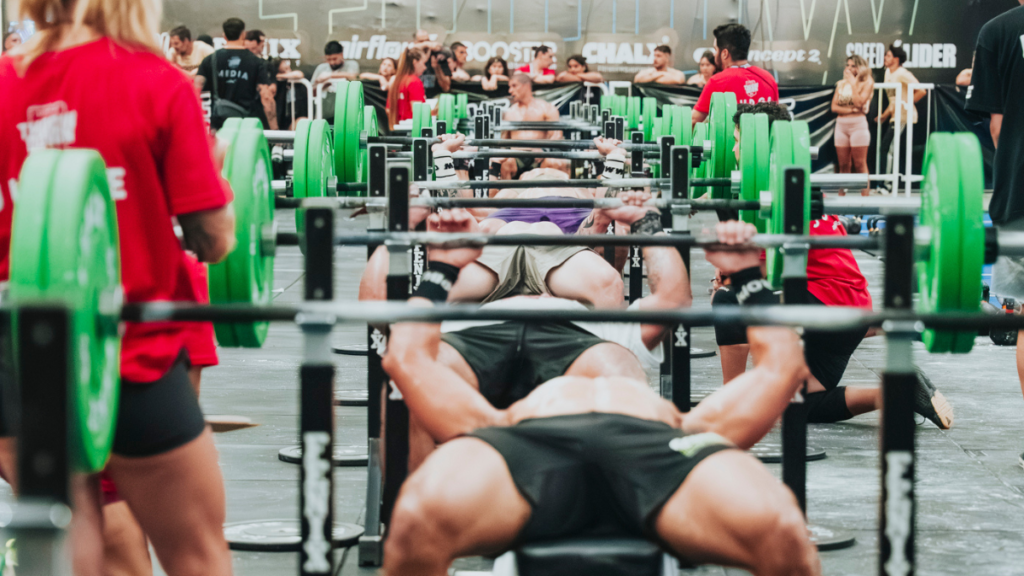
The bench press is the ultimate compound exercise for upper body muscle mass. It targets the pectoralis major, deltoids, and triceps, with secondary activation of the lats, traps, and core for stabilisation.
Why the Bench Press is Essential
The bench press effectively stimulates the chest and triceps due to its pressing motion. Research from the Journal of Sports Sciences highlights that the bench press produces maximal muscle activation in the pectoralis major when performed at moderate to heavy loads (Saeterbakken et al., 2017). Moreover, bench pressing with progressive overload is associated with greater hypertrophy and strength gains over time.
Variations of the Bench Press
- Flat Bench Press: Targets the chest evenly across its fibres.
- Incline Bench Press: Focuses on the upper pectorals for a more defined chest.
- Close-Grip Bench Press: Emphasises the triceps while still activating the chest.
Bench Press Technique Tips
- Lower the bar to your mid-chest with control to maximise muscle engagement.
- Retract your scapulae to create a stable pressing base.
- Keep your elbows at a 45-degree angle to the torso to avoid shoulder strain.
Why Compound Exercises Outperform Isolation Movements
Compound exercises like deadlifts, squats, and bench presses activate more muscle groups than isolation exercises, leading to higher calorie expenditure and greater overall hypertrophy.
A study published in Sports Medicine emphasised that compound lifts yield a larger hormonal response compared to isolation exercises, accelerating muscle growth and recovery (West et al., 2009). Additionally, they improve functional strength, which translates to better performance in sports and daily activities.
Key Takeaways
| Exercise | Primary Muscles Worked | Benefits |
|---|---|---|
| Deadlift | Glutes, hamstrings, erector spinae, traps | Builds overall strength, enhances posterior chain development |
| Squat | Quadriceps, hamstrings, glutes, core | Maximises lower body hypertrophy, improves functional movement patterns |
| Bench Press | Pectorals, deltoids, triceps | Builds upper body strength, targets multiple muscle groups simultaneously |
Bibliography
Clark, D. R., Lambert, M. I., & Hunter, A. M. (2012). Muscle activation in the loaded free barbell squat: a comparison of squatting below and above 90 degrees of knee flexion. Journal of Strength and Conditioning Research, 26(11), 2829–2836.
Escamilla, R. F., Francisco, A. C., Kayes, A., Speer, K. P., & Moorman, C. T. (2002). An electromyographic analysis of sumo and conventional style deadlifts. Medicine and Science in Sports and Exercise, 34(4), 682–688.
Hansen, S., Kvorning, T., Kjaer, M., & Sjogaard, G. (2001). The effect of short-term strength training on human skeletal muscle: the importance of physiologically elevated hormone levels. Scandinavian Journal of Medicine & Science in Sports, 11(6), 347–354.
Kraemer, W. J., Marchitelli, L., Gordon, S. E., Harman, E., Dziados, J. E., Mello, R., Frykman, P., McCurry, D., & Fleck, S. J. (1990). Hormonal and growth factor responses to heavy resistance exercise protocols. Journal of Applied Physiology, 69(4), 1442–1450.
Saeterbakken, A. H., Mo, D.-A., Scott, S., & Andersen, V. (2017). The effects of bench press variations in competitive athletes on muscle activity and performance. Journal of Sports Sciences, 35(2), 184–192.
West, D. W., Burd, N. A., Tang, J. E., Moore, D. R., Staples, A. W., Holwerda, A. M., Baker, S. K., & Phillips, S. M. (2009). Elevations in amino acid transport and mTOR signaling following resistance exercise reflect time-dependent increases in human muscle protein synthesis. Sports Medicine, 39(4), 271–290.