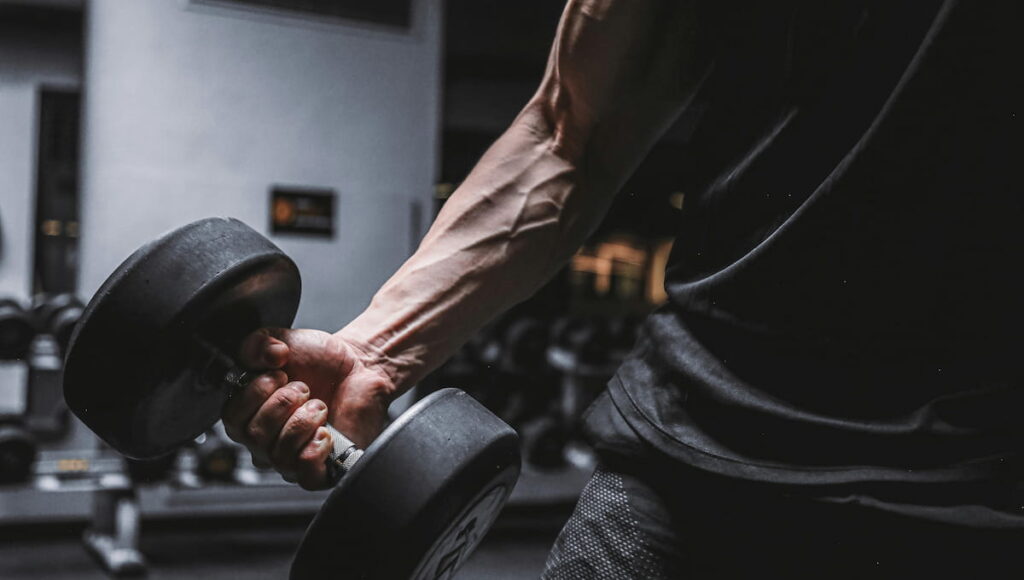
Dumbbells provide several advantages over barbells and machines when it comes to chest training. They allow for a greater range of motion, which increases muscle fibre recruitment and can lead to superior hypertrophy.
Additionally, dumbbells promote balanced strength development, reducing muscular imbalances between the left and right sides of the body. Research has shown that free weights like dumbbells activate more stabilising muscles compared to machines, leading to better overall muscle development and functional strength (Saeterbakken & Fimland, 2013).



The Best Dumbbell Chest Exercises for Maximum Growth
Each of the following exercises has been carefully selected based on biomechanical effectiveness and scientific research on muscle activation.
1. Dumbbell Bench Press
The dumbbell bench press is one of the most effective chest-building exercises. Compared to the barbell bench press, it allows for a greater range of motion and more activation of the stabilising muscles in the shoulders and triceps (Schoenfeld et al., 2017). To perform the exercise, lie on a flat bench with a dumbbell in each hand. Lower the weights slowly until they reach chest level, then press them back up to the starting position.
2. Dumbbell Incline Press
The incline dumbbell press targets the upper portion of the pectoral muscles more than the flat bench press. Research indicates that pressing at an incline of around 30 to 45 degrees increases activation of the clavicular head of the pectoralis major (Barnett et al., 1995). To execute the movement, set a bench to an incline, press the dumbbells overhead, and lower them under control.
3. Dumbbell Decline Press
The decline dumbbell press focuses on the lower part of the chest. Studies have shown that decline pressing angles increase activation of the sternocostal head of the pectoralis major (Trebs et al., 2010). Perform this exercise by adjusting a bench to a slight decline, pressing the dumbbells in a controlled manner.
4. Dumbbell Fly
Dumbbell flyes help stretch the chest muscles under load, which may contribute to muscle hypertrophy through greater muscle fibre elongation and tension (Schoenfeld, 2010). To perform a dumbbell fly, lie on a flat bench, hold the dumbbells with palms facing each other, lower them in a wide arc, and bring them back together above the chest.
5. Dumbbell Pullover
The dumbbell pullover is a unique movement that targets both the chest and the lats. Research suggests that it activates the pectoralis major significantly while also engaging the serratus anterior (Jung et al., 2019). Perform the exercise by holding a dumbbell with both hands, lowering it behind the head, and bringing it back over the chest.
Structuring the Perfect Dumbbell-Only Chest Workout
To maximise hypertrophy and strength, your dumbbell chest workout should follow a structured plan that includes appropriate volume, intensity, and rest periods.
Sample Dumbbell Chest Workout Plan
| Exercise | Sets | Reps | Rest |
|---|---|---|---|
| Dumbbell Bench Press | 4 | 6-10 | 90 sec |
| Dumbbell Incline Press | 4 | 8-12 | 90 sec |
| Dumbbell Decline Press | 3 | 8-12 | 75 sec |
| Dumbbell Fly | 3 | 10-12 | 75 sec |
| Dumbbell Pullover | 3 | 10-12 | 75 sec |
Training Principles for Maximum Chest Growth
Progressive Overload
To continuously build muscle, you need to increase the resistance over time. This can be done by increasing the dumbbell weight, adding more repetitions, or improving lifting technique. Studies confirm that progressive overload is essential for hypertrophy and strength gains (Kraemer & Ratamess, 2004).
Controlled Tempo and Full Range of Motion
Executing each repetition with a controlled tempo and complete range of motion maximises muscle activation. Research suggests that a slower eccentric phase (lowering portion) enhances muscle damage and subsequent growth (Schoenfeld et al., 2015).
Time Under Tension (TUT)
Increasing the duration a muscle is under tension stimulates hypertrophy. A study by Burd et al. (2012) found that extending TUT can increase muscle protein synthesis.
Proper Recovery and Nutrition
Muscles grow outside the gym during recovery. Ensure adequate protein intake, as research indicates that consuming 1.6-2.2g of protein per kg of body weight supports muscle hypertrophy (Morton et al., 2018). Also, aim for at least 48 hours of recovery between chest sessions to allow muscle repair and growth.
Common Mistakes to Avoid
Using Excessive Weight
Lifting too heavy often leads to poor form and reduced range of motion, limiting effectiveness. Instead, prioritise good technique and full contraction.
Inconsistent Range of Motion
Not lowering the dumbbells fully or stopping short at the top limits muscle activation. Always use a full range of motion for optimal gains.
Poor Shoulder Stability
Failing to engage stabilising muscles can increase injury risk. Keep your scapula retracted and maintain control throughout each repetition.
Conclusion
A dumbbell-only chest workout is highly effective for building size and strength while minimising joint strain. By incorporating exercises such as the dumbbell bench press, incline press, decline press, fly, and pullover, you can maximise muscle growth. Applying principles like progressive overload, controlled tempo, and proper recovery will further enhance results. Stick to a structured plan, maintain good form, and ensure adequate nutrition to build a powerful, well-defined chest.
Key Takeaways
| Key Point | Summary |
| Greater Range of Motion | Dumbbells allow for a fuller stretch and contraction compared to barbells. |
| More Muscle Activation | Research shows dumbbells activate more stabilising muscles. |
| Balanced Strength Gains | Dumbbells prevent strength imbalances between sides. |
| Essential Exercises | Dumbbell bench press, incline press, decline press, fly, and pullover. |
| Training Principles | Progressive overload, controlled tempo, and time under tension are key for growth. |
| Recovery Matters | Adequate protein intake and rest are necessary for muscle repair. |