Compound exercises are the cornerstone of any effective muscle-building programme. These multi-joint movements recruit multiple muscle groups, allowing for heavier loads, greater mechanical tension, and enhanced neuromuscular activation. Scientific research consistently supports compound lifts as the most efficient way to stimulate hypertrophy, increase strength, and optimise hormonal responses (Schoenfeld, 2010).
This article delves into five of the best compound exercises for maximising muscle growth, backed by evidence-based principles.


1. Barbell Squat
Why It Works
The barbell squat is often regarded as the king of lower body exercises, engaging the quadriceps, hamstrings, glutes, and core stabilisers. A study by Escamilla et al. (2001) found that squats elicit high levels of muscle activation in both the posterior and anterior chain, making them highly effective for hypertrophy and strength development.
Scientific Backing
Research has demonstrated that barbell squats significantly elevate testosterone and growth hormone levels post-exercise, contributing to muscle hypertrophy (Kraemer & Ratamess, 2005). Additionally, deep squats have been shown to induce greater muscle activation and growth compared to partial squats (Bloomquist et al., 2013).
Execution
- Stand with feet shoulder-width apart, barbell resting on the upper traps.
- Lower yourself by pushing your hips back and bending your knees until your thighs are parallel or lower.
- Drive back up, maintaining core engagement and an upright torso.
2. Deadlift
Why It Works
The deadlift is a full-body movement that primarily targets the posterior chain, including the glutes, hamstrings, and lower back. It also recruits the core, traps, and forearms due to the grip demand. A study by Swinton et al. (2011) found that the deadlift produces higher force output than almost any other resistance exercise, making it ideal for building overall strength and mass.
Scientific Backing
Deadlifts have been shown to generate significant increases in testosterone and human growth hormone (Häkkinen & Pakarinen, 1995). They also enhance intra-abdominal pressure, strengthening the core and reducing injury risk (McGill, 2006).
Execution
- Stand with feet hip-width apart, barbell over the midfoot.
- Grip the bar with hands slightly outside the knees.
- Drive through the heels, keeping the back straight, and extend the hips to stand up fully.
3. Bench Press
Why It Works
The bench press is a staple upper-body movement that primarily targets the pectoralis major, anterior deltoids, and triceps. Studies indicate that horizontal pressing movements like the bench press produce high levels of muscular activation, making them superior for chest hypertrophy (Schoenfeld et al., 2015).
Scientific Backing
A study by Clemons and Aaron (1997) found that barbell bench pressing leads to greater muscle fibre recruitment compared to machine-based pressing. Additionally, bench pressing with varying grip widths can alter muscle activation, maximising overall chest development (Lehman, 2005).
Execution
- Lie on a bench, grip the barbell slightly wider than shoulder-width.
- Lower the bar to the mid-chest, keeping elbows at a 45-degree angle.
- Press the bar back up, fully extending the arms without locking out.
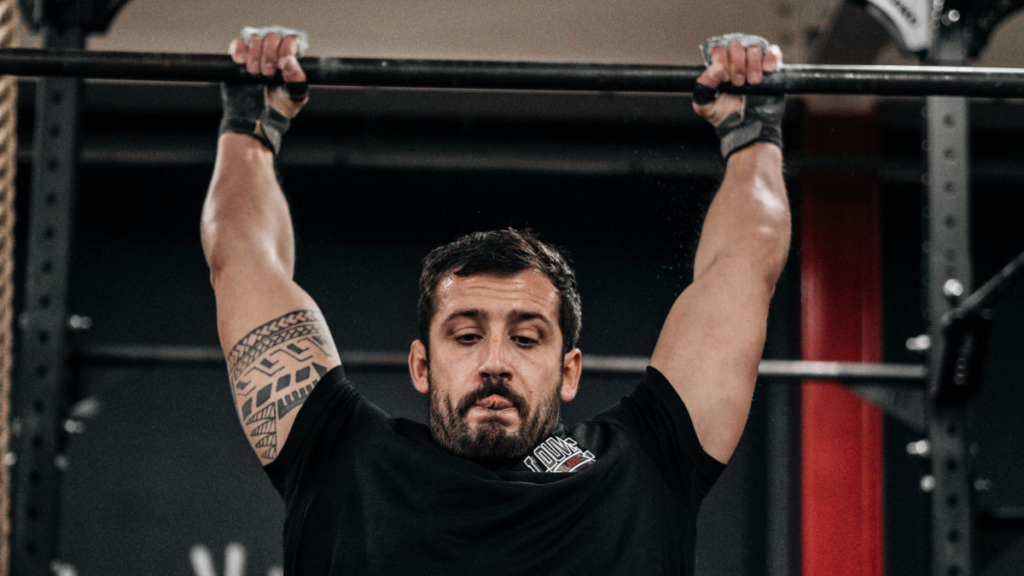
4. Pull-Ups
Why It Works
Pull-ups are a bodyweight compound exercise that targets the latissimus dorsi, biceps, and upper back. They are particularly effective for improving upper-body strength and muscular endurance (Youdas et al., 2010).
Scientific Backing
Studies show that pull-ups activate a larger portion of the latissimus dorsi than lat pulldowns, making them more effective for back development (Lusk et al., 2010). Additionally, eccentric pull-ups have been found to elicit greater muscle damage, leading to increased hypertrophic adaptations (Schoenfeld et al., 2014).
Execution
- Grip a pull-up bar with hands slightly wider than shoulder-width.
- Engage the scapula and pull the body up until the chin clears the bar.
- Lower under control, maintaining full range of motion.
5. Overhead Press
Why It Works
The overhead press targets the deltoids, triceps, and upper chest while engaging the core for stability. It is one of the best exercises for upper-body pressing strength and overall muscular development (Saeterbakken et al., 2013).
Scientific Backing
Research indicates that standing overhead presses lead to greater core activation compared to seated variations, making them superior for functional strength and athletic performance (Lehman, 2005). Additionally, pressing movements have been found to improve shoulder stability and mobility when performed correctly (Kibler et al., 2013).
Execution
- Stand with feet shoulder-width apart, barbell at shoulder height.
- Press the bar overhead, locking out the elbows.
- Lower under control, maintaining core engagement.
Conclusion Incorporating these five compound exercises into a structured strength programme provides the most efficient pathway to muscle growth. These movements target large muscle groups, optimise hormonal responses, and build foundational strength essential for long-term progress. Proper technique and progressive overload should be prioritised to maximise hypertrophy while reducing injury risk.
Key Takeaways
| Exercise | Primary Muscles Worked | Scientific Benefits |
|---|---|---|
| Barbell Squat | Quads, hamstrings, glutes, core | High muscle activation, increased testosterone and GH levels |
| Deadlift | Glutes, hamstrings, lower back, core | Maximises posterior chain strength, enhances core stability |
| Bench Press | Chest, triceps, shoulders | Superior for chest hypertrophy, high muscular activation |
| Pull-Ups | Lats, biceps, upper back | Greater lat engagement compared to lat pulldowns |
| Overhead Press | Shoulders, triceps, core | Enhances shoulder strength and stability, high core engagement |
Bibliography
- Bloomquist, K. et al. (2013). ‘Effect of range of motion in heavy load squatting on muscle and tendon adaptations’. Journal of Strength and Conditioning Research, 27(8), pp.2287-2296.
- Clemons, J.M. and Aaron, C. (1997). ‘Effect of grip width on the myoelectric activity of the prime movers in the bench press’. Journal of Strength and Conditioning Research, 11(2), pp.82-87.
- Escamilla, R.F. et al. (2001). ‘Biomechanical analysis of the squat exercise’. Medicine & Science in Sports & Exercise, 33(1), pp.127-141.
- Häkkinen, K. and Pakarinen, A. (1995). ‘Acute hormonal responses to different resistance exercise protocols in young and old men’. European Journal of Applied Physiology, 72(5-6), pp.371-377.
- Kibler, W.B., Sciascia, A. and Wilkes, T. (2013). ‘Scapular dyskinesis and its relation to shoulder pain’. Journal of the American Academy of Orthopaedic Surgeons, 21(6), pp.364-372.
- Kraemer, W.J. and Ratamess, N.A. (2005). ‘Hormonal responses and adaptations to resistance exercise and training’. Sports Medicine, 35(4), pp.339-361.
- McGill, S. (2006). ‘Ultimate Back Fitness and Performance’. Wabuno Publishers.
- Schoenfeld, B.J. (2010). ‘The mechanisms of muscle hypertrophy and their application to resistance training’. Journal of Strength and Conditioning Research, 24(10), pp.2857-2872.