Many believe that lifting heavy weights is the only way to build a bigger and stronger chest. While heavy lifting certainly has its benefits, research shows that other methods can effectively stimulate muscle growth and strength gains without subjecting the body to excessive loads.
This article explores three scientifically backed strategies for building a powerful chest without relying on heavy weights: high-repetition training, time under tension (TUT), and advanced bodyweight techniques.


High-Repetition Training for Muscle Growth
How High Reps Stimulate Muscle Hypertrophy
Research indicates that muscle hypertrophy can occur at a range of intensities, provided that sets are taken close to failure (Schoenfeld et al., 2017). High-repetition training (15+ reps per set) increases metabolic stress, a key driver of muscle growth.
This method is particularly effective for chest development because it enhances muscular endurance and capillary density while still promoting hypertrophy.
Benefits of High-Repetition Training for the Chest
- Increased Muscle Activation: Lighter loads performed for higher reps lead to prolonged time under tension, triggering hypertrophy through metabolic stress (Lasevicius et al., 2018).
- Reduced Joint Stress: Lifting heavy weights repeatedly can place undue stress on the shoulder joints. High-rep training allows for effective chest development without the associated risk of joint degeneration.
- Improved Muscular Endurance: Higher rep ranges enhance slow-twitch muscle fibre endurance, leading to better performance in activities that require sustained pushing strength (Schoenfeld et al., 2017).
How to Implement High-Repetition Training
- Perform exercises such as dumbbell flyes, incline push-ups, and resistance band chest presses in the 15-25 rep range.
- Focus on proper form and controlled movements to maximise muscle activation.
- Train the chest at least twice per week, incorporating a variety of angles and movement patterns.
Time Under Tension (TUT) Training
The Science Behind TUT for Chest Growth
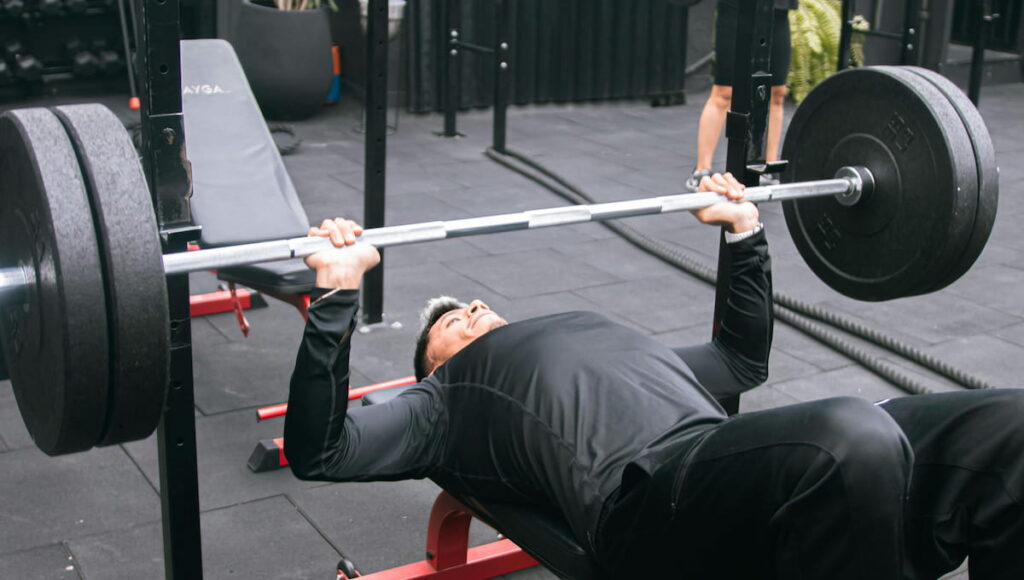
Time under tension refers to the total duration a muscle is placed under strain during a set. Studies show that longer TUT, especially in the eccentric (lowering) phase, enhances muscle protein synthesis and hypertrophy (Schoenfeld, 2020). Slow, controlled movements create sustained tension, stimulating both fast-twitch and slow-twitch muscle fibres.
Why TUT Works for Chest Development
- Maximised Muscle Fibre Recruitment: Slow eccentric phases (e.g., lowering in a push-up or bench press) increase muscle fibre activation, leading to enhanced hypertrophy (McMahon et al., 2014).
- Greater Metabolic Stress: Keeping the chest muscles under tension for longer promotes lactic acid buildup, which stimulates anabolic hormone production (Kumar et al., 2009).
- Reduced Need for Heavy Weights: By slowing the movement tempo (e.g., using a 4-second eccentric phase), muscles experience a similar or even greater training stimulus compared to heavier loads performed explosively.
How to Apply TUT to Chest Training
- Slow Down Repetitions: Use a 3-4 second eccentric phase for each rep of push-ups, dips, or dumbbell presses.
- Pause at Peak Contraction: Hold the top position of a push-up or chest fly for 2-3 seconds to maximise tension.
- Perform Isometric Holds: Integrate static holds at different phases of an exercise to increase muscle engagement.
Advanced Bodyweight Techniques
How Bodyweight Movements Build Chest Strength and Size
Bodyweight exercises can be adapted to create high-intensity stimuli without requiring heavy loads. Techniques such as mechanical drop sets, plyometric movements, and unilateral variations provide sufficient resistance for muscle hypertrophy (Calatayud et al., 2015).
Effective Bodyweight Strategies for Chest Growth
- Archer Push-Ups: These increase unilateral loading, forcing each side of the chest to work harder while improving muscle symmetry.
- Explosive Plyometric Push-Ups: Performing clapping or explosive push-ups activates fast-twitch muscle fibres, essential for power and hypertrophy (Cormie et al., 2011).
- Weighted Vest Push-Ups or Resistance Band Flyes: Light external resistance, such as a weighted vest or resistance bands, can significantly enhance chest development without requiring barbells or dumbbells.
How to Incorporate Advanced Bodyweight Movements
- Mechanical Drop Sets: Start with archer push-ups, transition to regular push-ups, and finish with knee push-ups to exhaust the chest.
- Unilateral Variations: Incorporate single-arm push-ups or ring push-ups to increase muscle activation.
- Explosive Reps: Integrate plyometric push-ups into workouts for increased power development.
Conclusion
Building a bigger and stronger chest without lifting heavy weights is entirely possible using evidence-based strategies. High-repetition training induces metabolic stress and muscle hypertrophy. Time under tension maximises muscle fibre recruitment and enhances protein synthesis. Advanced bodyweight techniques ensure progressive overload and varied muscle stimulation. By integrating these methods into your training, you can achieve significant chest development without relying on heavy weights.
Key Takeaways
| Strategy | Benefits | How to Implement |
|---|---|---|
| High-Repetition Training | Increases endurance, enhances metabolic stress, and reduces joint strain | Perform 15-25 reps per set, focus on controlled movements, train the chest twice weekly |
| Time Under Tension (TUT) | Maximises muscle activation, increases anabolic hormone production, and reduces need for heavy loads | Slow down reps (3-4 sec eccentric), pause at contraction, integrate isometric holds |
| Advanced Bodyweight Techniques | Improves strength and size, enhances fast-twitch muscle activation, allows for progressive overload | Use mechanical drop sets, plyometric push-ups, and unilateral movements |
Bibliography
- Calatayud, J. et al. (2015). ‘Muscle activation during push-ups with different suspension training systems.’ Journal of Strength and Conditioning Research, 29(10), pp. 2908-2913.
- Cormie, P., McGuigan, M. R. & Newton, R. U. (2011). ‘Developing maximal neuromuscular power: Part 1—biological basis of power production.’ Sports Medicine, 41(1), pp. 17-38.
- Kumar, V. et al. (2009). ‘Age-related differences in the dose–response relationship of muscle protein synthesis to resistance exercise in young and old men.’ Journal of Physiology, 587(1), pp. 211-217.
- Lasevicius, T. et al. (2018). ‘Effects of different intensities of resistance training on muscle hypertrophy and strength in trained men.’ Journal of Strength and Conditioning Research, 32(7), pp. 1892-1901.
- McMahon, G. E. et al. (2014). ‘Impact of velocity of movement on performance factors in resistance exercise.’ Journal of Strength and Conditioning Research, 28(7), pp. 1856-1865.
- Schoenfeld, B. J. (2020). ‘The mechanisms of muscle hypertrophy and their application to resistance training.’ Journal of Strength and Conditioning Research, 34(10), pp. 2851-2860.
- Schoenfeld, B. J. et al. (2017). ‘Effects of resistance training with different loading strategies on muscular adaptations in well-trained men.’ Journal of Strength and Conditioning Research, 31(12), pp. 3508-3516.