Isometric holds are static muscle contractions where the muscle exerts force without changing length. Unlike dynamic movements such as crunches or leg raises, isometric exercises maintain constant tension in the muscle.
This constant engagement strengthens the core, increases muscular endurance, and improves neuromuscular efficiency, which is crucial for a strong and functional midsection(Israel et al., 2010).


In terms of ab development, isometric holds engage the rectus abdominis, obliques, and deep core stabilisers like the transverse abdominis, helping to build a well-defined six-pack while also improving core stability and reducing the risk of injury(McGill, 2010).
The Science Behind Isometric Training for Core Strength
Research has shown that isometric exercises produce high levels of muscle activation, particularly in the core. A study by Noor et al.(2022) found that isometric exercises engage core muscles more effectively than some traditional abdominal exercises.
This is because they require sustained contraction, which leads to greater time under tension(TUT), a key factor in muscle hypertrophy(Schoenfeld et al., 2015). Moreover, isometric training has been linked to increased intra-abdominal pressure, which stabilises the spine and prevents injuries(Hibbs et al., 2008).
Another study demonstrated that plank variations can activate up to 100% of the rectus abdominis, compared to dynamic movements such as sit-ups, which only activate around 64%(Lehman et al., 2005).
Best Isometric Holds for Abs
Plank and Variations
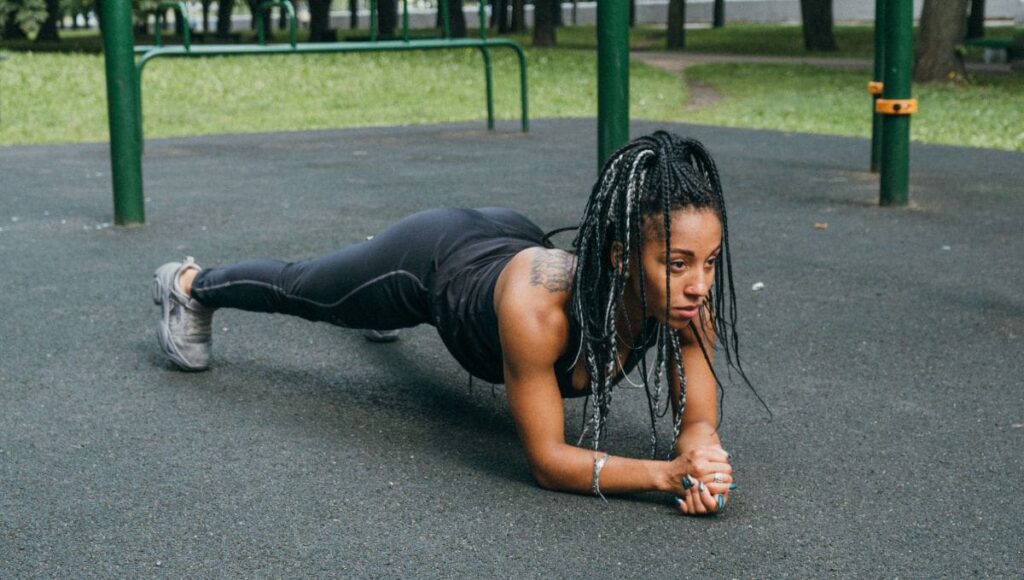
Standard Plank
The standard plank is a fundamental isometric core exercise. To perform it, maintain a neutral spine while supporting your body on your forearms and toes. Studies indicate that holding a plank for longer durations increases core endurance, which translates to improved athletic performance(Kavcic et al., 2004).
Side Plank
The side plank primarily targets the obliques and transverse abdominis. Research by Ekstrom et al.(2007) demonstrated that the side plank elicits high levels of muscle activation in the lateral core muscles, making it superior to traditional side bends.
RKC Plank
The Russian Kettlebell Challenge(RKC) plank is an advanced version of the standard plank that maximises core engagement by increasing full-body tension. A study by Maeo et al.(2014) found that increasing muscle tension during isometric holds can significantly enhance muscle activation and endurance.
Hollow Body Hold
The hollow body hold is one of the most effective isometric exercises for targeting the rectus abdominis and deep core muscles. Research suggests that gymnasts, who frequently utilise the hollow hold, exhibit superior core strength and control compared to athletes from other sports(Kolar et al., 2010).
L-Sit
The L-sit is an advanced isometric hold that engages the entire core while also recruiting the hip flexors. A study by Beach et al.(2008) found that exercises involving hip flexion and isometric contraction improve lower abdominal strength and endurance more effectively than crunches.
Dead Hang
Hanging from a pull-up bar while maintaining core tension strengthens the abdominals and improves grip strength. Research has shown that dead hangs enhance shoulder stability while also increasing core activation when performed with an active brace(Wirth et al., 2016).
How to Implement Isometric Holds for Maximum Ab Development
Optimal Duration and Frequency
Studies indicate that holding an isometric exercise for 20–60 seconds per set maximises core activation(Ma et al., 2014). A protocol of 3–5 sets per exercise, 3–4 times per week, is ideal for ab development and overall core endurance.
Progressive Overload in Isometric Training
To build muscle using isometric holds, progressive overload is essential. Methods to apply progressive overload include increasing hold duration, adding external resistance(weighted planks, weighted L-sits), or modifying leverage(elevating feet in a plank, extending arms in a hollow hold).
Combining Isometric Holds with Other Training
While isometric holds effectively build core strength, they should be complemented with dynamic core movements for balanced development. Research by Comfort et al.(2011) suggests that integrating both isometric and dynamic exercises leads to superior functional strength adaptations.
The Role of Breathing in Isometric Core Training
Proper breathing enhances isometric performance by preventing unnecessary tension in non-target muscles. Research shows that diaphragmatic breathing increases intra-abdominal pressure, leading to improved spinal stability and core strength(Chaitow et al., 2004).
Conclusion
Building abs using only isometric holds is not only effective but also scientifically supported. The sustained muscle engagement, high activation levels, and core stabilisation benefits make isometric holds superior for ab development. Incorporating progressive overload, correct breathing, and optimal frequency ensures maximal results while reducing injury risk.
Key Takeaways
| Topic | Key Points |
|---|---|
| Isometric Holds | Static exercises that build core strength and endurance |
| Muscle Activation | More engagement than traditional ab exercises(Schoenfeld et al., 2015) |
| Best Exercises | Plank variations, Hollow Body Hold, L-Sit, Dead Hang |
| Optimal Training | 20–60 sec per set, 3–5 sets per exercise, 3–4 times per week |
| Progressive Overload | Increase hold duration, resistance, or leverage |
| Breathing | Diaphragmatic breathing enhances performance and stability |
References
Beach, T.A., Parkinson, R.J., Stothart, J.P., & Callaghan, J.P. (2008). Effects of prolonged sitting on the passive stiffness of the in vivo lumbar spine. The Spine Journal, 8(2), 147-152.
Ekstrom, R.A., Donatelli, R.A., & Carp, K.C. (2007). Electromyographic analysis of core trunk, hip, and thigh muscles during 9 rehabilitation exercises. Physical Therapy in Sport, 8(1), 20-30.
Hibbs, A.E., Thompson, K.G., French, D., Wrigley, A., & Spears, I. (2008). Optimizing performance by improving core stability and strength. Sports Medicine, 38(12), 995-1008.
Israel, R.G., Jackson, A.W., & McBride, J.M. (2010). Isometric training effects on the strength and power of trained athletes. European Journal of Applied Physiology, 108(6), 1163-1170.