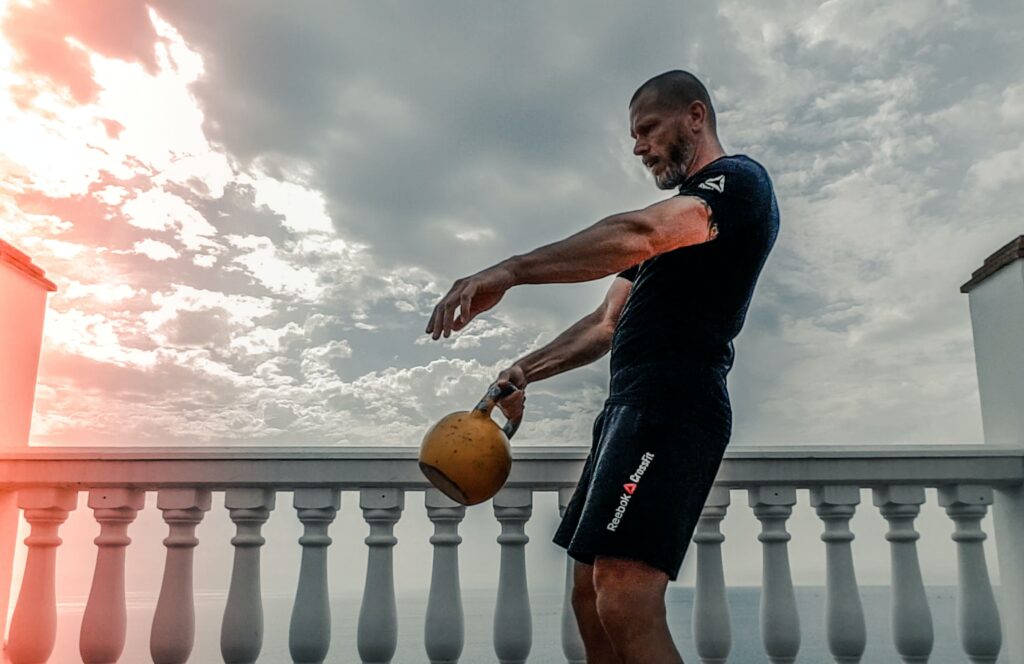
Kettlebells are often associated with full-body conditioning and ballistic movements, but they are also an excellent tool for chest development. Unlike dumbbells and barbells, kettlebells create a unique loading pattern due to their offset centre of mass, which increases muscular stabilisation and neuromuscular coordination.
Research has shown that instability training with free weights can enhance muscle activation (Behm & Anderson, 2006). This makes kettlebells an effective way to develop pressing power, stability, and hypertrophy in the chest.


1. Kettlebell Floor Press
How It Works
The kettlebell floor press is a variation of the traditional bench press that allows for increased stability and control. By limiting the range of motion, it emphasises the lockout portion of the lift, targeting the triceps and upper chest. The unilateral nature of the movement also helps to correct muscular imbalances.
Execution
- Lie on your back with a kettlebell in one hand, positioned near your shoulder.
- Keep your elbow at a 45-degree angle and press the kettlebell straight up until your arm is fully extended.
- Slowly lower the weight until your elbow touches the ground.
- Perform all reps on one side before switching to the other.
Scientific Insight
A study by Saeterbakken & Fimland (2013) found that unilateral pressing exercises increase core and shoulder stabilisation, which contributes to improved muscle engagement and reduces injury risk.
2. Kettlebell Crush Press
How It Works
The kettlebell crush press is a variation that enhances chest contraction through isometric tension. By squeezing the kettlebell between both hands, you engage the pectoral muscles throughout the entire movement.
Execution
- Hold a kettlebell by its sides, pressing both hands firmly against the handles.
- Position the kettlebell at chest level and press it straight forward.
- Pause at full extension while maintaining pressure on the kettlebell.
- Slowly return to the starting position.
Scientific Insight
Research suggests that squeezing an object while pressing increases pectoral activation due to increased neuromuscular drive (Calatayud et al., 2015). This makes the crush press an effective method for enhancing chest hypertrophy.
3. Kettlebell Archer Push-Up
How It Works
The kettlebell archer push-up is a dynamic movement that increases time under tension for the chest while improving unilateral strength and stability.
Execution
- Assume a push-up position with one hand on the floor and the other gripping a kettlebell handle.
- Lower yourself toward the ground, shifting more weight to the kettlebell side.
- Press back up while maintaining control and repeat on the other side.
Scientific Insight
A study by Youdas et al. (2010) demonstrated that elevated hand positions in push-ups can alter muscle activation patterns, leading to increased chest engagement. The archer push-up allows for a deep stretch and greater pectoral activation.
4. Kettlebell Fly
How It Works
The kettlebell fly provides an intense stretch and contraction of the chest, mimicking the dumbbell fly but with greater stability demands due to the offset weight distribution.
Execution
- Lie on the ground or a bench, holding a kettlebell in each hand.
- Start with your arms extended and lower the kettlebells in a controlled arc.
- Stop when your arms are parallel to the ground and return to the starting position.
Scientific Insight
Butterfield et al. (2005) found that eccentric loading, such as in the lowering phase of a fly, enhances muscle damage and hypertrophic response. Kettlebells increase this effect by forcing greater stabilisation.
5. Kettlebell Incline Press
How It Works
The kettlebell incline press targets the upper chest, a crucial area for a well-developed pectoral structure. Performing this movement with kettlebells enhances scapular stability and control.
Execution
- Lie on an inclined surface holding kettlebells in each hand.
- Press the weights upward while keeping control of the kettlebells’ movement.
- Lower them back down in a slow, controlled manner.
Scientific Insight
Incline pressing has been shown to increase upper chest activation compared to flat pressing (Trebs et al., 2010). The instability of kettlebells further enhances this effect by engaging stabilising muscles.
Key Takeaways
| Exercise | Primary Benefit |
|---|---|
| Kettlebell Floor Press | Enhances stability and corrects imbalances |
| Kettlebell Crush Press | Increases chest activation through isometric tension |
| Kettlebell Archer Push-Up | Improves unilateral strength and stability |
| Kettlebell Fly | Provides deep muscle stretch and contraction |
| Kettlebell Incline Press | Targets the upper chest for balanced development |