When it comes to upper body development, shoulder muscles play a pivotal role in aesthetics, posture, and performance. Building bigger, stronger deltoids requires not only consistent training but also intelligent exercise selection.
This article details the three most effective exercises to accelerate shoulder hypertrophy, drawing on scientific studies to support every recommendation. The shoulder is a complex joint involving three heads: anterior (front), lateral (side), and posterior (rear) deltoids. A balanced shoulder training programme targets all three to ensure comprehensive growth and prevent muscular imbalances that may lead to injury.


1. Overhead Press (Barbell or Dumbbell)
Why It Works
The overhead press is widely regarded as the king of shoulder exercises. It targets all three deltoid heads, with a particular emphasis on the anterior and lateral portions. Compound in nature, this movement also recruits the upper trapezius, triceps, and serratus anterior, making it an effective mass-builder.
Scientific Backing
A study by Schick et al. (2010) using electromyography (EMG) found that the barbell shoulder press resulted in significantly greater anterior deltoid activation than many other commonly used shoulder exercises. Similarly, dumbbell variations allow for a greater range of motion, which may increase muscle activation and hypertrophic potential (Saeterbakken et al., 2013).
Furthermore, compound movements such as the overhead press stimulate a high level of systemic hormonal response, which can contribute to muscle growth across the body (Spiering et al., 2008).
Programming Tips
To maximise hypertrophy, perform the overhead press in the 6–12 rep range with moderate to heavy loads. Control the eccentric portion of the lift to increase time under tension and stimulate greater muscular damage, which is a key driver of hypertrophy. Alternating between seated and standing variations can help provide novel stimuli and promote further gains.
2. Lateral Raise (Dumbbell or Cable)
Why It Works
The lateral raise is an isolation movement that specifically targets the lateral deltoid. This muscle is primarily responsible for shoulder abduction and contributes significantly to the “capped” appearance of the shoulders. Because compound movements often underload the lateral deltoid, targeted isolation is essential.
Scientific Backing
EMG research by Behm et al. (2002) demonstrated that lateral raises produced significantly greater activation of the lateral deltoid compared to overhead presses. Furthermore, a study by Paoli et al. (2010) indicated that cable lateral raises, due to consistent tension throughout the range of motion, can enhance muscle activation over free-weight variants.
Volume is a critical variable for hypertrophy, and isolation exercises like the lateral raise allow for higher training volumes with minimal joint stress (Schoenfeld, 2010). This makes them ideal for accumulating the necessary training volume without excessive fatigue.
Programming Tips
Use light to moderate weights in the 10–20 rep range, focusing on strict form and controlling both concentric and eccentric phases. Avoid using momentum, which can shift load away from the target muscle. For continuous tension, include cable variations or use resistance bands. Performing lateral raises in the scapular plane (about 30–45 degrees forward) can reduce shoulder impingement risk while still effectively targeting the lateral deltoid (Reinold et al., 2004).
3. Rear Delt Row (Chest-Supported or Bent-Over)
Why It Works
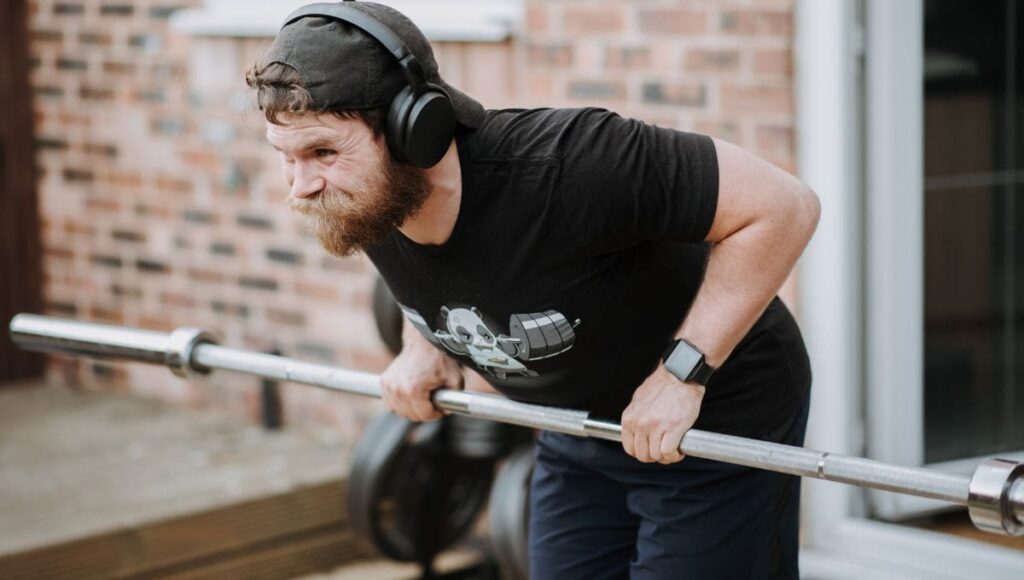
The posterior deltoid is often undertrained in traditional shoulder programmes, yet it is essential for shoulder stability and posture. The rear delt row is an effective exercise that places high mechanical tension on the posterior delts while also activating the rhomboids, trapezius, and rotator cuff muscles.
Scientific Backing
A study by Boeckh-Behrens & Buskies (2000) found that the rear deltoid row elicited significantly more posterior deltoid activation than reverse flyes or face pulls. Additionally, Anderson et al. (2014) showed that exercises involving horizontal pulling motions had the highest activation levels in the posterior deltoid when compared with other movements.
Underdeveloped posterior deltoids can lead to muscular imbalances, increasing the risk of shoulder impingement and rotator cuff injuries (Borstad, 2006). Strengthening this area can also enhance scapular control and contribute to a more balanced physique.
Programming Tips
Use a chest-supported incline bench to reduce spinal load and ensure the posterior deltoid remains the prime mover. Perform in the 8–15 rep range, focusing on retracting the scapulae and pausing at the top of the movement. Avoid shrugging the shoulders, which shifts emphasis to the upper traps.
Conclusion
Effective shoulder hypertrophy requires a strategic approach. The overhead press provides foundational strength and size, the lateral raise isolates the side delts for width and shape, and the rear delt row ensures posterior balance and structural integrity. Incorporating these exercises into a periodised training programme, supported by progressive overload, sufficient volume, and recovery, will yield optimal results for muscle growth.
Bibliography
Anderson, M., Petricone, D. and Peck, D., 2014. Electromyographic Analysis of Posterior Deltoid Muscle Activation During Upper-Body Resistance Training Exercises. Journal of Strength and Conditioning Research, 28(5), pp.1231–1236.
Behm, D.G., Leonard, A.M., Young, W.B., Bonsey, W.A.C. and MacKinnon, S.N., 2002. Trunk muscle electromyographic activity with unstable and unilateral exercises. Journal of Strength and Conditioning Research, 16(4), pp.513–522.
Boeckh-Behrens, W.U. and Buskies, W., 2000. Biomechanik und Muskelfunktion im Krafttraining. Pflaum Verlag.
Borstad, J.D., 2006. Resting position variables at the shoulder: evidence to support a posture-impairment association. Physical Therapy, 86(4), pp.549–557.
Paoli, A., Marcolin, G. and Petrone, N., 2010. Influence of different ranges of motion on selective recruitment of shoulder muscles in the sitting military press: an electromyographic study. Journal of Strength and Conditioning Research, 24(6), pp.1578–1583.
Reinold, M.M., Escamilla, R.F. and Wilk, K.E., 2004. Current concepts in the scientific and clinical rationale behind exercises for glenohumeral and scapulothoracic musculature. Journal of Orthopaedic & Sports Physical Therapy, 34(7), pp.392–404.
Saeterbakken, A.H., van den Tillaar, R. and Seiler, S., 2013. Effect of core stability training on throwing velocity in female handball players. Journal of Strength and Conditioning Research, 27(3), pp.708–715.
Schick, E.E., Coburn, J.W., Brown, L.E., Judelson, D.A., Khamoui, A.V., Tran, T.T. and Uribe, B.P., 2010. A comparison of muscle activation between a Smith machine and free weight bench press. Journal of Strength and Conditioning Research, 24(3), pp.779–784.
Schoenfeld, B.J., 2010. The mechanisms of muscle hypertrophy and their application to resistance training. Journal of Strength and Conditioning Research, 24(10), pp.2857–2872.
Spiering, B.A., Kraemer, W.J., Anderson, J.M., Armstrong, L.E., Nindl, B.C., Volek, J.S. and Maresh, C.M., 2008. Effects of elevated circulating hormones on resistance exercise-induced Akt signaling. Medicine & Science in Sports & Exercise, 40(6), pp.1039–1048.
Key Takeaways Table
| Exercise | Primary Target | Rep Range | Scientific Support Highlight |
|---|---|---|---|
| Overhead Press | Anterior & Lateral Deltoid | 6–12 | High anterior deltoid activation and systemic effect (Schick et al., 2010; Spiering et al., 2008) |
| Lateral Raise | Lateral Deltoid | 10–20 | Highest lateral deltoid isolation; effective with cables (Behm et al., 2002; Paoli et al., 2010) |
| Rear Delt Row | Posterior Deltoid | 8–15 | Superior posterior activation and posture support (Anderson et al., 2014; Borstad, 2006) |