Building an aesthetic and proportional upper body requires a structured and scientifically backed training approach. This involves strategic programming that ensures all muscle groups are developed symmetrically while optimising for hypertrophy, strength, and injury prevention.
The upper body comprises several major muscle groups, including the pectorals, deltoids, trapezius, latissimus dorsi, rhomboids, biceps, and triceps. A well-designed workout split ensures balanced development, preventing muscle imbalances that can lead to poor posture and an asymmetrical physique.


The Science of Training Frequency and Volume
Research suggests that training a muscle group at least twice per week is superior for hypertrophy compared to once per week (Schoenfeld et al., 2016).
Additionally, volume, defined as the total number of sets and reps performed, plays a critical role in muscle growth. A meta-analysis concluded that performing 10+ sets per muscle group per week leads to significantly greater hypertrophy compared to lower volumes (Schoenfeld, Ogborn & Krieger, 2017).
The Optimal Upper Body Workout Split
1. Push/Pull Upper Body Split
One of the most effective ways to train for an aesthetic and proportional upper body is to divide workouts into push and pull movements.
Day 1: Upper Body Push (Chest, Shoulders, Triceps)
1. Flat Barbell Bench Press – 4 sets of 6-8 reps 2. Overhead Barbell Press – 3 sets of 8-10 reps 3. Incline Dumbbell Press – 3 sets of 10-12 reps 4. Dips (Weighted if possible) – 3 sets of 10-12 reps 5. Lateral Raises – 3 sets of 12-15 reps 6. Triceps Rope Pushdown – 3 sets of 12-15 reps
Day 2: Upper Body Pull (Back, Biceps, Rear Delts, Traps)
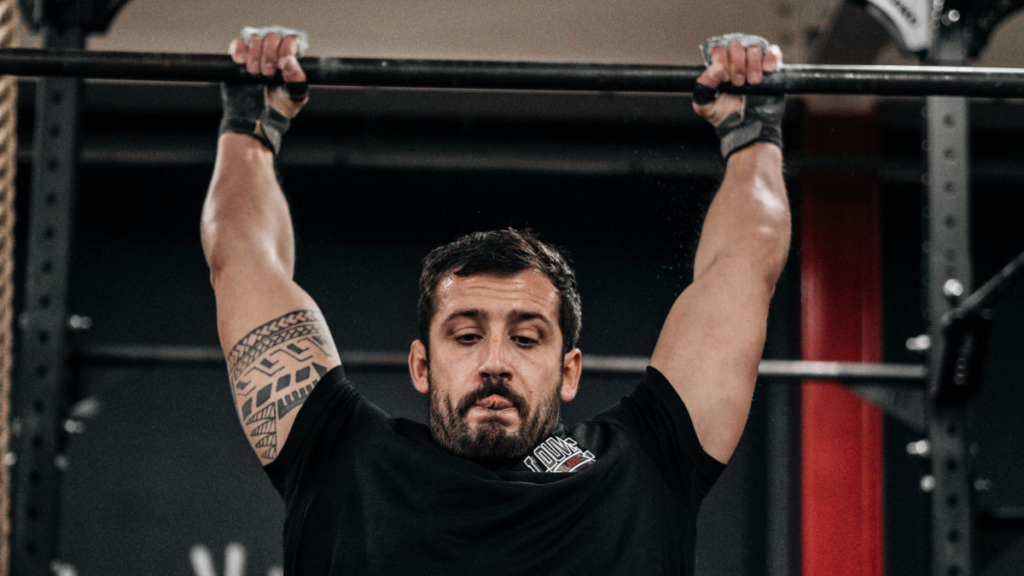
1. Weighted Pull-Ups – 4 sets of 6-8 reps 2. Barbell Row – 4 sets of 8-10 reps 3. Face Pulls – 3 sets of 12-15 reps 4. Lat Pulldown – 3 sets of 10-12 reps 5. Dumbbell Shrugs – 3 sets of 12-15 reps 6. Barbell or Dumbbell Curls – 3 sets of 12-15 reps
A push/pull split ensures muscles are trained at an optimal frequency while allowing sufficient recovery time. It also reduces overlap fatigue, meaning pushing and pulling muscles are trained fresh, maximising performance and hypertrophy (Schoenfeld, 2020).

2. Upper/Lower Body Split
Another highly effective method is an upper/lower body split, training the upper body twice per week while dedicating two additional sessions to the lower body.
Day 1: Upper Body Strength Focus
1. Flat Barbell Bench Press – 5 sets of 4-6 reps 2. Weighted Pull-Ups – 4 sets of 6-8 reps 3. Overhead Barbell Press – 3 sets of 8-10 reps 4. Barbell Row – 3 sets of 8-10 reps 5. Triceps Dips – 3 sets of 10-12 reps 6. Barbell Curls – 3 sets of 12-15 reps
Day 3: Upper Body Hypertrophy Focus
1. Incline Dumbbell Press – 4 sets of 8-12 reps 2. Lat Pulldown – 3 sets of 10-12 reps 3. Arnold Press – 3 sets of 10-12 reps 4. Dumbbell Rows – 3 sets of 10-12 reps 5. Face Pulls – 3 sets of 12-15 reps 6. Hammer Curls – 3 sets of 12-15 reps
This split effectively targets both strength and hypertrophy adaptations by varying rep ranges and intensity across sessions (Dankel et al., 2016).
Exercise Selection and Symmetry
Muscle imbalances can be prevented by incorporating unilateral exercises. Studies have shown that unilateral training helps correct strength discrepancies and improve motor control (Behm et al., 2010). Including single-arm dumbbell presses, unilateral rows, and single-arm lateral raises ensures a balanced physique.
Progressive Overload and Recovery
Progressive overload—gradually increasing the weight, reps, or sets—is crucial for continued muscle growth (Schoenfeld, 2010). However, adequate recovery, including proper sleep and nutrition, is equally important. Research has shown that muscle protein synthesis remains elevated for up to 48 hours post-training, highlighting the need for rest before retraining a muscle group (MacDougall et al., 1995).

Nutrition for Aesthetic Upper Body Development
Muscle growth depends not just on training but also on nutrition. Studies indicate that consuming 1.6-2.2g of protein per kg of body weight optimises muscle growth (Morton et al., 2018). A combination of lean protein, complex carbohydrates, and healthy fats supports hypertrophy and recovery.
Conclusion
A scientifically backed workout split focusing on balanced push-pull movements or an upper/lower split ensures an aesthetic and proportional upper body. By optimising training frequency, incorporating progressive overload, and ensuring proper recovery, significant improvements in muscle size and symmetry can be achieved.
Key Takeaways
| Key Point | Summary |
|---|---|
| Training Frequency | Train each upper body muscle group at least twice per week for optimal hypertrophy. |
| Workout Split | Use a push/pull split or upper/lower split to ensure balanced muscle development. |
| Exercise Selection | Incorporate both bilateral and unilateral exercises to prevent imbalances. |
| Progressive Overload | Increase weight, reps, or sets progressively for continued muscle growth. |
| Recovery | Allow at least 48 hours before retraining a muscle group to maximise muscle protein synthesis. |
| Nutrition | Consume 1.6-2.2g of protein per kg of body weight to support hypertrophy. |
Bibliography
- Behm, D.G., Drinkwater, E.J., Willardson, J.M. and Cowley, P.M. (2010). The use of instability to train the core musculature. Strength & Conditioning Journal, 32(3), pp.43-47.
- Dankel, S.J., Loenneke, J.P., Counts, B.R., Jessee, M.B., Mattocks, K.T. and Mouser, J.G. (2016). The effects of varying resistance training frequency on muscle size and strength. European Journal of Applied Physiology, 116(11-12), pp.2421-2429.
- MacDougall, J.D., Gibala, M.J., Tarnopolsky, M.A., MacDonald, J.R., Interisano, S.A. and Yarasheski, K.E. (1995). The time course for elevated muscle protein synthesis following heavy resistance exercise. Canadian Journal of Applied Physiology, 20(4), pp.480-486.
- Morton, R.W., Murphy, K.T., McKellar, S.R., Schoenfeld, B.J., Henselmans, M., Helms, E., Aragon, A.A. and Phillips, S.M. (2018). A systematic review, meta-analysis and meta-regression of the effect of protein intake on resistance training-induced gains in muscle mass and strength. British Journal of Sports Medicine, 52(6), pp.376-384.
- Schoenfeld, B.J. (2010). The mechanisms of muscle hypertrophy and their application to resistance training. Journal of Strength and Conditioning Research, 24(10), pp.2857-2872.
- Schoenfeld, B.J., Ogborn, D. and Krieger, J.W. (2017). Dose-response relationship between weekly resistance training volume and increases in muscle mass: a systematic review and meta-analysis. Journal of Sports Sciences, 35(11), pp.1073-1082.