Building strength doesn’t require a gym membership, a barbell, or even a home squat rack. A minimalist approach, grounded in science and simplicity, can yield impressive strength gains using bodyweight exercises, basic equipment, and smart programming.
This method is particularly valuable for athletes, busy professionals, and those training at home who want efficient and effective results without complexity. This article outlines the evidence-based minimalist method to building strength without barbells.


Defining Strength in the Minimalist Context
Strength, in its most basic sense, is the capacity of the neuromuscular system to produce force. In the minimalist method, we focus on relative strength—the ability to generate maximal force relative to bodyweight—rather than absolute strength, which is typically associated with heavy barbell lifts. Relative strength is particularly relevant for bodyweight-dominant sports such as gymnastics, climbing, calisthenics, and martial arts.

The foundational principle of strength development remains consistent across modalities: progressive overload. Regardless of whether you use external loads or bodyweight, your muscles need to experience increased tension over time to adapt and grow stronger.
Core Tenets of the Minimalist Method

1. Progressive Overload Without Weights
Progressive overload in a minimalist context involves manipulating variables such as leverage, volume, time under tension, and exercise complexity. For instance, transitioning from a standard push-up to a one-arm push-up significantly increases load on the working limb, demanding greater force production. Similarly, elevating the feet or slowing down the eccentric phase increases time under tension, stimulating further adaptation.
Studies support this approach. Calatayud et al. (2015) found that push-ups can activate the pectoralis major and triceps brachii to a degree comparable to bench press when load is adjusted via added resistance or exercise progression.
2. Mastery of Foundational Movement Patterns
Minimalist strength training focuses on the five primary movement patterns: push, pull, hinge, squat, and core stabilisation. Bodyweight and minimal-equipment variations of these movements develop full-body strength:
- Push: push-ups, pike push-ups, handstand push-ups
- Pull: inverted rows, pull-ups, towel rows
- Hinge: hip thrusts, single-leg glute bridges
- Squat: split squats, pistol squats, shrimp squats
- Core: hollow holds, L-sits, planks
By progressing each of these patterns, a trainee can build balanced strength. For example, pistol squats not only develop leg strength but also challenge core stability, ankle mobility, and balance.
3. Utilising Simple Tools
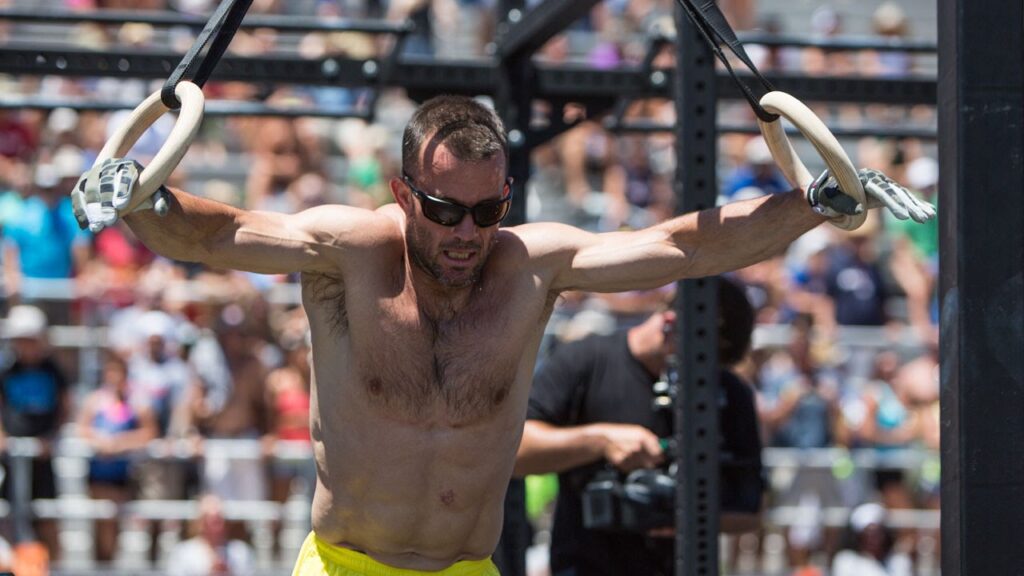
Resistance bands, gymnastic rings, and a pull-up bar can dramatically expand the range of minimalist training. Rings, in particular, increase instability, activating more muscle fibres. A study by Gulmez et al. (2016) demonstrated significantly higher activation of the pectoralis and deltoid muscles during ring push-ups compared to stable surface push-ups.

Resistance bands are effective in adjusting difficulty without changing form. A 2018 review by Lopes et al. concluded that elastic resistance training provides similar strength gains to conventional resistance training, making it suitable for minimalist applications.
Scientific Foundations for Strength Gains Without Barbells
Neuromuscular Adaptations
Strength gains are initially driven by neural adaptations, including improved motor unit recruitment, firing rates, and coordination. These improvements can occur without significant changes in muscle size. Behm and Sale (1993) highlighted that early-stage strength gains are primarily neurological, which aligns with the effectiveness of bodyweight and low-load training for beginners.
Hypertrophy With Low Loads
Contrary to the belief that heavy loads are essential for muscle growth, multiple studies show that training to failure with low loads can induce hypertrophy. Schoenfeld et al. (2015) reported no significant difference in muscle growth between groups lifting heavy (8-12RM) and those using lighter loads (25-35RM), provided they trained to volitional fatigue.
This finding is critical for minimalist training. Exercises like Bulgarian split squats or handstand push-ups, taken close to failure, can stimulate both hypertrophy and strength, especially when progressively overloaded.
Eccentric Training
Eccentric (lengthening) contractions produce greater force and mechanical tension than concentric contractions. They are also more effective at inducing muscle hypertrophy. Bodyweight training can exploit this by emphasising slow eccentrics or using negative reps, such as slow descents in one-arm push-ups or pull-ups.
Proske and Morgan (2001) identified eccentric training as particularly effective for increasing muscle fascicle length and preventing injury. It is especially valuable when training without heavy equipment, as slowing down movement increases time under tension without added load.
Programming the Minimalist Method
Frequency and Volume
For strength, training each movement pattern 2-4 times per week is optimal. Volume should be sufficient to elicit adaptation without overtraining. A meta-analysis by Ralston et al. (2018) suggests that strength gains are maximised by multiple weekly sets per muscle group, ideally spread across several sessions.
Example weekly schedule:
- Day 1: Upper body push/pull (horizontal)
- Day 2: Lower body + core
- Day 3: Rest or mobility
- Day 4: Upper body push/pull (vertical)
- Day 5: Full body (compound movement focus)
Exercise Progressions
Progression is key. Here are sample progressions for key movements:
Push-up: Wall push-up > Incline push-up > Standard push-up > Diamond push-up > Archer push-up > One-arm push-up
Pull-up: Dead hang > Scapular pull-up > Band-assisted pull-up > Pull-up > Archer pull-up > One-arm pull-up
Squat: Box squat > Air squat > Split squat > Bulgarian split squat > Shrimp squat > Pistol squat
Core: Hollow hold > Tuck L-sit > L-sit > Hanging leg raise > Front lever
Progress slowly but consistently. Master each step before moving on to the next.
Intensity and Rest
In the absence of external load, intensity is regulated by proximity to failure and exercise difficulty. Aim for 2-3 sets of 5-15 reps, stopping 1-2 reps short of failure for most sets. For maximal strength efforts (e.g., one-arm push-up practice), rest intervals of 2-3 minutes are optimal (Henselmans & Schoenfeld, 2014).
Periodisation
Minimalist strength programmes benefit from undulating periodisation—alternating between phases of volume and intensity. For example, a three-week block of moderate reps (8-12) can be followed by two weeks of lower reps with more advanced progressions (3-6 reps). This approach helps avoid plateaus and supports continued adaptation (Williams et al., 2017).
Addressing Limitations of Minimalist Training
While the minimalist method is effective, it does come with limitations:
- Maximal load capacity: Beyond a point, increasing difficulty requires extreme progressions (e.g., one-arm pull-ups), which may not be practical for everyone.
- Lower body loading: The legs respond well to load. While exercises like pistol squats are effective, adding a weighted vest or using a resistance band may be necessary to continue progressing.
- Grip strength: Pull-up variations and hanging holds help, but barbell and kettlebell work still offer superior grip loading.
These limitations can be mitigated by strategic use of minimal equipment and smart programming.
Case Study: Strength Gains With Bodyweight Training
A study by Kikuchi and Nakazato (2017) compared push-ups with bench press over eight weeks. Both groups saw similar improvements in upper body strength and hypertrophy. This supports the notion that, when load is matched and exercises are taken close to failure, bodyweight training can be as effective as traditional lifting.
Another example is calisthenics athletes. A 2020 study by Silva-Grigoletto et al. found that calisthenics practitioners had similar strength endurance and body composition outcomes to those in traditional resistance training programmes.
Practical Application for Athletes and General Population
Athletes can use minimalist training during travel, off-seasons, or for deload weeks. It maintains neuromuscular readiness without high joint stress. For general population clients, it offers a sustainable, accessible path to strength without intimidation or complexity.
Emphasising control, full range of motion, and consistency ensures long-term success. Moreover, minimalist training encourages mindfulness and body awareness, which enhances motor control and reduces injury risk.
Bibliography
Behm, D.G. and Sale, D.G. (1993) ‘Velocity specificity of resistance training’, Sports Medicine, 15(6), pp. 374-388.
Calatayud, J., Borreani, S., Colado, J.C., Martin, F., Rogers, M.E. and Behm, D.G. (2015) ‘Bench press and push-up at comparable levels of muscle activity results in similar strength gains’, Journal of Strength and Conditioning Research, 29(1), pp. 246-253.
Gulmez, I., Yildiz, Y. and Uzun, M. (2016) ‘Comparison of muscle activation in traditional and suspension push-ups’, Isokinetics and Exercise Science, 24(2), pp. 141-147.
Henselmans, M. and Schoenfeld, B.J. (2014) ‘The effect of inter-set rest intervals on resistance exercise-induced muscle hypertrophy’, Sports Medicine, 44(12), pp. 1635-1643.
Kikuchi, N. and Nakazato, K. (2017) ‘Comparison of muscle hypertrophy following 6-month of traditional resistance training, bodyweight training and a combination of both’, Journal of Physical Fitness and Sports Medicine, 6(2), pp. 83-90.
Lopes, J., Machado, D., Junqueira, C., Vieira, T., Araújo, S. and Mota, J. (2018) ‘Effectiveness of resistance training with elastic bands on strength, body composition and functional fitness in older adults: a systematic review and meta-analysis’, Archives of Gerontology and Geriatrics, 79, pp. 103-115.
Proske, U. and Morgan, D.L. (2001) ‘Muscle damage from eccentric exercise: mechanism, mechanical signs, adaptation and clinical applications’, The Journal of Physiology, 537(2), pp. 333-345.
Ralston, G.W., Kilgore, L., Wyatt, F.B., Baker, J.S. and Keogh, J.W. (2018) ‘The effect of weekly set volume on strength gain: a meta-analysis’, Sports Medicine, 48(2), pp. 387-403.
Schoenfeld, B.J., Peterson, M.D., Ogborn, D., Contreras, B. and Sonmez, G.T. (2015) ‘Effects of low- vs. high-load resistance training on muscle strength and hypertrophy in well-trained men’, Journal of Strength and Conditioning Research, 29(10), pp. 2954-2963.
Silva-Grigoletto, M.E., Brito, C.J., Heredia, J.R., Martinez-Rodriguez, A. and Gomez-Alonso, C. (2020) ‘Effects of calisthenics training on muscle strength and body composition in healthy adults’, Journal of Human Kinetics, 75(1), pp. 123-132.
Williams, T.D., Tolusso, D.V., Fedewa, M.V. and Esco, M.R. (2017) ‘Comparison of periodized and non-periodized resistance training on maximal strength: a meta-analysis’, Sports Medicine, 47(10), pp. 2083-2100.