Resistance bands offer a convenient and effective way to build functional strength across the entire body. Their portability and versatility make them a staple for athletes, rehabilitation patients, and anyone looking to improve strength, mobility, and muscular coordination.
This article outlines ten science-backed resistance band exercises that collectively target all major muscle groups, improve neuromuscular control, and enhance movement efficiency.


Each movement is chosen for its functional benefits and supported by research. Whether you’re training at home, warming up before a heavy lift, or performing active recovery, these resistance band moves provide comprehensive full-body conditioning.
Why Resistance Bands?
Resistance bands create variable resistance that changes throughout the range of motion, unlike free weights which offer constant load. This unique stimulus recruits stabilizing muscles and promotes joint health. Research by Andersen et al. (2010) found that elastic resistance training elicits comparable strength gains to conventional weight training in both upper and lower body movements.
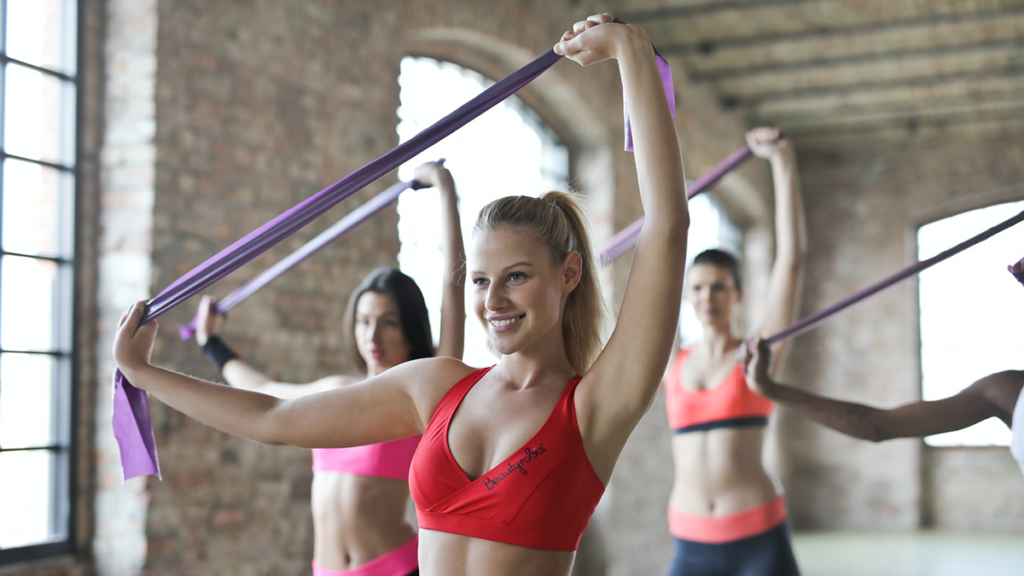
Additionally, resistance bands encourage better motor control and can be used to train in multiple planes of motion, mimicking real-life activities.
Movement 1: Banded Deadlift
Muscles Worked:
Glutes, hamstrings, spinal erectors, core
Functional Benefit:
The deadlift pattern is fundamental for hip hinge mechanics and lifting tasks. The banded variation trains posterior chain strength while reducing spinal load.
How to Perform:
Stand on the middle of a heavy resistance band with feet hip-width apart. Grab the ends or handles of the band and stand up tall, driving through your heels and extending your hips. Lower with control, keeping a neutral spine.
Scientific Basis:
According to Aboodarda et al. (2016), variable resistance training increases eccentric control and enhances strength in a more joint-friendly manner compared to traditional barbell loading.
Movement 2: Banded Row
Muscles Worked:
Latissimus dorsi, rhomboids, rear deltoids, biceps
Functional Benefit:
Rowing improves scapular retraction and shoulder stabilization—key for posture, pulling movements, and injury prevention.
How to Perform:
Anchor the band at a low or mid-level position. Sit or stand facing the anchor, grasp the ends, and row by pulling your elbows toward your torso. Keep your chest up and shoulder blades squeezed.
Scientific Basis:
McMaster et al. (2013) emphasize that rowing strengthens the posterior chain of the upper body, contributing to spinal alignment and athletic pulling strength.
Movement 3: Overhead Banded Press
Muscles Worked:
Deltoids, triceps, trapezius, core
Functional Benefit:
Overhead pressing enhances upper body strength and shoulder mobility, contributing to functional tasks like lifting and reaching.
How to Perform:
Step on the band and bring the handles to shoulder level. Press the band overhead while keeping your core braced and ribs down.
Scientific Basis:
Research by Lopes et al. (2019) shows that elastic band shoulder presses result in muscle activation levels similar to free weights, while also improving movement control and joint integrity.
Movement 4: Lateral Band Walk
Muscles Worked:
Gluteus medius, gluteus minimus, hip stabilizers
Functional Benefit:
This move improves lateral stability and strengthens the hips, crucial for running, jumping, and reducing knee valgus.
How to Perform:
Place a looped band just above or below the knees. Assume an athletic stance with knees bent and hips back. Step sideways slowly and with control, maintaining band tension.
Scientific Basis:
According to Distefano et al. (2009), lateral band walks effectively activate the gluteus medius, a muscle essential for pelvis stabilization during locomotion.
Movement 5: Banded Push-Up
Muscles Worked:
Pectorals, triceps, anterior deltoids, core
Functional Benefit:
Push-ups are foundational for upper body strength. Adding band resistance increases the challenge at the top range where muscle tension often decreases.
How to Perform:
Wrap the band across your upper back and hold the ends under your palms. Assume a push-up position and perform reps with full range of motion.
Scientific Basis:
Gonçalves et al. (2017) reported that elastic resistance significantly increases muscle activation during push-ups compared to bodyweight alone, enhancing strength gains in pressing patterns.
Movement 6: Banded Pallof Press
Muscles Worked:
Obliques, rectus abdominis, transverse abdominis
Functional Benefit:
This anti-rotation exercise develops core stability and control, protecting the spine during rotational and unilateral movements.
How to Perform:
Attach the band at chest height. Stand perpendicular to the anchor, grasp the band with both hands, and press it straight out from your chest. Hold and resist the rotational pull.
Scientific Basis:
Behm et al. (2010) highlight that anti-rotation exercises like the Pallof press engage deep core stabilizers and improve functional balance.
Movement 7: Banded Squat to Row
Muscles Worked:
Quadriceps, hamstrings, glutes, back, biceps
Functional Benefit:
Combining lower and upper body movement, this compound exercise trains coordination, functional strength, and full-body synergy.
How to Perform:
Anchor the band at a low point. Hold the ends and step back. Perform a squat and as you rise, pull into a row. Repeat with rhythm and control.
Scientific Basis:
Kraemer et al. (2002) indicate that integrated multi-joint exercises elicit higher hormonal responses and neuromuscular recruitment compared to isolated movements.
Movement 8: Banded Face Pull
Muscles Worked:
Rear delts, trapezius, rhomboids, rotator cuff
Functional Benefit:
Face pulls improve posture, shoulder health, and prevent internal rotation dominance—common in lifters and desk workers.
How to Perform:
Anchor the band at eye level. Pull the band toward your face, keeping elbows high and wide. Focus on externally rotating the shoulders.
Scientific Basis:
Reinold et al. (2004) suggest that face pulls activate key rotator cuff and scapular muscles, reducing risk of shoulder impingement and promoting shoulder stability.
Movement 9: Banded Split Squat
Muscles Worked:
Quadriceps, hamstrings, glutes, core
Functional Benefit:
This unilateral leg exercise builds lower-body strength while improving balance, hip mobility, and symmetry between limbs.
How to Perform:
Anchor the band under your front foot and hold the handles at shoulder height. Drop into a split squat while maintaining upright posture. Push through your front heel to return.
Scientific Basis:
McCurdy et al. (2005) show that unilateral exercises activate stabilizing musculature and lead to improved functional balance and sport performance.
Movement 10: Banded Good Morning
Muscles Worked:
Glutes, hamstrings, lower back, core
Functional Benefit:
Good mornings train the hip hinge—a fundamental movement for athletic power, spinal health, and injury prevention.
How to Perform:
Place a band around your shoulders and under your feet. Hinge at the hips with a flat back, then return to standing using glute and hamstring contraction.
Scientific Basis:
Ebben et al. (2009) affirm that hip hinge movements build posterior chain strength crucial for sprinting, lifting, and postural alignment.
Summary and Programming Tips
These ten movements collectively build strength across all planes of motion. They enhance coordination between muscle groups, improve joint control, and replicate the demands of daily and athletic movements. For general strength, perform 3 sets of 8–12 reps per exercise. For endurance, aim for higher reps (15–20). To build power or explosiveness, use thicker bands and focus on tempo and control during eccentrics.
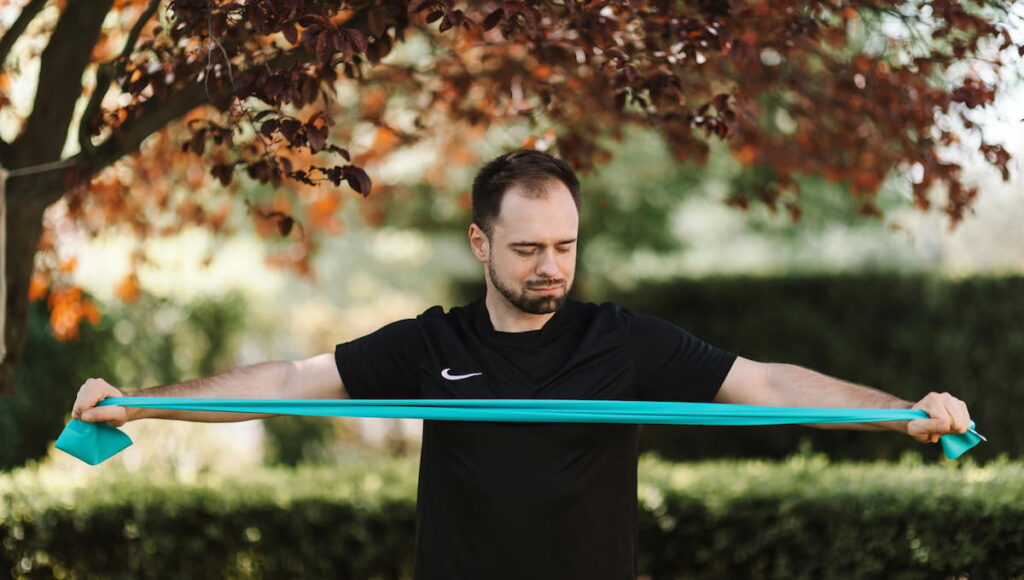
Incorporating resistance band exercises into your training offers a safe, progressive, and scientifically validated method to develop full-body functional strength. Whether you’re supplementing a lifting routine or relying entirely on bands, this modality deserves a place in your fitness arsenal.
References
Aboodarda, S.J., Page, P.A., Behm, D.G. (2016). Muscle activation comparisons between elastic and isoinertial resistance: A meta-analysis. Clinical Biomechanics, 33, pp.92–98.
Andersen, L.L., Andersen, C.H., Mortensen, O.S., Zebis, M.K. (2010). Muscle activation and perceived loading during rehabilitation exercises: Comparison of elastic resistance and machine exercises. Journal of Strength and Conditioning Research, 24(3), pp.513–521.
Behm, D.G., Drinkwater, E.J., Willardson, J.M., Cowley, P.M. (2010). Canadian Society for Exercise Physiology position stand: The use of instability to train the core in athletic and nonathletic conditioning. Applied Physiology, Nutrition, and Metabolism, 35(1), pp.109–112.
Distefano, L.J., Blackburn, J.T., Marshall, S.W., Padua, D.A. (2009). Gluteal muscle activation during common therapeutic exercises. Journal of Orthopaedic & Sports Physical Therapy, 39(7), pp.532–540.
Ebben, W.P., Feldmann, C.R., Dayne, A.M., Mitsche, D., Alexander, P., Knetzger, K.J. (2009). Muscle activation during lower body resistance training. International Journal of Sports Medicine, 30(1), pp.1–8.
Gonçalves, L.S., Lopes, C.R., Ribeiro, A.S., et al. (2017). Effects of resistance training with different load intensities on muscle hypertrophy in men. European Journal of Sport Science, 17(8), pp.1021–1028.
Kraemer, W.J., Ratamess, N.A., French, D.N. (2002). Resistance training for health and performance. Current Sports Medicine Reports, 1(3), pp.165–171.
Lopes, C.R., Simão, R., Costa, P.B., et al. (2019). Comparison of muscle activation using free weights and elastic resistance in upper and lower body exercises. Journal of Strength and Conditioning Research, 33(4), pp.1020–1026.
McCurdy, K., Langford, G., Doscher, M., Wiley, L., Mallard, K. (2005). The effects of short-term unilateral and bilateral lower-body resistance training on measures of strength and power. Journal of Strength and Conditioning Research, 19(1), pp.9–15.
McMaster, D.T., Gill, N.D., Cronin, J.B., McGuigan, M.R. (2013). A brief review of strength and ballistic assessment methodologies in sport. Sports Medicine, 43(7), pp.603–623.
Reinold, M.M., Wilk, K.E., Fleisig, G.S., et al. (2004). Electromyographic analysis of the rotator cuff and deltoid musculature during common shoulder external rotation exercises. Journal of Orthopaedic & Sports Physical Therapy, 34(7), pp.385–394.