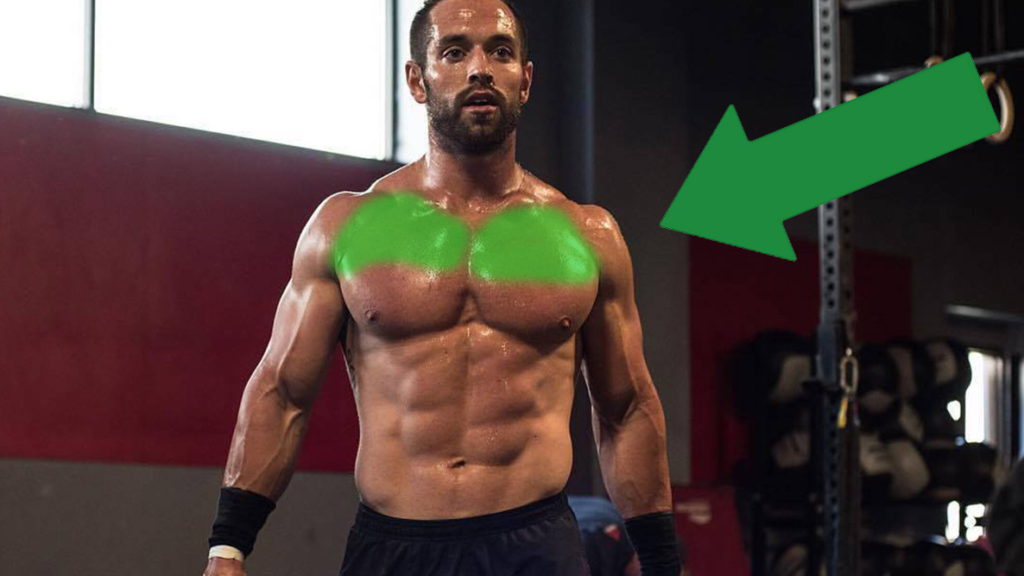
The chest is one of the most aesthetically prominent muscle groups and a cornerstone of upper body strength. Building a chiseled chest goes beyond bench presses and dumbbell flyes; it requires training the pectoral muscles through a wide range of motion, with varied resistance and stability challenges.
Gymnastic rings offer a uniquely powerful tool in this quest. They activate more muscle fibers, increase joint stability, and foster superior neuromuscular control, especially in the chest region. In this article, we’ll explore three scientifically grounded methods for using gymnastic rings to sculpt a powerful and well-defined chest.


Why Gymnastic Rings Work for Chest Development
Enhanced Muscle Activation
Rings require stabilization in three dimensions, which significantly increases muscle recruitment. A study published in the Journal of Strength and Conditioning Research (2007) compared electromyographic (EMG) activity in push-up variations and found that instability increased muscle activation in the pectoralis major, deltoids, and triceps. When the hands are not fixed, as with gymnastic rings, the pectoral muscles must work harder to maintain balance and control.
Greater Range of Motion
Gymnastic rings allow for a deeper stretch at the bottom of pushing movements and a more forceful contraction at the top. This longer range of motion engages more muscle fibers and can lead to greater hypertrophy. Schoenfeld (2010) noted that exercises employing a full range of motion produce superior muscle growth compared to partial range exercises.
Functional and Athletic Carryover
Training on rings doesn’t just build mass; it also builds functional strength and joint integrity. Because of the dynamic and unstable environment, the nervous system must work in concert with muscular systems, enhancing coordination and stability, particularly in the shoulder girdle and chest.
Method 1: Ring Push-Ups and Their Variations
Standard Ring Push-Ups
Standard ring push-ups are an entry-level but effective movement that targets the pectorals while engaging stabilizer muscles. Set the rings just above the ground. Get into a plank position with hands on the rings and lower your body slowly, letting your elbows flare slightly to activate the pecs. Push back up to full extension while keeping your body in a straight line.
Scientific Rationale: In unstable conditions like those provided by rings, pectoral activation is significantly increased. A 2011 study by Saeterbakken and Fimland showed that unstable surface push-ups led to greater activation of the pectoralis major compared to traditional push-ups.
Archer Ring Push-Ups
This variation emphasizes unilateral pectoral development. Perform a standard push-up but extend one arm out to the side, keeping the other bent. Alternate sides with each rep. This variation allows for greater time under tension and isolates each side of the chest.
Ring Flyes
Ring flyes are a powerful movement for inner chest development. Start in a ring push-up position, then slowly open your arms outward while keeping a slight bend in the elbows, mimicking a dumbbell fly. Bring your hands back together using your chest muscles.
Scientific Rationale: Fly-type movements are known for activating the sternal head of the pectoralis major. A study by Clemons and Aaron (1997) highlighted that flyes, due to their stretch and contraction cycle, are superior for hypertrophy of the inner chest compared to presses.
Tempo Ring Push-Ups
In this variation, the downward and upward phases of the push-up are slowed down (e.g., 3 seconds down, 2 seconds hold at the bottom, 1 second up). This increases time under tension and enhances muscular hypertrophy.
Scientific Rationale: Schoenfeld et al. (2015) emphasized the hypertrophic benefit of increased time under tension, especially during eccentric contractions, which create greater muscle microtrauma and lead to more significant gains.
Method 2: Ring Dips and Chest-Focused Adjustments
Standard Ring Dips
Ring dips are a compound movement that strongly targets the lower portion of the pectorals. Start with your arms locked at the top. Lower your body by bending your elbows and allowing your torso to lean slightly forward. Push back up to the starting position.
Scientific Rationale: The leaning position during dips increases the angle of shoulder flexion, placing greater stress on the lower chest. This has been corroborated by studies like that of Trebs et al. (2010), which analyzed muscle activation in various push movements.
Deep Ring Dips
To further increase muscle recruitment, dip deeper than a typical range, allowing the shoulder to drop below the elbows while maintaining control. This recruits more muscle fibers and enhances stretch-mediated hypertrophy.
Scientific Rationale: Stretch under load is a known hypertrophy stimulus. Schoenfeld (2010) reported that exercises emphasizing a loaded stretch produce enhanced mechanical tension, a primary driver of muscle growth.
Weighted Ring Dips
Adding weight via a dip belt or weighted vest increases resistance and overloads the pectoral muscles. This is particularly useful for more advanced athletes who have mastered bodyweight dips.
Scientific Rationale: Progressive overload is the cornerstone of hypertrophy. A study by Krieger (2010) demonstrated that higher loads, even in lower rep ranges, are effective for muscle growth when volume is equated.
Eccentric-Only Ring Dips
Use a step to jump to the top of the dip position, then slowly lower yourself over 5-8 seconds. This technique exploits the muscle’s ability to handle more weight eccentrically than concentrically.
Scientific Rationale: Eccentric overload has been shown to induce more muscle damage and subsequent hypertrophy compared to concentric-focused training (Roig et al., 2009).
Method 3: Isometric and Advanced Gymnastic Ring Techniques
Ring Support Holds
Holding yourself in the top of a dip position with arms locked and rings stable works the chest isometrically. Keep your shoulders depressed and chest pushed forward.
Scientific Rationale: Isometric contractions can significantly activate muscle fibers and improve joint stability. A study by Kubo et al. (2006) found that isometric training at specific joint angles increased muscle size and strength, especially when performed under high tension.
Ring Chest Flies (Extended Range)
Different from the earlier flye variation, this method uses a lowered starting position. Begin with the rings at hip height and feet on the ground, then extend your body into a horizontal flye. This increased range adds intensity and stretch.
Bulgarian Flye Push-Ups
A hybrid between flyes and push-ups, one ring performs a flye while the other performs a push-up. This challenges the pectorals differently on each side and increases neuromuscular adaptation.
Scientific Rationale: Asymmetrical loading and unilateral patterns have been shown to increase intermuscular coordination and improve proprioception, as seen in the findings of Behm and Anderson (2006).
Isometric Chest Squeezes on Rings
With rings set at chest height, press your hands together in a static squeeze and hold for 15-30 seconds. This builds mind-muscle connection and isolates the pectorals.
Scientific Rationale: Maximal voluntary isometric contractions can improve strength and neural recruitment. Folland and Williams (2007) demonstrated that isometric training could lead to significant gains in maximal voluntary strength.
Key Takeaways
| Concept | Summary |
|---|---|
| Muscle Activation | Rings increase pectoral recruitment due to instability |
| Range of Motion | Greater stretch and contraction enhances hypertrophy |
| Functional Strength | Rings improve coordination, joint integrity, and neuromuscular control |
| Push-Up Variations | Archer, tempo, and flye push-ups emphasize different areas of the chest |
| Dips and Overload | Weighted, eccentric, and deep dips provide progressive overload |
| Isometric Techniques | Ring holds and chest squeezes build strength and muscle control |
| Advanced Variations | Bulgarian flyes and extended flyes target the chest with new stimuli |