When it comes to building an impressive, well-balanced upper body, bilateral lifts like the bench press and pull-up tend to dominate training programs. However, unilateral exercises—movements that train one limb at a time—offer unique advantages for muscle growth, strength balance, and injury prevention.
This article examines the three most effective unilateral upper body exercises, backed by scientific evidence, and explains exactly why and how to perform them for maximal results.


Why Unilateral Training Matters
Unilateral exercises target one arm or side of the body at a time. This has several benefits:
Correction of Strength Imbalances
Training one side at a time ensures each limb is doing equal work. Research shows that limb asymmetries exceeding 10% can impair performance and increase injury risk (Bailey et al., 2015). Unilateral training is the most direct method of addressing these imbalances.
Enhanced Motor Unit Recruitment
Unilateral movements require increased neural drive to stabilize the body. Studies have found greater contralateral activation and motor unit recruitment compared to bilateral training when loads are matched (Herbert & Gabriel, 2002).

Core and Stabilizer Activation
Because one side is working independently, the body must counteract rotational forces. This results in higher activation of stabilizing muscles in the trunk, shoulder girdle, and hips (Behm et al., 2010).
Exercise 1: Single-Arm Dumbbell Bench Press
Overview
The single-arm dumbbell bench press is a horizontal pressing movement that builds the pectorals, anterior deltoids, and triceps while challenging core stability.
Scientific Rationale
The unilateral bench press increases activation in the obliques and rectus abdominis due to anti-rotation demands (Saeterbakken et al., 2011). This makes it both a chest builder and a core-strengthening tool.
Execution
- Lie flat on a bench with a dumbbell in one hand.
- Keep your feet planted and core braced.
- Press the dumbbell straight up over your chest.
- Lower slowly until your elbow is just below the bench height.
- Complete all reps on one side before switching.
Programming Guidelines
- Load: 65–80% of your one-rep max for dumbbell press.
- Sets/Reps: 3–5 sets of 6–10 reps per arm.
- Tempo: 2-second eccentric, 1-second concentric.
Common Mistakes
- Allowing the dumbbell to drift inward or outward.
- Overarching the lower back.
- Failing to brace the core, leading to rotational collapse.
Exercise 2: Single-Arm Landmine Row
Overview
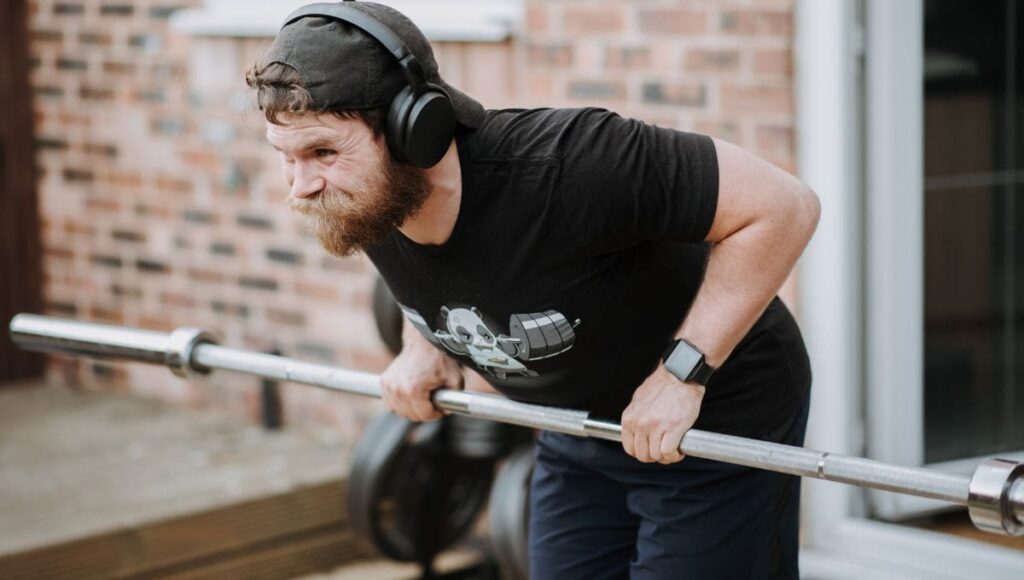
The single-arm landmine row is a unilateral pulling exercise targeting the latissimus dorsi, traps, rhomboids, and posterior deltoids while demanding strong anti-rotation from the torso.
Scientific Rationale
Compared to machine-based rowing, free-weight unilateral rowing requires greater stabilizer activation and grip strength (Andersen et al., 2014). The landmine setup also allows a joint-friendly pulling angle that reduces stress on the lower back.
Execution
- Stand beside a loaded barbell anchored in a landmine attachment.
- Hinge at the hips with a neutral spine.
- Row the barbell handle toward your torso, driving the elbow up and back.
- Lower under control, avoiding torso rotation.
Programming Guidelines
- Load: Moderate-heavy, allowing controlled movement.
- Sets/Reps: 3–4 sets of 8–12 reps per arm.
- Rest: 60–90 seconds between sides.
Common Mistakes
- Twisting the torso to lift more weight.
- Overextending the neck during the pull.
- Letting the elbow flare excessively.
Exercise 3: Single-Arm Overhead Dumbbell Press
Overview
The single-arm overhead dumbbell press trains the deltoids, triceps, and upper traps while significantly engaging the core.
Scientific Rationale
Overhead pressing unilaterally increases activation of the contralateral obliques and spinal erectors due to load asymmetry (Behm & Sale, 1993). It also improves scapular control and shoulder stability, both essential for upper body longevity.
Execution
- Stand with feet shoulder-width apart.
- Hold a dumbbell at shoulder level with a neutral grip.
- Brace your core and press overhead until the elbow is fully extended.
- Lower under control without leaning.
Programming Guidelines
- Load: 60–75% of one-rep max for overhead press.
- Sets/Reps: 3–5 sets of 6–10 reps per arm.
- Rest: 60–90 seconds per side.
Common Mistakes
- Leaning excessively to one side.
- Using leg drive unintentionally (unless performing a push press).
- Not locking out fully at the top.
How to Integrate These Exercises
Weekly Structure
These three movements can be incorporated into your existing push/pull/upper body split or used in a dedicated unilateral day. For hypertrophy, train each exercise 1–2 times per week with progressive overload.
Pairing with Bilateral Lifts
Bilateral lifts like the barbell bench press or pull-up should remain foundational. Unilateral work supplements them by addressing weaknesses and improving stability.

Additional Benefits Supported by Research
Cross-Education Effect
Training one limb can improve strength in the untrained contralateral limb through neural adaptations—a phenomenon known as cross-education (Carroll et al., 2006). This makes unilateral work valuable during injury rehabilitation.
Reduced Joint Stress
Because unilateral lifts use lower absolute loads, they can reduce compressive and shear forces on the spine and joints while still stimulating muscle growth (McCurdy et al., 2005).
Safety and Progression
Injury Prevention
Performing these exercises with strict form reduces the likelihood of overuse injuries caused by dominance patterns and asymmetries.
Progressive Overload Strategies
- Gradually increase load in small increments.
- Extend the range of motion where safe.
- Increase time under tension with slower eccentrics.
Conclusion
Unilateral upper body exercises are not just accessory work—they are essential for balanced, resilient, and high-performing musculature. The single-arm dumbbell bench press, single-arm landmine row, and single-arm overhead press are the three most effective movements for building size and strength while addressing imbalances and improving stability.
Key Takeaways Table
| Exercise | Primary Muscles | Key Benefit | Sets/Reps | Unique Advantage |
|---|---|---|---|---|
| Single-Arm Dumbbell Bench Press | Pectorals, anterior delts, triceps, core | Builds pressing strength and anti-rotation stability | 3–5 x 6–10 per arm | Enhances core activation |
| Single-Arm Landmine Row | Lats, traps, rhomboids, posterior delts, core | Improves pulling strength and posture | 3–4 x 8–12 per arm | Spine-friendly pulling angle |
| Single-Arm Overhead Dumbbell Press | Deltoids, triceps, upper traps, core | Develops shoulder stability and strength | 3–5 x 6–10 per arm | Strengthens anti-lateral flexion |
Bibliography
- Andersen, V., et al. (2014) ‘Muscle activation and strength in free-weight and machine-based exercises’, Journal of Strength and Conditioning Research, 28(11), pp. 2976–2983.
- Bailey, C. A., et al. (2015) ‘The relationship between unilateral and bilateral performance and limb asymmetries in elite youth soccer players’, Journal of Strength and Conditioning Research, 29(11), pp. 3166–3173.
- Behm, D. G. and Sale, D. G. (1993) ‘Intended rather than actual movement velocity determines velocity-specific training response’, Journal of Applied Physiology, 74(1), pp. 359–368.
- Behm, D. G., et al. (2010) ‘The role of instability with resistance training’, Journal of Strength and Conditioning Research, 24(3), pp. 679–684.
- Carroll, T. J., et al. (2006) ‘Cross-education: Strength training of one limb increases strength of the contralateral limb’, Exercise and Sport Sciences Reviews, 34(1), pp. 42–47.
- Herbert, R. D. and Gabriel, M. (2002) ‘Effects of unilateral strength training on contralateral limb strength in humans: A meta-analysis’, Journal of Applied Physiology, 93(5), pp. 1733–1740.
- McCurdy, K., et al. (2005) ‘The validity and reliability of the single-leg squat test’, Journal of Strength and Conditioning Research, 19(4), pp. 899–903.
- Saeterbakken, A. H., et al. (2011) ‘Effects of bench press variations in competitive athletes on muscle activation and performance’, Journal of Strength and Conditioning Research, 25(9), pp. 2496–2501.