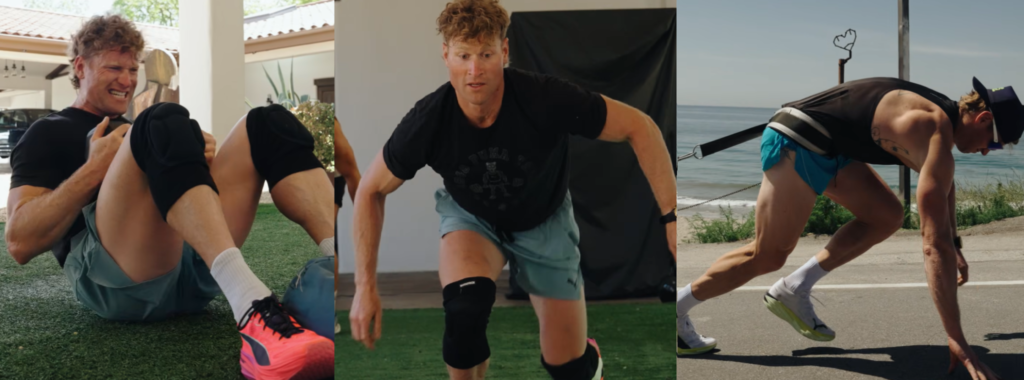
In the world of competitive fitness, there’s an unspoken truth everyone knows but few discuss openly: not all reps are created equal. In Hyrox, CrossFit, and similar functional fitness competitions, there’s a subtle but game-changing loophole—what some athletes might call efficiency and others might call outright cheating.
It’s the “no rep.”


We’re going to look specifically at the wall ball no rep—when an athlete doesn’t squat to full depth or fails to meet the movement standard. On paper, it’s a penalty. In practice, it’s biomechanical doping.
And the numbers prove it.
The Experiment: Measuring the Cheat
Armed with motion sensors the excellent team at WOD Science set out to quantify just how much easier a no rep really is. Using advanced IMU motion tracking, the experiment compared two versions of wall balls:
- Full Reps – squat below parallel, drive up, hit the target.
- No Reps – a shallower squat, above parallel, still releasing the ball.
Fifteen reps of each were recorded. The sensors captured vertical displacement, power output, and work done—both during the eccentric phase (catching the ball and squatting down) and the concentric phase (driving back up and throwing).
The graphs told a simple truth: less depth meant less work.
The Physics of Cutting Corners
In mechanical terms, work equals the sum of potential energy (mass × gravity × height) and kinetic energy (movement speed). A deeper squat increases both displacement and energy requirements.

The results were startling:
- Work Reduction: No reps required 27–26% less total work than full reps.
- Speed Advantage: Each no rep took 0.2 seconds less to complete (1.7s vs. 1.9s).
In competition terms, that’s a double advantage: you’re moving faster and burning less energy.
The 100-Wall-Ball Hypothetical
Let’s put this into a race scenario. Imagine the final stage of a Hyrox competition: 100 wall balls for time. A disciplined athlete hitting full depth will take roughly 20 seconds longer than a “cheater” hitting no reps—and that’s not counting the extra fatigue from doing 27% more work.
Breaking it down:
- Calories burned (metabolic cost)
- No reps: ~84 kcal
- Full reps: ~115 kcal
- No reps: ~84 kcal
The gap is enormous. Over the course of a long event, that saved energy could be the difference between a podium finish and burning out.
Biomechanical Doping: Why It Matters
Calling no reps “cheating” isn’t just about following the rules—it’s about fairness in physiological demand. When an athlete skips depth, they’re essentially lowering the mechanical tax on their body while still reaping the scoring reward.
That’s why in this experiment, the verdict was blunt: no reps are double cheating. They slash your workload and speed up your cycle time.
The Takeaway for Athletes and Judges
For serious competitors, the lesson is twofold:
- Know your own depth. Even if you’re not intentionally cheating, excessive depth can slow you down and sap your energy—review footage and aim for just-below-parallel efficiency.
- Enforce the standard. In judged events, no reps must be caught and penalized to maintain competitive integrity.
Because in the end, biomechanics don’t lie. A no rep isn’t just a bad habit—it’s a performance enhancer.