Lunges are one of the most powerful exercises for building strength, stability, and balance. They’re a staple in CrossFit, HYROX, running programs, and gym training everywhere. But there’s a catch: they’re also one of the most common exercises to cause knee pain.
Why do so many athletes struggle with lunges? And more importantly, should you push through the pain, or is it a warning sign you’re doing damage?



As a physiotherapist, I treat athletes with this exact issue every week. The good news is that most cases of lunge-related knee pain can be fixed. With the right tweaks to technique, smarter training progressions, and a focus on stability, you can keep lunges in your program without sacrificing your knees.
Here’s how.
Why Do Lunges Hurt Your Knees?
If lunges leave you wincing, you’re not alone. Knee pain from lunges is incredibly common and it usually comes down to a mix of technical errors, weaknesses, and mobility issues.
The most common culprits are:
- Poor form and misalignment — knees collapsing inward or drifting too far forward
- Underlying conditions — like Hoffa’s fat pad impingement or arthritis
- Muscle imbalances — strong quads but weak glutes or hamstrings
- Lack of motor control — the body can’t keep the knee stable under load
Fortunately, these issues are usually manageable with specific training changes.
How to Check Your Own Lunge Technique

You don’t need a full biomechanics lab to spot common mistakes. A few simple at-home tests can highlight weak links:
- Film yourself — watch if your knees cave inward or your torso tips forward.
- Single-leg balance test — can you hold 30 seconds without wobbling?
- Step-down test — step off a box and watch where the knee tracks.
If you spot hip drops, collapsing knees, or instability, that’s a red flag that your mechanics need attention.
The Fix: Physio-Approved Strategies to Stop Knee Pain
The key to pain-free lunges isn’t avoiding them — it’s fixing what’s causing the pain in the first place. Here are the strategies I use with athletes:
1. Perfect Your Form Before Adding Weight
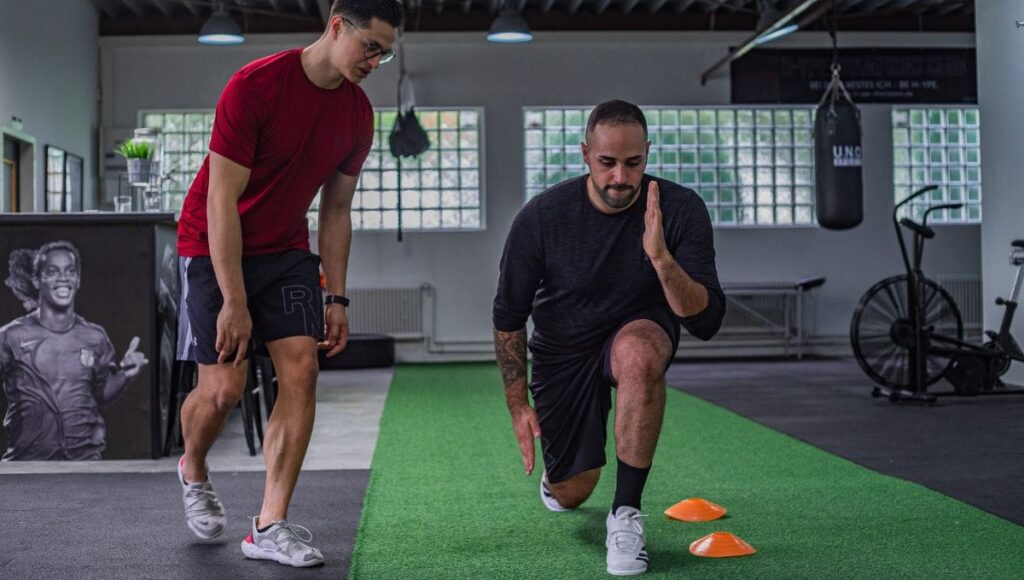
Most knee pain comes from poor alignment. Keep the front knee in line with the second toe, brace the core, and control your descent. Only add dumbbells or barbells when you can do this consistently.
2. Strengthen the Right Muscles
If your quads are carrying the load, your knees will take the hit. Strengthen glutes, hamstrings, and hip stabilisers with exercises like:
- Glute bridges
- Single-leg Romanian deadlifts
- Side planks
- Banded lateral walks
3. Improve Hip and Ankle Mobility
Tight hips or stiff ankles force the knee into awkward positions. Add mobility drills for hip flexors, quads, and calves alongside your strength training.
4. Progress Slowly
Jumping from bodyweight lunges to heavy barbell variations is a recipe for pain. Increase load gradually and only challenge balance with unstable surfaces when your form is locked in.
5. Listen to Pain Signals
Mild soreness that fades in a day or two is normal. Sharp, stabbing, or lingering pain is not. Treat pain as feedback – and if it persists, get checked by a physiotherapist.

The Prevention Mindset
The athletes who lunge pain-free year after year aren’t necessarily stronger – they’re smarter. They:
- Prioritise stability and technique checks
- Train glutes and hips as much as quads
- Schedule mobility and recovery into their week
- Avoid sudden jumps in training volume
If you adopt these habits, lunges stop being a source of pain and become one of the most powerful tools in your training arsenal.
Bottom Line: Don’t Push Through the Wrong Kind of Pain
Knee pain during lunges isn’t just “part of training.” It’s usually a sign of poor mechanics, imbalances, or mobility issues that can be fixed.
With the right technique, strength, and prevention strategies, lunges can be both safe and highly effective. But if pain persists, don’t ignore it – get assessed and protect your long-term performance.
About the Author
Nahor Garcia is the Founder of Seventeen Physiotherapy and a Consultant Physiotherapist based in London. Originally from Barcelona, he holds a Degree in Physiotherapy from the International University of Catalunya and a Master’s in Sports Physiotherapy from Universidad Europea de Madrid.With over a decade of experience across private practice, the NHS, and elite fitness settings including Nuffield Health, Harley Street clinics, and Equinox, Nahor specialises in TECAR therapy, shockwave treatment, and sports rehabilitation. He has helped athletes in HYROX, CrossFit, and endurance sports recover from injury, prevent setbacks, and achieve long-term performance goals.