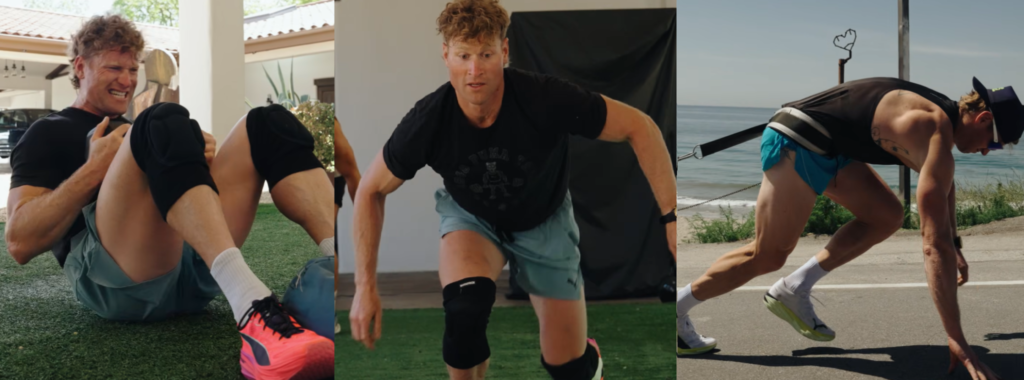
It is midday in Salford in Manchester and Gethin Jones is already moving through the first minutes of his training session. The day started long before sunrise with Morning Live, yet inside Collective, the same gym used by HYROX athlete James Kelly when he last visited the city, Jones shows no signs of slowing down. He greets his coach Sam Dimmick, eases onto a bike for a steady warm up and begins preparing for a session built around strength, consistency and a pace that works for the life he leads now.
Jones says he used to train almost every day. For years he relied on squeezing in exercise wherever possible. A back injury forced him to rethink that approach.


“I used to train pretty much every day and realised that was not the smartest thing to do. I am doing probably three days now, lots of strength and conditioning and a bit of cardio in between.”

Those sessions now follow a pattern that prioritises control and joint support rather than volume. The strength block begins with a rack press for upper body power, followed by chest supported rows to allow tension without stressing the back. Barbell hip thrusts add posterior strength and Bulgarian split squats bring single leg stability into the session. Each exercise is performed at a measured tempo with clear purpose, and none of the movements are rushed.
“As you get older you really feel the benefit of lifting slightly heavier but static. Building strength and core stability, all body work really.”
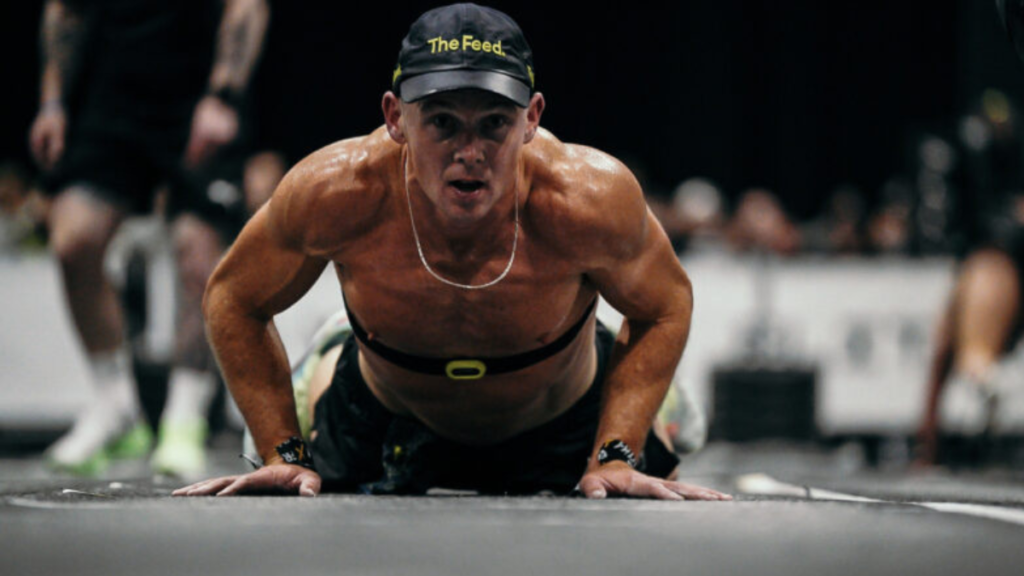
Jones has tried many forms of training over the years. He mentions CrossFit, circuits and classes that demanded fast transitions and high energy output. HYROX appealed to him for a different reason. It offered structure and a clear format that matched the way he naturally approaches exercise.

“HYROX kind of came from nowhere. As soon as I heard about it I was really interested.”
Once he started, he discovered a part of the format that took some time to adapt to.
“The hardest thing about HYROX was the compromised running, the ability to run after a station and the other way around.”
The conditioning block in today’s session reflects that challenge. It moves from rower to Ski Erg to short bouts of running and finishes with sled work. The transitions ask for effort but also for pacing. Dimmick keeps an eye on how Jones manages the changes in intensity. The work is demanding but steady, more focused on repeatability than on dramatic output.
Jones explains that he has always enjoyed pushing himself physically, but he trains differently now. The goal is not to chase exhaustion. The goal is to make the work fit the longer picture.

“I have always liked that feeling of being empty and trying to keep going, but I am getting better at training smarter, not just more.”
Routine plays a major part in that shift. His Morning Live schedule, although early, has made his training remarkably consistent.
“Since I started Morning Live, I found training easier because of the routine. I come straight after work. If I do not do it then I have no chance.”
The environment around him contributes to that consistency. Jones trains well when he is surrounded by people who understand what he is trying to achieve and how he prefers to train. Working closely with Dimmick gives him structure and accountability.
Jones has always responded well to training environments that feel supportive and familiar. Over the years he has taken on challenges with colleagues he respects, including events alongside Helen Skelton, who shares his enjoyment of physical activity. He now trains regularly with Sam Dimmick at Collective and says that the people around him play as much of a role in his progress as the exercises themselves.

Before his television career became his main focus, Jones spent many years in sport. He played scrum half in cup winning rugby teams and says that experience shaped his thinking about preparation and teamwork in a lasting way. Those qualities later carried into challenges he took on for charity. During his Blue Peter years he completed the Royal Marine Commando thirty mile Yomp across Dartmoor with a full kit. He finished in eight hours and twenty minutes and became only the second civilian to complete the task. More recently he took part in a twenty four hour fitness challenge to raise money for Red Nose Day.
These experiences inform how he thinks about effort and recovery today. They also influence his perspective as he prepares for his role as Chef de Mission for Team Wales at the 2026 Commonwealth Games.

“You see how athletes of all sports train. Some of them work full time and still go for medals.”
Recovery remains the part of training he still works on. Jones says he has not always been good at setting aside time for it, but age and experience have changed how he views it.
“I have never been great at setting aside time for recovery, but as I have got older I have had more niggles than ever. You realise you have to do it.”
His nutrition is straightforward. Overnight oats with berries and seeds are a typical start to the day. Supplements are rare unless Dimmick suggests something for a specific training period. Once this resulted in him mistakenly taking pre workout instead of creatine.
“That was an interesting session. I was flying.”
Training for him now is not about building an extreme level of fitness. It is about supporting the demands of his work and daily life. Presenting live television requires clarity and energy, and he sees his physical preparation as part of that responsibility.
“If I am doing a live TV show or a corporate late at night, you have to be physically fit for it. You have to be sharp.”
As the session draws to an end Jones moves into stretches recommended by his physio. The gym is quieter by this point and the pace has eased. The hour reflects the way he trains at this stage of his life. Focused, consistent and without unnecessary intensity. It is a routine that fits the rhythm of his week and supports everything around it.
Gethin is passionate about this part.
“People think once something hurts, you stop. That’s wrong. Strength training in your forties and fifties is essential.”
Last year, he and Sam clocked a 67–68 minute HYROX time.

“That’s not bad for 47,” he laughs. “I’m not slowing down.”
Leading Team Wales at The Commonwealth Games 2026

Becoming Chef de Mission for Team Wales wasn’t a celebrity appointment – it was built over years.
- Two decades of live broadcasting.
- A master’s degree in leadership and culture.
- Work across multiple sports.
- Passion for performance and athlete wellbeing.
“I didn’t want to just interview athletes,” he says. “I wanted to support them properly.”
The 2026 Commonwealth Games in Glasgow will be the culmination of that journey.
“We’re less than a year out. Kits, logistics, selections, it’s all happening. My job is to support the athletes and be the voice of Team Wales.”
Watching Olympic and Commonwealth-level athletes up close has changed how he trains himself.
“If they can work full-time, train for medals and still stay disciplined, I can get up and train.”
Sport, TV and the Icons Who Inspire Him
He names Henry Cavill and Chris Hemsworth as two TV figures who always seem in remarkable shape.
Among athletes, inspiration comes from his home nation: sprinter Jeremiah Azu, Para-athlete Olivia “Libby” Breen, cyclist Geraint Thomas.
“I pick up something from every sport.”
So who would he train with if he could choose anyone?
“An NFL team, definitely. The science, the explosiveness… I’d probably just watch. Not sure I could keep up.”
When the session ends, Jones treats the cool down with the same care as the warm up. It is a reminder that his training is no longer about pushing harder, but about building something that lasts. His experiences in rugby, in the challenges he has taken on for charity and now in his work with Team Wales all point to the same idea: progress is built on small decisions repeated often. HYROX suits that approach, as does the strength work that anchors his weeks. For Jones, training is simply part of the life he leads, and the discipline that supports everything around it.