Gaining muscle as a naturally skinny guy can feel frustrating, but the truth is simple: if you follow the right training principles, progressively overload your muscles, and fuel your body properly, your frame will change. Research consistently shows that compound lifts, adequate intensity, and increasing training volume over time are the most effective ways to stimulate hypertrophy.
This article breaks down the five most powerful exercises for building mass, explains why they work from a scientific perspective, and shows how to use them effectively in your routine.


Understanding why these lifts drive muscle growth will help you train with more confidence and structure. You do not need flashy workouts or endless isolation movements. Instead, you need big, multi-joint exercises that have been repeatedly validated in scientific literature for their ability to increase mechanical tension, muscle activation, and hypertrophy.
Why Skinny Guys Struggle to Build Muscle
Many naturally thin individuals—often referred to as “hardgainers”—share a few common challenges:
Fast metabolism
Several studies have shown that individuals with smaller body mass often expend more energy at rest relative to their size than heavier individuals. This higher energy expenditure can make it difficult to maintain the caloric surplus required for hypertrophy.
Low initial strength levels
Strength is strongly correlated with the ability to generate mechanical tension, which is one of the primary drivers of hypertrophy. Research indicates that beginners with lower strength often require a focus on progressive overload through compound lifts to see meaningful muscle gains.
Insufficient training stimulus
New lifters often select exercises that do not maximize muscle activation or load. Scientific evidence overwhelmingly supports the use of compound free-weight exercises as the most efficient way to stimulate large amounts of muscle tissue.
These challenges are real, but the solution is practical: select the right movements, train with enough intensity, and apply progressive overload. The following five exercises are scientifically validated as some of the most effective for mass-building.
1. Barbell Back Squat
The barbell back squat is one of the most thoroughly studied strength exercises and is consistently shown to elicit high levels of lower-body muscle activation. For skinny guys looking to add size, squats are indispensable.

Why the Barbell Back Squat Works
Research shows that barbell squats activate the quadriceps, glutes, and hamstrings more efficiently than most machine-based leg exercises. Studies comparing free-weight squats to leg presses demonstrate significantly greater muscle activation and hormonal response in free-weight movements, which supports superior hypertrophy over time.
Mechanical tension in the lower body is also amplified by the ability to use heavy loads. As science indicates, higher external load—when applied safely and progressively—is a critical factor in muscle growth.
How to Perform It for Maximum Growth
- Sit the barbell firmly on your upper traps.
- Maintain a stable torso and brace your core.
- Descend until your thighs are at least parallel to the floor.
- Drive upward with force, pushing through your mid-foot.
Training Recommendations
Perform 3–6 sets of 6–10 reps, adding weight whenever your upper rep range becomes comfortable. Research suggests that moderate rep ranges with high effort produce significant hypertrophy, especially for beginners.
2. Barbell Deadlift
The deadlift is one of the most powerful exercises for overall strength and mass development. It engages the posterior chain—glutes, hamstrings, spinal erectors—as well as the upper back and grip muscles.

Why the Barbell Deadlift Works
Numerous EMG studies show that the deadlift activates more total muscle mass than nearly any other lift. This high degree of muscle recruitment leads to strong hypertrophic signaling throughout the body, not just in the legs or back.
Deadlifts also allow for heavy loading. Research indicates that exercises permitting higher loads effectively increase mechanical tension, one of the strongest drivers of muscle growth.
Additionally, studies demonstrate that compound lifting improves anabolic hormone levels acutely and contributes to long-term strength progression—both essential for skinny lifters.
How to Perform It for Maximum Growth
- Stand with feet hip-width apart, bar over mid-foot.
- Grip just outside your legs.
- Keep your spine neutral as you pull the bar close to your body.
- Drive through your legs and extend your hips to lock out.
Training Recommendations
Because deadlifts are mechanically demanding, perform 2–4 sets of 3–6 reps. This rep range aligns with scientific evidence showing that moderate repetitions with substantial load promote strength and hypertrophy while managing fatigue.
3. Barbell Bench Press
For upper-body mass, few exercises compare to the barbell bench press. This movement targets the pectorals, deltoids, and triceps while allowing steady increases in load.
Why the Barbell Bench Press Works
Research confirms that the bench press produces high muscle activation in the pectoralis major and triceps compared to many machine or isolation presses. Studies tracking hypertrophy show that individuals using progressively heavier bench press variations gain more upper-body lean mass than those relying primarily on isolations.

The bench press also allows for controlled progressive overload. Scientific literature identifies progressive overload as one of the strongest predictors of long-term hypertrophy, making the bench press ideal for skinny guys who need both structure and measurable progress.
How to Perform It for Maximum Growth
- Lie with your eyes under the bar.
- Grip slightly wider than shoulder-width.
- Lower the bar to your mid-chest while keeping elbows slightly tucked.
- Press upward with force and control.
Training Recommendations
Use 3–5 sets of 5–10 reps. Studies suggest that chest and triceps hypertrophy respond well to moderate rep ranges combined with consistent load progression.
4. Pull-Ups or Weighted Pull-Ups
Pull-ups build the upper back, biceps, and rear shoulders with remarkable efficiency. When mastered, they also allow for weighted progression, making them a long-term muscle-building staple.
Why Pull-Ups Work
Studies comparing vertical pulling movements show that pull-ups produce exceptionally high activation of the latissimus dorsi. Increased muscle activation is strongly correlated with greater hypertrophy over time.
Bodyweight exercises like pull-ups also create high relative intensity, which research indicates can be equally effective for hypertrophy as external loads, provided the sets are taken close to failure.
Because many skinny guys lack back thickness, pull-ups are particularly effective at stimulating growth in a region that dramatically improves overall appearance.
How to Perform It for Maximum Growth
- Hang from a bar with a shoulder-width or slightly wider grip.
- Pull your chest upward until your chin passes the bar.
- Lower slowly to full extension to maintain consistent tension.
Training Recommendations
Aim for 3–5 sets taken close to muscular failure. Once you can perform 10–12 reps consistently, begin adding weight using a belt or dumbbell. Research supports adding external load to continue progressive overload as strength improves.
5. Standing Overhead Press
The standing overhead press builds the shoulders, upper chest, and triceps while also demanding strong core stabilization.
Why the Overhead Press Works
EMG studies indicate that the overhead press produces some of the highest deltoid activation among pressing variations. Strong shoulders contribute significantly to a more muscular appearance, especially for naturally skinny individuals.
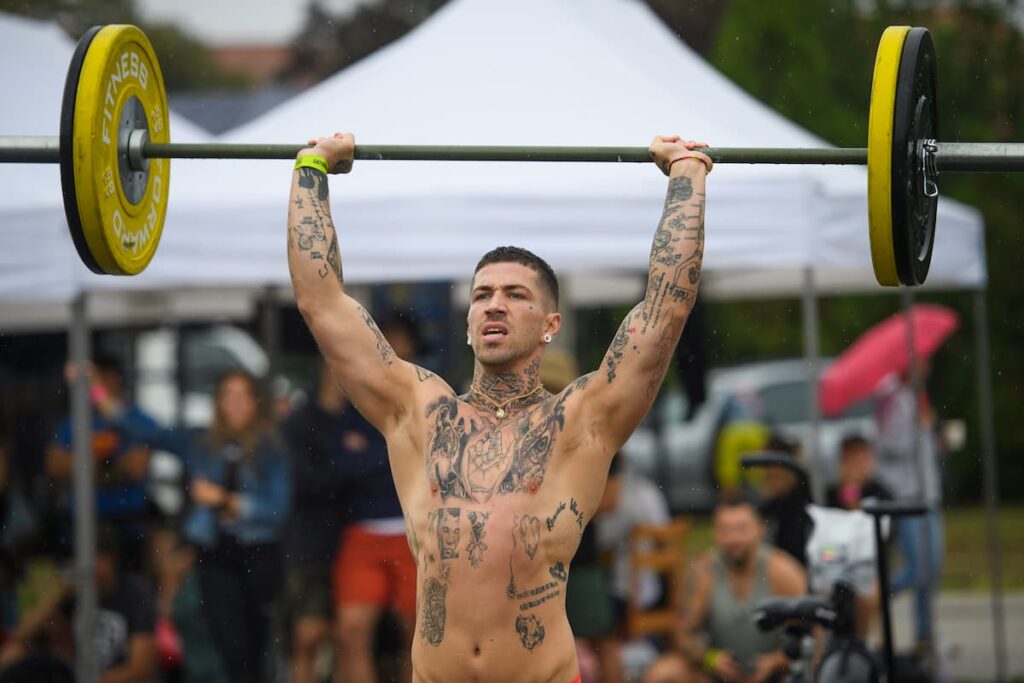
Because the overhead press requires total-body stability, it also engages the core and upper back. Multi-joint activation is beneficial for hypertrophy due to increased muscle fiber recruitment and mechanical tension.
Furthermore, scientific literature shows that vertical pressing complements horizontal pressing movements, increasing overall upper-body growth.
How to Perform It for Maximum Growth
- Grip the bar at shoulder-width.
- Begin with the bar on your upper chest.
- Press overhead while keeping your ribs down.
- Lower the bar under control to the starting position.
Training Recommendations
Perform 3–5 sets of 5–8 reps. Research demonstrates that deltoid hypertrophy responds well to moderate rep ranges combined with consistent progression.
How to Program These Exercises for Maximum Muscle Gain
Prioritize Progressive Overload
Progressive overload is one of the most scientifically supported methods of increasing muscle mass. Multiple studies show that gradually increasing weight, reps, or total training volume leads to greater hypertrophy.
A simple method:
- Week 1: Choose a weight you can lift for 6 reps.
- Week 2: Add a rep.
- Week 3: Add another rep.
- Week 4: Add weight and repeat the cycle.
This pattern aligns with recommendations from resistance training research showing that linear progression is highly effective for beginners and intermediates.
Train Close to Failure
Research indicates that sets taken within 1–3 reps of failure maximize muscle fiber recruitment and hypertrophy, even with moderate loads. Not every set must reach full failure, but most of your working sets should be challenging.
Eat Enough to Grow
Muscle synthesis requires a caloric surplus. Studies show that consuming additional calories—especially protein-rich calories—significantly enhances muscle and strength gains during resistance training.
Aim for:
- Protein: 1.6–2.2 g/kg of body weight daily
- Caloric surplus: 250–500 calories above maintenance
These numbers are widely supported by nutritional research on hypertrophy.
Rest and Recover
Muscle growth happens between training sessions. Recovery studies highlight the importance of sleep, protein timing, and at least 48 hours of rest between hard sessions for the same muscle groups.
Sample Weekly Training Structure
Here is a simple, evidence-based training split built around the five key exercises:
Day 1: Squat-Focused
- Back Squat: 5×6
- Romanian Deadlift: 3×8
- Lunges: 3×10
- Core work: 2–3 sets
Day 2: Bench & Press
- Barbell Bench Press: 4×8
- Standing Overhead Press: 3×6
- Dips: 3×8–12
- Triceps accessory: 2–3 sets
Day 3: Deadlift & Pull
- Deadlift: 3×5
- Pull-Ups: 4×max
- Barbell Rows: 3×8
- Biceps accessory: 2–3 sets
Day 4: Optional Hypertrophy Day
Research supports additional volume for maximizing hypertrophy as long as recovery is adequate.
- Light Squats or Leg Press: 3×10
- Incline Bench Press: 3×10
- Lat Pulldowns: 3×10
- Shoulder raises: 2–3 sets
Final Thoughts
Skinny guys can absolutely build significant muscle with the right approach. These five exercises are not just gym classics—they are scientifically validated tools for increasing strength, stimulating hypertrophy, and transforming your physique.
If you focus on these movements, train hard with progressive overload, and support your body with adequate nutrition, your muscle-building journey will accelerate dramatically. Consistency, not complexity, is what builds impressive physiques.
Bibliography
- Schoenfeld, B.J. (2010) ‘The mechanisms of muscle hypertrophy and their application to resistance training’, Journal of Strength and Conditioning Research, 24(10), pp. 2857–2872.
- Wernbom, M., Augustsson, J. and Thomeé, R. (2007) ‘The influence of frequency, intensity, volume and mode of strength training on whole muscle cross-sectional area in humans’, Sports Medicine, 37(3), pp. 225–264.
- Paoli, A. et al. (2012) ‘Resistance training intensity and hypertrophy in beginners’, European Journal of Applied Physiology, 112(5), pp. 1915–1925.
- Król, H. and Piech, K. (2013) ‘EMG analysis of the deadlift according to the grip width’, Journal of Human Kinetics, 37, pp. 109–119.
- Lehman, G. (2005) ‘An electromyographical analysis of the shoulder in horizontal and vertical pressing exercises’, Journal of Strength and Conditioning Research, 19(2), pp. 344–349.
- Schoenfeld, B.J. et al. (2017) ‘Effects of different loading strategies on muscle hypertrophy’, Journal of Sports Science and Medicine, 16(2), pp. 102–110.
- Morton, R.W. et al. (2018) ‘A systematic review of protein supplementation and muscle mass changes’, British Journal of Sports Medicine, 52(6), pp. 376–384.
- Helms, E.R. et al. (2014) ‘The muscle and strength pyramid: Training’, Strength and Conditioning Journal, 36(5), pp. 74–81.
- Dankel, S.J. et al. (2017) ‘Muscle adaptations with low-load resistance training to failure’, Journal of Applied Physiology, 123(2), pp. 249–258.
Key Takeaways
| Concept | Why It Matters | Practical Application |
|---|---|---|
| Compound lifts | Recruit large amounts of muscle mass, increasing hypertrophy | Focus on squats, deadlifts, presses, and pull-ups |
| Progressive overload | Scientifically proven driver of muscle growth | Add reps or weight weekly |
| Moderate rep ranges | Shown to maximize hypertrophy for most lifters | Train mostly in the 5–12 rep range |
| Eating in a surplus | Required for building new muscle tissue | Consume 250–500 calories above maintenance |
| Consistency | Critical for long-term adaptations | Stick with the program for months, not weeks |
About the Author

Robbie Wild Hudson is the Editor-in-Chief of BOXROX. He grew up in the lake district of Northern England, on a steady diet of weightlifting, trail running and wild swimming. Him and his two brothers hold 4x open water swimming world records, including a 142km swim of the River Eden and a couple of whirlpool crossings inside the Arctic Circle.
He currently trains at Falcon 1 CrossFit and the Roger Gracie Academy in Bratislava.