Dumbbells are often seen as a secondary tool—useful when barbells or machines are unavailable, but not powerful enough to drive serious muscle growth. That assumption is wrong.
When used correctly, dumbbells can stimulate full-body hypertrophy just as effectively as barbells and machines, while offering unique advantages for joint health, muscle balance, and long-term progress. Research consistently shows that muscle growth depends on mechanical tension, sufficient volume, proximity to failure, and progressive overload—not on the specific tool used to create that tension.


This article breaks down three science-backed hacks that allow you to use dumbbells for maximal full-body muscle growth. These are not gimmicks or shortcuts. Each hack is grounded in peer-reviewed research on hypertrophy, biomechanics, and neuromuscular adaptation, and each one can be applied immediately to your training.
You will learn how to:
• Increase muscle activation and growth stimulus using unilateral loading
• Exploit extended ranges of motion and resistance curves unique to dumbbells
• Apply evidence-based intensity techniques that work especially well with dumbbells
The goal is simple: help you build more muscle with the equipment you already have.
Hack 1: Use Unilateral Dumbbell Training to Increase Muscle Activation and Growth
Why Unilateral Loading Works
Unilateral training means working one limb at a time. Dumbbells are uniquely suited for this because they allow independent loading of each arm or leg without complex setups.
From a hypertrophy standpoint, unilateral training increases muscle activation due to higher stabilization demands and greater neural drive. When one limb works independently, the body must recruit more motor units to control balance, joint position, and force production.
Electromyography (EMG) studies consistently show higher activation in stabilizing muscles during unilateral movements compared to bilateral equivalents. This higher activation translates to greater mechanical tension at the muscle level, which is the primary driver of hypertrophy.
Mechanical tension refers to the force experienced by muscle fibers when they produce or resist load. Research identifies it as the most important stimulus for muscle growth, ahead of muscle damage or metabolic stress.
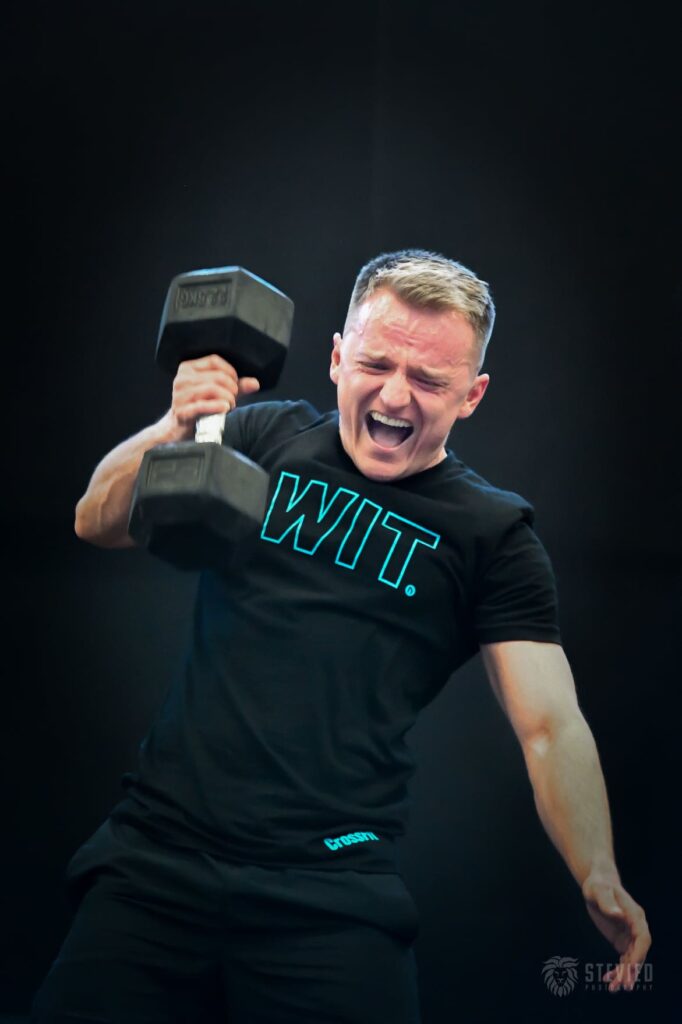
Unilateral dumbbell work also allows each side of the body to be trained at its true capacity. In bilateral barbell lifts, the stronger side often compensates for the weaker one, reducing stimulus where it is needed most. Over time, this can reinforce asymmetries.
Evidence Supporting Unilateral Training for Hypertrophy
Multiple studies have demonstrated that unilateral resistance training produces similar—or in some cases superior—hypertrophy compared to bilateral training when volume and effort are matched.
Research comparing single-leg and double-leg training found equivalent increases in muscle size, with unilateral training producing greater improvements in strength balance between limbs. This matters for long-term hypertrophy, as balanced force production allows higher loading and better technique over time.
Additionally, unilateral training benefits from what is known as the “cross-education effect.” When one limb is trained, neural adaptations occur in the untrained limb as well. While this effect is more pronounced for strength than size, it supports the idea that unilateral loading creates a strong neural stimulus.
From a practical perspective, unilateral dumbbell exercises also reduce spinal loading while maintaining high muscular tension. This allows you to accumulate more quality volume with less systemic fatigue, which is critical for muscle growth over weeks and months.
How to Apply Unilateral Dumbbell Training for Full-Body Growth
To maximize hypertrophy, unilateral work should be treated as a primary stimulus—not an accessory.
Upper-body examples:
• Single-arm dumbbell bench press
• Single-arm overhead press
• One-arm dumbbell row
• Single-arm incline press
Lower-body examples:
• Bulgarian split squats
• Single-leg Romanian deadlifts
• Dumbbell step-ups
• Single-leg goblet squats
The key is effort. Each set should be taken close to muscular failure, typically within one to three repetitions in reserve. Research shows that hypertrophy is similar across a wide rep range as long as sets are performed near failure.
Volume should be matched per limb. If you perform three sets for the right arm, you must perform three equally challenging sets for the left.
Common Mistakes That Reduce Effectiveness
The most common mistake with unilateral dumbbell training is using loads that are too light. Balance challenges should not come at the expense of mechanical tension.
If stability limits load too much, use a staggered stance or light external support while maintaining unilateral loading. This allows you to push the working muscle harder without turning the exercise into a balance drill.

Another mistake is rushing rest periods. Unilateral work effectively doubles time under tension, so adequate rest—at least 90 to 120 seconds between sets per limb—is essential to maintain output.
Hack 2: Exploit Greater Range of Motion and Resistance Curves With Dumbbells
Why Range of Motion Matters for Muscle Growth
Range of motion (ROM) is one of the most underrated variables in hypertrophy training. A growing body of research shows that training muscles through longer ranges of motion produces greater muscle growth than partial movements.
Longer ROM increases muscle fiber stretch under load. This stretch appears to enhance hypertrophic signaling through mechanisms involving passive tension, sarcomere elongation, and mechanosensitive pathways.
Dumbbells allow greater freedom of movement than barbells or machines, making it easier to train muscles in positions that maximize stretch and tension simultaneously.
Scientific Evidence on Long-Length Training
Studies comparing partial and full ROM training consistently show superior hypertrophy when exercises are performed through longer muscle lengths.
Recent research has also shown that emphasizing the stretched position of an exercise can produce more muscle growth than emphasizing the shortened position, even when total volume is matched.
This is particularly relevant for dumbbells because they allow:
• Deeper presses without barbell interference
• Greater shoulder extension during rows
• Increased hip hinge depth in Romanian deadlifts
The ability to move freely also allows you to adjust joint angles to match individual anatomy, reducing joint stress while increasing muscular tension.
Dumbbell Exercises That Maximize Growth Through ROM
Chest:
Dumbbell presses allow the elbows to travel lower than a barbell press, increasing stretch on the pectoralis major. This increased stretch has been linked to greater hypertrophy.
Perform presses with controlled eccentrics and a brief pause near the bottom to increase time under tension in the stretched position.
Back:
One-arm dumbbell rows allow greater scapular protraction at the bottom and retraction at the top compared to barbell rows. This increases total ROM for the lats and upper back.
Allow the shoulder to fully stretch at the bottom before initiating each repetition.
Shoulders:
Dumbbell lateral raises allow resistance through a longer arc of motion compared to machines. When performed with a slight forward lean, they maintain tension on the medial deltoid through more of the movement.
Legs:
Dumbbell Romanian deadlifts enable deeper hip flexion than barbell versions for many lifters, increasing hamstring stretch under load.
Split squats allow a much deeper knee and hip bend than bilateral squats for most people, increasing stimulus to the quads and glutes.
Resistance Curves and Dumbbells
Resistance curves describe how difficult an exercise is at different points in the movement. Dumbbells often provide a more natural resistance curve because they are not constrained by a fixed path.
For example, in dumbbell presses, resistance aligns closely with the direction of force production throughout the lift. This leads to more consistent tension across the ROM.
Consistent tension matters because muscle growth is driven by the cumulative time fibers spend under meaningful load. Dumbbells allow you to keep tension where it matters most.
Practical Programming Tips
Use controlled tempos, especially during the eccentric phase. Slower eccentrics increase time under tension and improve motor control without requiring heavier loads.

Aim for full, pain-free ROM on every rep. Partial reps can be useful, but they should complement—not replace—full ROM training.
Prioritize exercises that load muscles in stretched positions early in your workout, when fatigue is lowest and force output is highest.
Hack 3: Use Dumbbell-Specific Intensity Techniques to Increase Effective Volume
What Is Effective Volume?
Effective volume refers to the number of hard sets that meaningfully contribute to muscle growth. Research suggests that sets performed close to failure are far more hypertrophic than easy sets, regardless of load.
Dumbbells are particularly effective for accumulating high-quality volume because they allow intensity techniques that are difficult or unsafe with barbells.
Drop Sets With Dumbbells
Drop sets involve performing a set to near failure, reducing the load, and continuing without rest.
Research shows that drop sets can produce similar hypertrophy to traditional straight sets while requiring less total time. This is because they increase metabolic stress and motor unit recruitment within a single extended set.
Dumbbells make drop sets practical because weight changes are quick and do not require unloading a bar.
For example:
• Dumbbell incline press: perform 8–10 reps, reduce weight by 20–30 percent, perform another 8–12 reps
• Dumbbell rows: perform heavy reps, then immediately switch to lighter dumbbells
Limit drop sets to one or two per exercise to avoid excessive fatigue.
Rest-Pause Training With Dumbbells
Rest-pause training involves performing a set to near failure, resting briefly (10–20 seconds), then continuing with the same load.
Studies show that rest-pause training produces hypertrophy comparable to traditional training with fewer total sets, making it highly time-efficient.
Dumbbells are ideal for rest-pause because they are easy to re-rack and reset without disrupting setup.
This method is particularly effective for:
• Dumbbell shoulder presses
• Goblet squats
• Dumbbell curls and extensions
Mechanical Drop Sets
Mechanical drop sets change the leverage or movement pattern rather than the load.
Example for shoulders:
• Dumbbell lateral raises with strict form to failure
• Immediately transition to slight body English raises
• Finish with partial reps
This approach maintains high tension as fatigue accumulates, extending the effective set length.
Research supports this strategy by showing that muscle activation remains high as long as effort remains high, even if technique changes slightly.
Why Dumbbells Reduce Injury Risk With Intensity Techniques
Dumbbells allow each joint to move naturally, reducing joint torque in compromised positions. This makes advanced techniques safer compared to barbells, which lock the body into fixed paths.
Lower injury risk allows more consistent training, and consistency is a key predictor of long-term hypertrophy.
Weekly Volume Guidelines
Based on current research, most individuals maximize hypertrophy with:
• 10–20 hard sets per muscle group per week
• Sets performed within 1–3 reps of failure
• At least 48 hours between training the same muscle group
Dumbbells make it easier to distribute this volume across the week without excessive joint stress.
How to Combine All Three Hacks Into One Program
A full-body dumbbell program might include:
• Unilateral compound lifts as primary movements
• Exercises emphasizing long ROM early in sessions
• One intensity technique per muscle group per workout
This approach maximizes mechanical tension, effective volume, and recovery capacity.
Example structure:
Day 1: Upper body push and pull
Day 2: Lower body and core
Day 3: Full-body accessory emphasis
This frequency aligns with research showing that training muscles two to three times per week leads to superior hypertrophy compared to once-weekly training.
Conclusion
Dumbbells are not a compromise. They are a powerful hypertrophy tool when used with intention and evidence-based principles.
By focusing on unilateral loading, extended ranges of motion, and dumbbell-specific intensity techniques, you can stimulate full-body muscle growth effectively without relying on barbells or machines.
The science is clear: muscle does not care about the tool. It responds to tension, effort, and consistency. Dumbbells can deliver all three.
Bibliography
• Journal of Strength and Conditioning Research – Schoenfeld, B.J. (2010). The mechanisms of muscle hypertrophy and their application to resistance training.
• Journal of Strength and Conditioning Research – Schoenfeld, B.J., Ogborn, D. and Krieger, J.W. (2017). Dose-response relationship between weekly resistance training volume and increases in muscle mass.
• European Journal of Applied Physiology – McCurdy, K. et al. (2005). The effect of short-term unilateral and bilateral lower-body resistance training on strength and power.
• Sports Medicine – Schoenfeld, B.J. (2016). Science and development of muscle hypertrophy.
• Journal of Sports Sciences – Gentil, P. et al. (2017). Effects of resistance training range of motion on muscle hypertrophy and strength.
About the Author

Robbie Wild Hudson is the Editor-in-Chief of BOXROX. He grew up in the lake district of Northern England, on a steady diet of weightlifting, trail running and wild swimming. Him and his two brothers hold 4x open water swimming world records, including a 142km swim of the River Eden and a couple of whirlpool crossings inside the Arctic Circle.
He currently trains at Falcon 1 CrossFit and the Roger Gracie Academy in Bratislava.