When most people think about “core training,” they picture crunches, sit-ups, or planks. While these exercises can have value, they only train a small slice of what the core is actually designed to do. In real movement and sport, the core’s primary job is not to flex the spine repeatedly, but to stabilize it, transmit force between the upper and lower body, and resist unwanted motion under load and fatigue.
Conditioning drills — exercises that elevate heart rate, challenge coordination, and involve large muscle groups — place unique demands on the core. Unlike isolated core exercises, conditioning drills force the trunk muscles to work reflexively and continuously while the arms and legs produce force. This mirrors how the core functions in athletic performance, daily life, and injury prevention.


Scientific research consistently shows that the core muscles are most active during dynamic, loaded, multi-joint tasks rather than isolated abdominal movements. Studies using electromyography (EMG) demonstrate higher activation of deep stabilizing muscles such as the transverse abdominis, multifidus, and obliques during standing, loaded, and asymmetrical tasks compared to floor-based abdominal exercises (McGill, 2010; Behm et al., 2010).
This article breaks down three conditioning drills that do far more than just “get you tired.” Each drill strengthens the core in a functional, science-backed way while also improving work capacity, coordination, and resilience. These are not random exercises. They are tools grounded in biomechanics, motor control research, and strength and conditioning science.
Understanding What “Core Strength” Really Means
Before diving into the drills, it is important to clarify what core strength actually is.
The core is not just the rectus abdominis (the “six-pack”). It is a complex system of muscles that includes the deep stabilizers of the spine, the muscles of the abdominal wall, the diaphragm, the pelvic floor, and the muscles that connect the hips to the trunk. Together, these muscles create stiffness, control spinal position, and allow efficient force transfer between the limbs.
Research by Hodges and Richardson showed that deep core muscles activate prior to limb movement, highlighting their role in anticipatory postural control rather than visible movement (Hodges and Richardson, 1997). This means the core works best when it is trained to stabilize while the rest of the body moves.
Conditioning drills that involve load, speed, and asymmetry force the core to do exactly that.
Drill 1: Loaded Carries

What Are Loaded Carries?
Loaded carries involve walking while holding external weight. Common variations include farmer’s carries (weights in both hands), suitcase carries (weight in one hand), front rack carries, and overhead carries. While they look simple, loaded carries place continuous demands on the trunk, hips, and shoulders.
Unlike traditional core exercises that last a few seconds per set, loaded carries challenge the core for extended durations under fatigue, which is critical for real-world and sport-specific performance.
Why Loaded Carries Strengthen the Core
Loaded carries require the core to resist multiple forces at once: spinal flexion, extension, lateral flexion, and rotation. The body must maintain upright posture while the lower body moves and the load shifts slightly with each step.
Biomechanical research shows that gait under load significantly increases trunk muscle activation. A study by Anderson et al. found that carrying asymmetric loads increased activation of the obliques and quadratus lumborum to control lateral flexion and rotation (Anderson et al., 2007). This is especially true for suitcase carries, where the load is on one side only.
Farmer’s carries, where load is held bilaterally, increase overall trunk stiffness. McGill’s research demonstrates that increased spinal stiffness through co-contraction of trunk muscles enhances spinal stability under load (McGill, 2007). Carries train this stiffness in a way that static planks cannot.
Conditioning Effect and Core Endurance
Core endurance is a key factor in injury prevention. Research has linked poor trunk endurance to higher rates of low back pain and reduced athletic performance (McGill, 2001). Loaded carries extend core activation over time, improving endurance rather than just peak strength.
Because carries elevate heart rate and breathing, they also integrate the diaphragm into core function. The diaphragm plays a dual role in respiration and spinal stability, and its coordination with abdominal muscles is essential for efficient core function (Kolar et al., 2010).
How to Perform Loaded Carries Effectively
Choose a load that challenges posture without forcing compensations. Walk tall, keep ribs stacked over the pelvis, and avoid leaning or twisting excessively. Distance-based sets (for example, 20–40 meters) allow consistent time under tension and measurable progression.
Suitcase carries should be performed on both sides to ensure balanced trunk development. Over time, gradually increase load or distance, but never at the expense of posture.
Drill 2: Sled Pushes and Pulls
What Are Sled Pushes and Pulls?
Sled training involves pushing or pulling a weighted sled across the ground. It is commonly used for conditioning, acceleration development, and rehabilitation due to its low eccentric load. However, sled work is also a powerful core training tool.
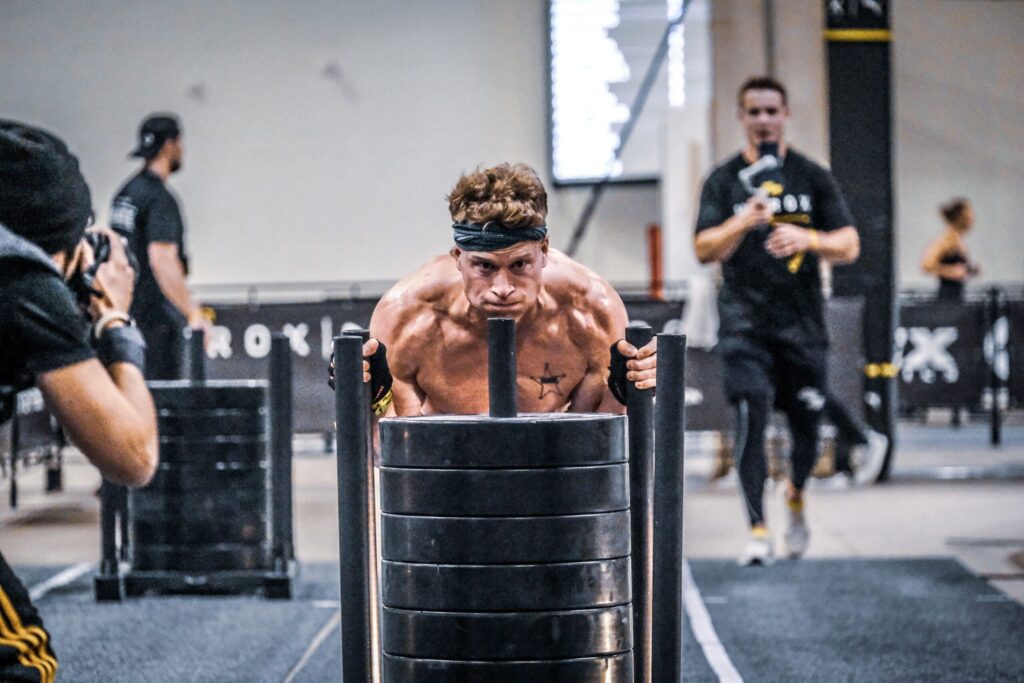
Unlike running or jumping, sled work allows high force production without high impact, making it suitable for a wide range of athletes.
Core Demands During Sled Work
During sled pushes, the body adopts a forward-leaning position while maintaining a neutral spine. This requires the anterior core muscles to resist spinal extension while the posterior chain produces force. At the same time, the obliques and deep stabilizers control rotational forces as the arms and legs alternate.
Electromyographic studies show that pushing tasks significantly activate the rectus abdominis, obliques, and erector spinae simultaneously, creating a stable yet dynamic trunk (Escamilla et al., 2010). This co-contraction is critical for spinal stability under load.
Sled pulls, especially backward or lateral variations, increase demand on trunk control in different planes of motion. Lateral sled pulls challenge frontal plane stability, which is often neglected in traditional core training.
Conditioning and Fatigue Resistance
Conditioning is not just about cardiovascular fitness. It is about maintaining movement quality under fatigue. As fatigue sets in, the core’s role in maintaining posture becomes more important.
Research shows that trunk muscle fatigue alters movement mechanics and increases injury risk (Granata and Orishimo, 2001). Conditioning drills like sled pushes train the core to maintain stability even as breathing rate and muscular fatigue increase.
Because sled work is cyclical and repeatable, it allows prolonged exposure to these conditions without excessive joint stress.
How to Use Sleds for Core Development
Load the sled so that movement remains smooth and controlled. Excessive load that forces spinal flexion or rounding reduces the core benefit and increases injury risk. Focus on strong, consistent steps and stable torso alignment.
Intervals of 10–30 seconds with moderate rest balance conditioning and technical quality. Backward and lateral variations should be included to expose the core to multiple planes of force.
Drill 3: Medicine Ball Rotational Throws
What Are Medicine Ball Rotational Throws?
Medicine ball rotational throws involve generating force through the hips and trunk to throw a ball against a wall or to a partner. Common variations include standing rotational throws, scoop tosses, and rotational shot-put-style throws.

These drills train the core as a force transmitter rather than a force producer in isolation.
The Core’s Role in Rotational Power
Most athletic movements involve rotation. The core must efficiently transfer force from the ground, through the hips, and into the upper body. Research on the kinetic chain shows that weak or poorly coordinated core muscles reduce force transfer efficiency and increase stress on the shoulders and spine (Kibler et al., 2006).
Medicine ball throws demand rapid trunk rotation while maintaining spinal stability. EMG studies demonstrate high activation of the obliques and transverse abdominis during rotational throwing movements, especially during the deceleration phase (Escamilla and Andrews, 2009).
This eccentric control is critical for both performance and injury prevention.
Conditioning and Neuromuscular Demand
When performed in repeated sets, medicine ball throws elevate heart rate and challenge coordination under fatigue. This combination enhances neuromuscular efficiency — the ability of the nervous system to recruit muscles quickly and effectively.
Research suggests that explosive rotational training improves trunk muscle timing and coordination, which are key components of functional core strength (Zazulak et al., 2007).
Unlike slow, controlled core exercises, medicine ball throws train the core at sport-relevant speeds.
How to Program Rotational Throws Safely
Use a ball that allows explosive movement without excessive strain. Quality of movement is more important than load. Focus on initiating rotation from the hips, bracing the trunk, and allowing the arms to follow.
Perform throws on both sides to reduce asymmetry. Sets of 5–10 throws per side with short rest periods can be used for conditioning without sacrificing power output.
Why Conditioning Drills Outperform Isolated Core Exercises
Isolated core exercises often fail to transfer to real-world performance because they do not replicate how the core functions during movement. Studies comparing unstable surface training and isolated abdominal work to traditional compound movements show that standing, loaded exercises produce equal or greater core activation (Behm et al., 2010).
Conditioning drills integrate breathing, posture, coordination, and force production. This integration is essential for athletic performance and injury resilience.
Additionally, conditioning drills improve metabolic efficiency. The core must work harder when oxygen demand increases, reinforcing its role in maintaining posture during fatigue. This is supported by research linking trunk stability to running economy and movement efficiency (Saunders et al., 2004).
Programming Considerations
Conditioning drills should not replace all traditional strength work, but they complement it. Two to four sessions per week can significantly improve core strength and endurance when programmed intelligently.
Volume should be increased gradually. Sudden spikes in conditioning load increase injury risk, particularly for the lower back. Research on training load management emphasizes the importance of progressive overload and adequate recovery (Gabbett, 2016).
Rotate drills periodically to expose the core to varied stimuli while avoiding overuse.
Final Thoughts
A strong core is not built by endless sit-ups. It is built by teaching the trunk to stabilize, transmit force, and resist movement under real-world demands. Conditioning drills provide exactly that stimulus.
Loaded carries train anti-movement strength and endurance. Sled pushes and pulls reinforce trunk stability under force and fatigue. Medicine ball rotational throws develop dynamic core power and coordination.
Each of these drills is supported by scientific evidence and reflects how the core is designed to function. When programmed correctly, they strengthen the core while improving conditioning, movement quality, and long-term resilience.
References
- Anderson, G.S., Albert, W.J. and Pearson, A.M. (2007) ‘Biomechanics of load carriage’, Ergonomics, 50(8), pp. 1254–1267.
- Behm, D.G., Drinkwater, E.J., Willardson, J.M. and Cowley, P.M. (2010) ‘The use of instability to train the core musculature’, Applied Physiology, Nutrition, and Metabolism, 35(1), pp. 91–108.
- Escamilla, R.F. and Andrews, J.R. (2009) ‘Shoulder muscle recruitment patterns and related biomechanics during upper extremity sports’, Sports Medicine, 39(7), pp. 569–590.
- Escamilla, R.F., Lewis, C., Bell, D., Bramblet, G. and Daffron, J. (2010) ‘Core muscle activation during dynamic exercises’, Journal of Orthopaedic & Sports Physical Therapy, 40(10), pp. 1–8.
- Gabbett, T.J. (2016) ‘The training–injury prevention paradox’, British Journal of Sports Medicine, 50(5), pp. 273–280.
- Granata, K.P. and Orishimo, K.F. (2001) ‘Response of trunk muscle coactivation to changes in spinal stability’, Journal of Biomechanics, 34(9), pp. 1117–1123.
About the Author

Robbie Wild Hudson is the Editor-in-Chief of BOXROX. He grew up in the lake district of Northern England, on a steady diet of weightlifting, trail running and wild swimming. Him and his two brothers hold 4x open water swimming world records, including a 142km swim of the River Eden and a couple of whirlpool crossings inside the Arctic Circle.
He currently trains at Falcon 1 CrossFit in Bratislava.