Bodyweight training has long been regarded as a foundation of physical fitness. While beginners often focus on push-ups, pull-ups, and squats, the human body is capable of far more challenging movements that require no external equipment.
These advanced bodyweight movements demand strength, coordination, balance, and mobility, making them highly effective for athletes and fitness enthusiasts who want to push beyond the basics.
This article will explore six advanced bodyweight movements, detailing the biomechanics, scientific evidence behind their benefits, and the key principles for mastering them. Each movement has been studied in exercise science literature, providing a strong evidence base for their inclusion in advanced training programs.
Why Advanced Bodyweight Movements Matter
Unlike machine-based training, advanced bodyweight movements require full-body integration, motor control, and adaptability. They challenge stabilizing musculature and the neuromuscular system, producing carryover to both athletic performance and daily activities.
Research shows that exercises involving multi-joint coordination and closed kinetic chain patterns—common in bodyweight training—improve muscular strength, proprioception, and joint stability more effectively than isolated movements (Behm & Sale, 1993). Furthermore, because these movements use only body weight, they minimize equipment dependency while still offering progressive overload through technique variation and leverage manipulation.
Movement 1: The Planche
Advanced Bodyweight Movements: Overview
The planche is a gymnastics-inspired skill that requires holding the body parallel to the ground with only the hands supporting weight. It is one of the most demanding core and shoulder strength exercises.
Muscles Targeted
- Anterior deltoids
- Pectoralis major
- Triceps brachii
- Core stabilizers (rectus abdominis, transverse abdominis, obliques)
Advanced Bodyweight Movements: Science-Backed Benefits
Electromyographic (EMG) studies have shown that planche holds produce exceptionally high activation in the anterior deltoids and pectorals compared to traditional push-ups (Calatayud et al., 2015). The isometric nature of the planche also develops tendon stiffness and joint stability, which are critical for injury prevention in upper-body intensive sports.
Progression Strategy
- Tuck planche → Advanced tuck → Straddle planche → Full planche
- Use parallettes to reduce wrist strain.
Movement 2: The One-Arm Pull-Up
Overview
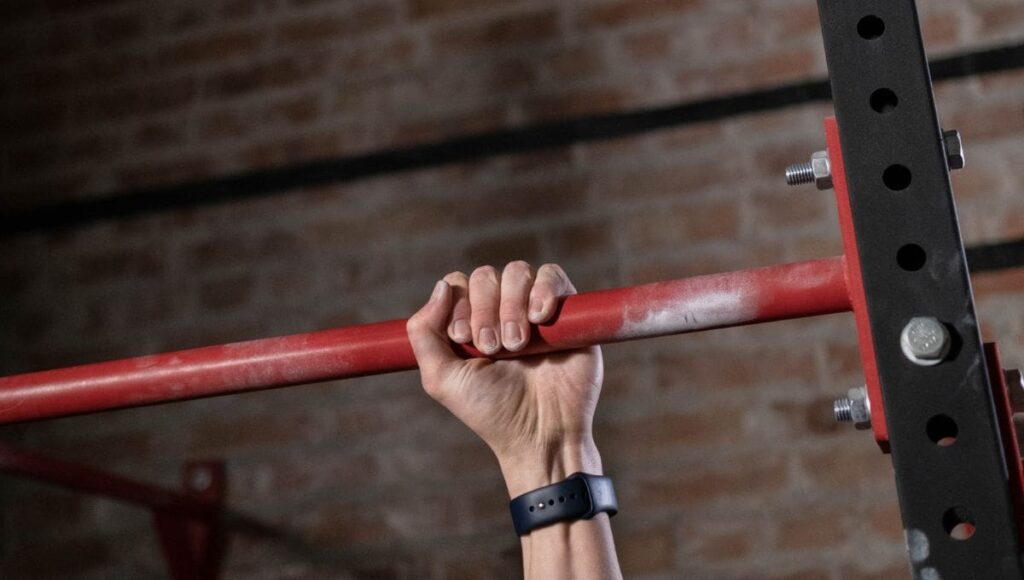
The one-arm pull-up represents maximal pulling strength, requiring both vertical pulling power and anti-rotation stability.
Muscles Targeted
- Latissimus dorsi
- Biceps brachii
- Brachialis
- Core and obliques (anti-rotation)
Science-Backed Benefits
Studies on unilateral versus bilateral training show unilateral loading increases core engagement due to the demand for anti-rotational stability (McCurdy et al., 2005). The one-arm pull-up is a prime example, where spinal stabilizers work to prevent torsion while the primary movers generate vertical force.
[wpcode id=”229888″]Progression Strategy
- Archer pull-ups → Typewriter pull-ups → Assisted one-arm pull-ups → Full one-arm pull-up.
Movement 3: The Pistol Squat
Overview
The pistol squat is a single-leg squat performed with the non-working leg extended forward. It develops leg strength, balance, and hip stability.
Muscles Targeted
- Quadriceps
- Gluteus maximus
- Hamstrings
- Ankle stabilizers
Science-Backed Benefits
Unilateral lower-body training improves inter-limb strength balance and reduces injury risk (Bailey & Sato, 2018). The pistol squat also develops ankle dorsiflexion range of motion, crucial for athletes in running and jumping sports.
Progression Strategy
- Box pistol squats → Supported pistols → Full pistols → Weighted pistols for overload.
Movement 4: The Handstand Push-Up

Overview
The handstand push-up (HSPU) mimics an overhead press but requires inversion, balance, and significant shoulder strength.
Muscles Targeted
- Deltoids
- Triceps
- Trapezius
- Core stabilizers
Science-Backed Benefits
Research comparing vertical pressing variations shows that overhead pressing generates higher deltoid and triceps activation than horizontal pressing (Schoenfeld, 2010). The HSPU provides these benefits with the added challenge of proprioceptive control in an inverted position, enhancing vestibular adaptation and balance.
Progression Strategy
- Pike push-ups → Wall-assisted HSPU → Partial range HSPU → Free-standing full ROM HSPU.
Movement 5: The Front Lever
Overview
The front lever is a static hold performed by suspending the body horizontally from a pull-up bar or rings. It requires tremendous lat and core strength.
Muscles Targeted
- Latissimus dorsi
- Rhomboids
- Core stabilizers
- Posterior chain
Science-Backed Benefits
Isometric holds like the front lever enhance muscle-tendon unit stiffness, improving both strength endurance and explosive force output (Kubo et al., 2001). This translates well to sports requiring rapid force transfer.
Progression Strategy
- Tuck lever → Advanced tuck → Straddle lever → Full front lever.
Movement 6: The Human Flag
Overview
The human flag is a lateral isometric hold performed on a vertical pole, where the body is held horizontal with only the arms for support.
Muscles Targeted
- Latissimus dorsi
- Obliques
- Deltoids
- Hip stabilizers
Science-Backed Benefits
The human flag is a prime anti-lateral flexion exercise. Research highlights the importance of lateral trunk stability in reducing spinal injury risk (McGill, 2010). Few exercises load the obliques and QL as effectively in an isometric fashion.
Progression Strategy
- Vertical flag tucks → Straddle flag → Full human flag.
Principles of Mastery
Leverage and Progression
Advanced bodyweight movements rely on leverage manipulation. Reducing mechanical advantage gradually (e.g., tuck to straddle to full) provides progressive overload without weights.
Core Stability
Nearly all advanced movements demand significant core activation. Research indicates that multi-planar core training improves athletic performance more effectively than isolated flexion/extension (Hibbs et al., 2008).
Tendon Adaptation
Isometrics and slow eccentrics in bodyweight training build tendon strength. Tendon adaptation requires high-intensity loads and sufficient time under tension (Kjaer et al., 2009).
Neural Efficiency
Advanced skills depend on neuromuscular coordination. Practice frequency and motor patterning are crucial for efficient recruitment and joint stabilization (Enoka, 1997).
Conclusion
Advanced bodyweight movements go beyond aesthetics or brute strength. They integrate the entire kinetic chain, improve tendon and joint health, and sharpen proprioception.
By mastering these six movements—the planche, one-arm pull-up, pistol squat, handstand push-up, front lever, and human flag—you can achieve elite-level strength and control without a single piece of equipment.
Key Takeaways
| Movement | Primary Benefit | Key Progression Example |
|---|---|---|
| Planche | Maximal shoulder & core stability | Tuck → Straddle → Full |
| One-Arm Pull-Up | Vertical pulling & anti-rotation | Archer → Assisted → Full |
| Pistol Squat | Leg strength & ankle mobility | Box pistol → Full → Weighted |
| Handstand Push-Up | Overhead pressing & balance | Pike → Wall → Free-standing |
| Front Lever | Lat & core isometric strength | Tuck → Straddle → Full |
| Human Flag | Lateral core & anti-flexion strength | Tuck → Straddle → Full |
References
- Bailey, C. A., & Sato, K. (2018). Single-leg training improves inter-limb strength asymmetry. Journal of Strength and Conditioning Research, 32(10), 2740–2747.
- Behm, D. G., & Sale, D. G. (1993). Intended rather than actual movement velocity determines velocity-specific training response. Journal of Applied Physiology, 74(1), 359–368.
- Calatayud, J., Borreani, S., Colado, J. C., Martin, F., Tella, V., & Andersen, L. L. (2015). Muscle activation during push-ups with different suspension training systems. Journal of Sports Science and Medicine, 14(3), 502–510.
- Enoka, R. M. (1997). Neural adaptations with chronic physical activity. Journal of Biomechanics, 30(5), 447–455.
- Hibbs, A. E., Thompson, K. G., French, D., Wrigley, A., & Spears, I. (2008). Optimizing performance by improving core stability and core strength. Sports Medicine, 38(12), 995–1008.
- Kjaer, M., Magnusson, P., Krogsgaard, M., Boysen Moller, J., Olesen, J., Heinemeier, K., & Langberg, H. (2009). Extracellular matrix adaptation of tendon and skeletal muscle to exercise. Journal of Anatomy, 208(4), 445–450.
- Kubo, K., Kanehisa, H., Kawakami, Y., & Fukunaga, T. (2001). Influence of static stretching on viscoelastic properties of human tendon structures in vivo. Journal of Applied Physiology, 90(2), 520–527.
- McCurdy, K., Langford, G., Doscher, M., Wiley, L., & Mallard, K. (2005). The effects of short-term unilateral and bilateral lower-body resistance training on measures of strength and power. Journal of Strength and Conditioning Research, 19(1), 9–15.
- McGill, S. (2010). Core training: Evidence translating to better performance and injury prevention. Strength and Conditioning Journal, 32(3), 33–46.
- Schoenfeld, B. J. (2010). The mechanisms of muscle hypertrophy and their application to resistance training. Journal of Strength and Conditioning Research, 24(10), 2857–2872.