The Benefits of GHD Sit Ups reach far beyond traditional core training. The Glute-Ham Developer (GHD) is one of the most misunderstood tools in strength and conditioning. Although the GHD sit up is often associated with CrossFit, it has deep roots in collegiate strength programs, gymnastics conditioning, and military physical preparation.
What makes the movement unique is its ability to challenge the trunk and hip musculature through an extended range of motion that cannot be replicated on the floor.
Many athletes and coaches avoid GHD sit ups due to concerns about lower-back stress. However, when executed with proper mechanics and intelligent programming, the movement offers powerful and scientifically supported benefits for core strength, hip flexor development, and full-body stability.
This article explores the three most important Benefits of GHD Sit Ups and breaks down the research behind why this exercise deserves a place in your training program.
What Makes GHD Sit Ups Different?
The GHD sit up is a dynamic trunk exercise that uses a much larger range of motion than standard sit ups. Instead of stopping at the floor, the torso travels below hip level, creating greater mechanical tension through the abdominals, hip flexors, and stabilizers.

Biomechanical research consistently shows that training muscles through a larger range of motion increases activation, tension, and adaptation. A study by McMahon et al.(2014) found that long-range-of-motion resistance exercises stimulate higher neuromuscular activity compared to shorter-range variations. This principle directly applies to the GHD sit up.
The ability to combine deep eccentric loading with explosive hip flexion makes the GHD sit up a uniquely powerful tool for building trunk and hip strength.
Benefit 1: Enhanced Core Strength Through Extended Range of Motion
One of the most significant Benefits of GHD Sit Ups is the ability to strengthen the abdominal muscles through a far greater range of motion than floor-based exercises. The increased stretch creates higher mechanical stress, leading to greater activation and adaptation.
Greater Activation of the Abdominal Musculature
The rectus abdominis, internal and external obliques, and deeper trunk muscles are heavily activated as the torso travels below the horizontal plane. This extended position produces higher electromyographic (EMG) activity.
Research supports this. A study by Youdas et al.(2008) found that exercises involving greater trunk extension before contraction significantly increased rectus abdominis activation compared to traditional sit ups. This means the GHD sit up forces the abdominals to work harder from a stretched position, improving both strength and hypertrophy.
When tension is maintained through a long range, the muscle fibers experience increased mechanical loading, which is essential for strength development.
Deep Stabilizer Engagement
Beyond the superficial abdominal muscles, the deeper core stabilizers—including the transversus abdominis and multifidus—play a crucial role in protecting the spine and providing postural support.
Akuthota et al.(2008) emphasize that deep core training is essential for preventing trunk instability and lowering the risk of back injury. Because the GHD sit up requires control throughout the entire lowering phase, the deep stabilizers must work constantly to maintain spinal alignment.
This level of engagement is rarely matched by traditional floor-based movements.
Strengthening Through Full-Length Eccentric Loading
Eccentric training—especially through long ranges—is scientifically recognized for producing superior strength gains. During GHD sit ups, the eccentric phase occurs as the torso lowers below parallel under control.
This creates high tension in the abdominal muscles, which improves:
– fiber recruitment
– muscular endurance
– structural resilience
Eccentric loading has been shown to stimulate greater increases in muscle strength compared to concentric-only movements (LaStayo et al.,2003).
This is one of the primary Benefits of GHD Sit Ups: developing exceptional abdominal strength through controlled eccentric motion.
Benefit 2: Increased Hip Flexor Strength and Power
The hip flexors are essential for athletic performance. They play critical roles in sprinting, kicking, lifting, climbing, jumping, and stabilizing the pelvis. GHD sit ups are one of the few trunk-focused movements that train the hip flexors through full contraction and extension.
Why Hip Flexor Strength Matters
The psoas major, iliacus, and rectus femoris are key muscles for generating speed and explosiveness. Strong hip flexors improve stride length and knee drive—two important components of sprint performance.
Deane et al.(2005) found that hip flexor strengthening significantly improved sprint acceleration in trained subjects. The researchers concluded that hip flexor strength directly influences early-phase sprint mechanics.
Because GHD sit ups involve a strong concentric pull from the hip flexors as the torso rises, the movement trains these muscles in a functional, athletic way.
Superior Eccentric Hip Flexor Training
Few exercises train the hip flexors eccentrically, but eccentric strengthening is essential for reducing injury risk and improving muscular durability.
According to LaStayo et al.(2003), eccentric loading increases muscle fiber length, improves force output, and enhances resistance to strain injuries.
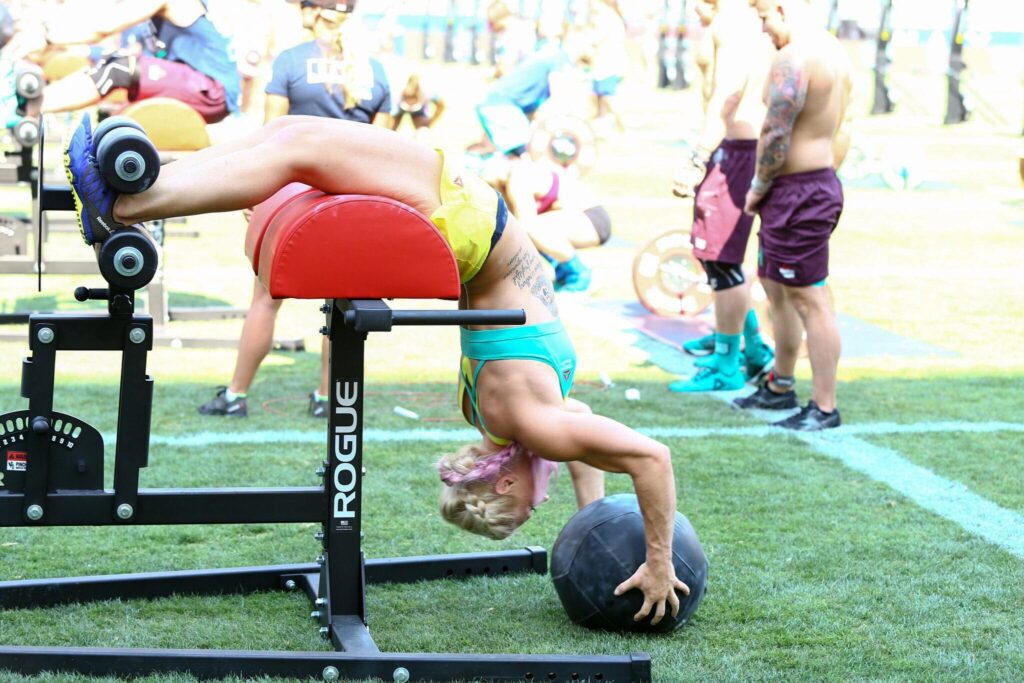
During GHD sit ups, as the torso extends backward, the hip flexors work eccentrically to control the descent. This type of training is extremely valuable for athletes who rely on rapid deceleration and acceleration movements.
Pelvic Stability and Lower-Back Health
Weak or imbalanced hip flexors can disrupt pelvic alignment, leading to increased stress on the lumbar spine. Strengthening them in coordination with the abdominals improves pelvic positioning, especially during athletic movements and heavy lifts.
Kendall et al.(2005) highlight how muscular imbalances around the pelvis contribute to lumbar strain and altered trunk mechanics. Balanced strengthening—especially through a controlled range—can improve functional movement patterns.
When performed correctly, the GHD sit up reinforces the connection between the hip flexors and trunk stabilizers, improving posture, control, and movement efficiency.
Benefit 3: Superior Trunk Stabilization and Functional Strength
Perhaps the most underrated Benefit of GHD Sit Ups is the improvement in functional trunk stability. Unlike machine-based ab exercises, the GHD sit up requires the entire kinetic chain to work together.
Enhanced Dynamic Trunk Control
The ability to stabilize the spine dynamically is essential for athletic performance and injury prevention. Behm and Colado(2012) explain that exercises requiring whole-body involvement produce higher neuromuscular activation and improve functional stability.
Because GHD sit ups challenge the trunk in multiple positions—flexed, extended, and neutral—the body must maintain control throughout the movement. This makes the exercise a powerful tool for developing dynamic trunk stability.
Posterior Chain Integration
Even though GHD sit ups focus on the anterior trunk, the posterior chain contributes significantly by stabilizing the pelvis and spine.
The glutes, hamstrings, and spinal erectors work together to hold the lower body in position. Hamlyn et al.(2007) demonstrated that the posterior chain becomes more active when the torso moves farther from neutral alignment.
This stabilizing role enhances the relationship between the anterior and posterior core, improving strength balance across the trunk.
Transfer to Athletic Movements and Lifts
Athletes with strong trunk stabilizers can generate more power and maintain efficient mechanics in high-skill movements. Improved trunk strength enhances performance in:
– Olympic lifts
– Squats
– Deadlifts
– Sprinting
– Gymnastics
– Change-of-direction sports
Comfort et al.(2011) found a positive correlation between trunk strength and power output in athletic lifts. GHD sit ups build the trunk strength necessary to stabilize heavy loads and explosive movements effectively.
This makes the GHD sit up a valuable accessory movement for athletes who rely on full-body power.
How to Perform GHD Sit Ups Safely
While the Benefits of GHD Sit Ups are substantial, proper technique is essential for preventing excessive lumbar strain.
Key Technical Points
– Maintain a neutral spine—avoid hyperextension.
– Brace the abdominals before each repetition.
– Lower under control; do not drop quickly into extension.
– Keep the ribs and pelvis aligned.
– Only go as low as you can maintain tension.
– Build volume gradually.
McGill(2007) emphasizes that poor trunk mechanics increase spinal stress. Proper technique dramatically reduces risk and ensures the movement trains the intended musculature.
Who Should Use GHD Sit Ups?
GHD sit ups are especially beneficial for:
– CrossFit athletes
– Sprinters
– Weightlifters
– Gymnasts
– Military and tactical athletes
– Field-sport athletes who require trunk strength and hip power
Beginners should start with partial range of motion and lower volume.
Individuals with existing lumbar spine conditions should consult a medical professional before performing the movement.
Fatigue has been shown to alter trunk mechanics and increase injury risk (Nadler et al.,2002), so athletes should prioritize quality over quantity.
Programming Recommendations
Beginner
– 2–3 sets of 6–10 reps
– Partial range of motion
– Slow and controlled tempo
Intermediate
– 3–4 sets of 10–15 reps
– Full range
– Moderate tempo
Advanced
– 4–5 sets
– 15–20+ reps
– Can add load (plate or med ball)
Progressive overload should be gradual to allow the trunk and hip flexors to adapt without excessive soreness.
Why GHD Sit Ups Are Worth Including in Your Training
The Benefits of GHD Sit Ups are backed by scientific evidence and practical results. Athletes who train with the GHD sit up can expect stronger abdominals, more powerful hip flexors, and improved trunk stability—all of which contribute to better performance in sport and training.
When executed correctly, the GHD sit up is one of the most effective, comprehensive, and athletic core exercises available.
Bibliography
• Akuthota, V., Ferreiro, A., Moore, T. and Fredericson, M.(2008) ‘Core stability exercise principles’, Current Sports Medicine Reports, 7(1), pp.39–44.
• Behm, D.G. and Colado, J.C.(2012) ‘The effectiveness of resistance training using unstable surfaces and devices for rehabilitation’, International Journal of Sports Physical Therapy, 7(2), pp.226–241.
• Comfort, P., Haigh, A. and Matthews, M.(2011) ‘Are changes in maximal squat strength during preseason training reflected in changes in sprint performance in rugby league players?’, Journal of Strength and Conditioning Research, 25(10), pp.2836–2843.
• Deane, R.S., Chow, J.W., Tillman, M.D. and Fournier, K.A.(2005) ‘Effects of hip flexor training on sprint, shuttle run, and vertical jump performance’, Journal of Strength and Conditioning Research, 19(3), pp.615–621.
• Hamlyn, N., Behm, D.G. and Young, W.B.(2007) ‘Trunk muscle activation during dynamic weight-training exercises and isometric instability activities’, Journal of Strength and Conditioning Research, 21(4), pp.1108–1112.
About the Author

Robbie Wild Hudson is the Editor-in-Chief of BOXROX. He grew up in the lake district of Northern England, on a steady diet of weightlifting, trail running and wild swimming. Him and his two brothers hold 4x open water swimming world records, including a 142km swim of the River Eden and a couple of whirlpool crossings inside the Arctic Circle.
He currently trains at Falcon 1 CrossFit and the Roger Gracie Academy in Bratislava.