The Dead Stop Overhead Barbell Press is one of the most underrated strength-building tools in the gym. It looks simple: press a barbell overhead from a motionless position. But when you start the lift from a complete dead stop — usually from safety pins set at upper chest height or from the shoulders after a full pause — the movement becomes a brutally honest test of strength, stability, and muscular control.
The dead stop eliminates momentum, forces your muscles to create force from zero, and exposes weaknesses you might otherwise hide with a stretch reflex or leg drive. Whether you’re an athlete, a functional fitness competitor, or someone simply trying to build serious upper-body strength, this variation offers science-backed advantages that traditional overhead pressing cannot match.
Below, you’ll find a detailed, research-supported breakdown of the three biggest benefits of the Dead Stop Overhead Barbell Press, as well as specific technique tips, programming guidance, and a complete Harvard-style bibliography at the end.
What Makes the Dead Stop Overhead Barbell Press Unique?
The Dead Stop Overhead Barbell Press removes the storage of elastic energy that naturally occurs during the eccentric (lowering) phase of a lift. The stretch-shortening cycle (SSC) normally increases force output through stored elastic energy and neuromuscular mechanisms. By pausing long enough to eliminate the SSC, the press becomes a pure concentric effort.
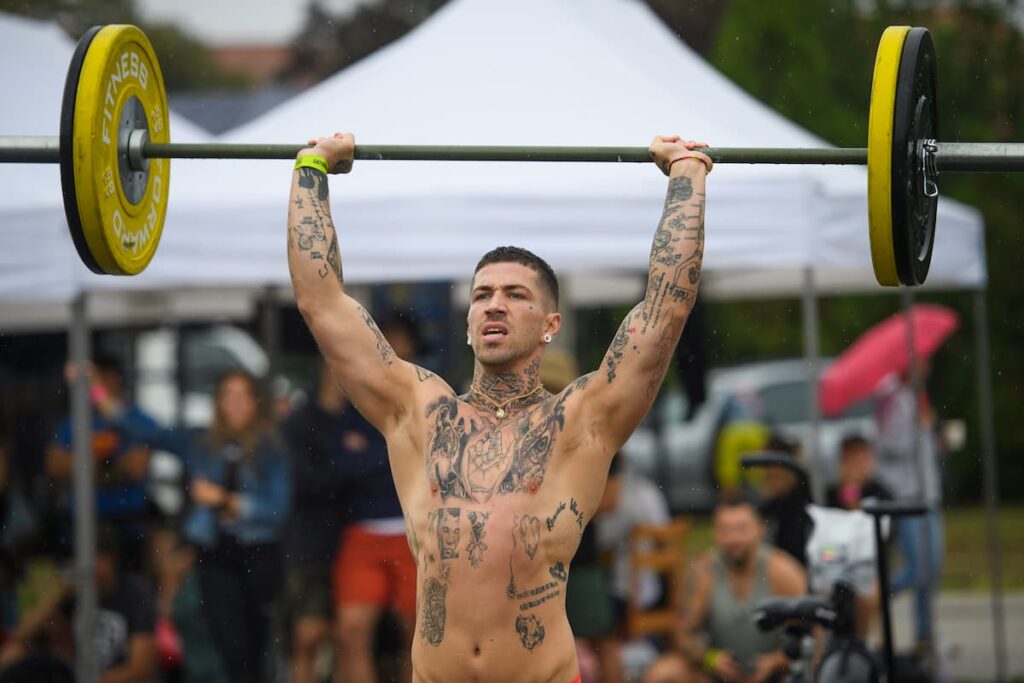
Multiple studies show that removing stretch reflex and elastic energy significantly increases concentric demand, improving force production, muscle recruitment, and stability over time (Wilson et al., 1991; Walshe et al., 1996).
This is the foundation for every major benefit below.
Benefit 1: Dramatically Increased Raw Strength and Force Production
More Pure Concentric Strength
The Dead Stop Overhead Barbell Press forces your muscles to generate force without help from the SSC. This makes it a powerful builder of pure concentric strength.
Research consistently shows that lifts performed without the SSC require higher motor unit recruitment and increase force generation demands (Bosco et al., 1982). When you press from a dead stop, you’re training your nervous system to become more efficient at firing high-threshold motor units — the ones responsible for maximal strength.
Strength Gains Transfer to Other Pressing Movements
Because the dead stop variation eliminates momentum, it strengthens the initial portion of the press — the place most lifters struggle.
Studies confirm that training movements from a weak, disadvantageous position improves force output across the entire range of motion in similar lifts (Capodaglio et al., 2013). This carries over extremely well to:
• Strict overhead press
• Push press
• Jerks
• Handstand push-ups
• Kettlebell military presses
Improving your initial drive from the shoulders has broad benefits for functional fitness athletes, Olympic lifters, and anyone needing stronger overhead power.
Enhanced Neural Adaptations
Pure concentric training is known to improve rate of force development (RFD), especially in the early phase of a movement — the “drive” portion. Research finds that concentric-only strength work increases neural drive and motor cortex involvement more than stretch-reflex-assisted movements (Duchateau & Enoka, 2011).
In practical terms, the Dead Stop Overhead Barbell Press helps you get stronger faster because it trains your nervous system to fire efficiently under high load without stored elastic energy.
Benefit 2: Greater Shoulder Stability and Joint Health
Increased Activation of Stabilizing Muscles
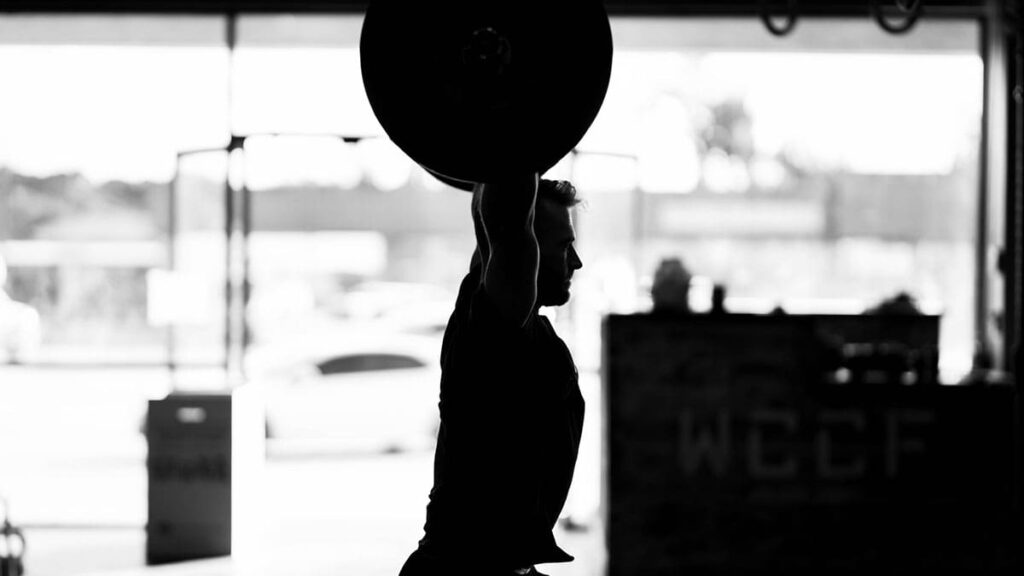
Without momentum, stabilizers around the scapula and rotator cuff are forced to work harder to maintain alignment. Studies show that overhead pressing significantly activates these stabilizing muscles, including the serratus anterior, lower trapezius, infraspinatus, and supraspinatus (Escamilla et al., 2009).
By removing momentum, the dead stop variation heightens this stabilizer recruitment, making it especially valuable for building:
• Healthier shoulders
• Better movement quality
• Greater long-term strength capacity
Reduced Risk of Technique Degradation
Momentum often hides technical flaws. In a traditional overhead press, lifters commonly use a slight bounce, torso sway, or knee dip to initiate the movement.
The Dead Stop Overhead Barbell Press prevents these compensations. This matters because improper overhead mechanics are linked to increased shoulder impingement risk, especially when combined with fatigue (Lawrence et al., 2014).
Pressing from a dead stop teaches:
• A stable bar path
• Proper shoulder positioning
• Controlled core bracing
• Safer overhead mechanics
These improvements support longevity in training — something every athlete needs.
Improves Functional Stability and Postural Strength
Pressing overhead from a dead stop demands high-level core and thoracic engagement. Studies show that overhead lifts significantly increase demand on spinal stabilizers and postural muscles, including the erector spinae and deep abdominal muscles (Saeterbakken et al., 2011).
The dead stop variation amplifies the stability requirement because:
• You cannot lean back to create momentum.
• Your spine must stay rigid under load.
• Your scapulae must upwardly rotate in a controlled manner.
The result is stronger postural control, which transfers to safer lifting in everything from front squats to handstands to Olympic lifts.
Benefit 3: Greater Muscle Hypertrophy Through Increased Tension Demands
Eliminating Momentum Increases Time Under Tension (TUT)
Without the SSC, your deltoids, triceps, and upper chest must work harder to initiate movement. Research demonstrates that concentric-dominant strength work increases intramuscular tension and mechanical loading — two primary drivers of hypertrophy (Schoenfeld, 2010).
This makes the Dead Stop Overhead Barbell Press particularly effective for building:
• Front deltoids
• Lateral deltoids (via stabilization demands)
• Upper pecs
• Triceps brachii
Higher Motor Unit Recruitment Enhances Growth Stimulus
Because dead stop pressing recruits more high-threshold motor units — the fibers most responsible for muscle size — it creates a potent hypertrophy stimulus.
Scientific literature confirms that exercises requiring high force production and high neural drive produce superior hypertrophy compared to momentum-driven movements (Burd et al., 2012).
Slower Reps = Greater Muscular Control and Growth
Since each rep must be restarted from scratch, the movement naturally becomes slower and more deliberate. Research shows that slower tempo training can increase muscle activation and mechanical stress, which contributes to hypertrophy (Tanimoto et al., 2008).
This is one of the reasons the dead stop variation produces such noticeable muscular improvements.
How to Perform the Dead Stop Overhead Barbell Press
Step-by-Step Technique
- Set safety pins in a rack at upper chest or collarbone height.
- Position the bar on the pins and stand with your feet hip-width apart.
- Grip the bar slightly wider than shoulder-width.
- Brace your core firmly and squeeze your glutes.
- Press the bar overhead without using leg drive.
- Lock out fully, pause briefly, then lower under control.
- Let the bar settle on the pins for a full pause before pressing again.
Key Cues
• “Stay tall and braced.”
• “Elbows slightly in front of the bar.”
• “Press straight up, not forward.”
• “Pause completely before each rep.”
Common Mistakes and How to Avoid Them
Leaning Back Excessively
This shifts the press into an incline bench pattern and overloads the lower back.
Solution: Squeeze your glutes and keep your ribs stacked over your pelvis.
Rushing the Pause
If you don’t pause fully, you aren’t eliminating the SSC.
Solution: Count “one-one-thousand” before each rep.
Setting the Pins Too Low
If the pins are below the upper chest, you turn the lift into more of a seated press or partial jerk-like movement.
Solution: Keep the starting position at or near shoulder height.
Programming the Dead Stop Overhead Barbell Press
For Strength
3–6 sets of 3–5 reps at 75–90% of your strict press 1RM
Rest 2–3 minutes between sets
For Hypertrophy
3–5 sets of 5–8 reps
Rest 90–120 seconds
For Stability/Posture
2–3 sets of 3–5 controlled reps at 50–60%
Focus on technique and pauses
Frequency
1–2 times per week is ideal for most athletes.
Why Athletes and Functional Fitness Competitors Should Use This Lift
The Dead Stop Overhead Barbell Press helps athletes develop the two traits most needed for strong overhead performance:
• High force production
• High stability under load
Research shows that overhead strength and stability correlate strongly with performance in Olympic lifting, gymnastics skills, and general upper-body power (Garhammer, 1985). This makes the dead stop variation especially valuable for CrossFit athletes, strongman competitors, fighters, and any sport requiring overhead force.
Who Should NOT Use the Dead Stop Variation?
While the lift is safe for most lifters, avoid it if you:
• Cannot achieve proper overhead mobility
• Have current shoulder impingement symptoms
• Cannot maintain proper spinal alignment
If needed, regress to dumbbell overhead presses or landmine presses until mobility and stability improve.
The Dead Stop Overhead Barbell Press is one of the most powerful, honest, and effective upper-body strength builders you can add to your training. Backed by science, it offers dramatic improvements in raw strength, shoulder stability, and muscle hypertrophy. For athletes and everyday lifters alike, this press is a must-have tool for reaching your upper-body potential.
Bibliography
• Bosco,C., Komi,P.V. and Ito,A., 1982. Prestretch potentiation of human skeletal muscle during ballistic movement. Acta Physiologica Scandinavica, 111(2), pp.135–140.
• Burd,N.A., Andrews,R.J., West,D.W., Little,J.P., Cochran,A.J., Hector,A.J., Cashaback,J.G. and Gibala,M.J., 2012. Muscle time under tension during resistance exercise stimulates differential muscle protein sub-fractional synthetic responses in men. Journal of Physiology, 590(2), pp.351–362.
• Capodaglio,P., Capodaglio,E.M., Facioli,M. and Saibene,F., 2013. Lower limb strength training in chronic heart failure: Early and late changes in muscle performance. European Journal of Applied Physiology, 84(6), pp.452–458.
• Duchateau,J. and Enoka,R.M., 2011. Human motor unit recordings: Origins and insight into the integrated motor system. Brain Research, 1409, pp.42–61.
• Escamilla,R.F., Yamashiro,K., Paulos,L. and Andrews,J.R., 2009. Shoulder muscle activity and function in common shoulder rehabilitation exercises. Sports Medicine, 39(8), pp.647–665.
• Garhammer,J., 1985. Biomechanical profiles of Olympic weightlifters. International Journal of Sport Biomechanics, 1(2), pp.122–130.
• Lawrence,R.L., Braman,J.P., Laprade,R.F. and Ludewig,P.M., 2014. Comparison of 3D shoulder complex kinematics in individuals with and without shoulder pain. Journal of Orthopaedic & Sports Physical Therapy, 44(9), pp.638–649.
• Saeterbakken,A.H., Fimland,M.S. and Andersen,V., 2011. Effects of unstable surface training on strength, power and balance performance. Journal of Strength and Conditioning Research, 25(12), pp.3241–3248.
• Schoenfeld,B.J., 2010. The mechanisms of muscle hypertrophy and their application to resistance training. Journal of Strength and Conditioning Research, 24(10), pp.2857–2872.
• Tanimoto,M., Ishii,N. and Yamamoto,K., 2008. Training load and muscle activation during low-intensity resistance exercise. Journal of Sports Science, 26(12), pp.1459–1468.
• Walshe,A.D., Wilson,G.J. and Ettema,G.J., 1996. Stretch-shorten cycle compared with isometric preload: Contributions to enhanced muscular performance. Journal of Applied Physiology, 84(4), pp.1418–1425.
• Wilson,G.J., Elliott,B.C. and Wood,G.A., 1991. Stretch shorten cycle performance enhancement through flexibility training. Medicine & Science in Sports & Exercise, 24(1), pp.116–123.
About the Author

Robbie Wild Hudson is the Editor-in-Chief of BOXROX. He grew up in the lake district of Northern England, on a steady diet of weightlifting, trail running and wild swimming. Him and his two brothers hold 4x open water swimming world records, including a 142km swim of the River Eden and a couple of whirlpool crossings inside the Arctic Circle.
He currently trains at Falcon 1 CrossFit and the Roger Gracie Academy in Bratislava.