Building a muscular chest is a priority for many fitness enthusiasts, as it enhances both strength and physical appearance. This article delves into the top three resistance exercises that will help you achieve a well-defined, muscular chest.
By leveraging research-backed techniques and understanding the specific muscles activated in each exercise, you can structure a workout that maximises your chest’s growth potential. Each exercise here has been selected for its efficiency, muscle activation, and scientific backing. Let’s explore these exercises in detail.
The Science Behind Chest Musculature
The primary muscles that make up the chest include the pectoralis major and pectoralis minor. The pectoralis major is a large, fan-shaped muscle covering the upper chest, while the pectoralis minor is a thinner, triangular muscle located beneath the major. According to an electromyography (EMG) analysis, effective chest exercises must stimulate these muscles across various angles (Trebs et al., 2010).
Proper technique and resistance levels are critical in targeting these muscles effectively, ensuring optimal activation and minimising injury risk (Welsch et al., 2005).
1. Barbell Bench Press
The barbell bench press is one of the most powerful compound exercises for chest development. It is widely regarded as the cornerstone for building chest strength and hypertrophy. The barbell bench press is particularly effective because it targets multiple muscle groups, including the pectoralis major, triceps, and anterior deltoids, making it one of the best exercises for overall upper body strength.
Execution and Technique
- Lie back on a flat bench and grip the barbell slightly wider than shoulder-width apart.
- Lower the barbell to the middle of your chest, keeping your elbows at about a 45-degree angle to avoid shoulder strain.
- Press the barbell back up to the starting position by extending your arms fully.
- Repeat for the desired number of repetitions.
Why It Works
The barbell bench press creates a significant stretch in the pectoral muscles, particularly the lower and middle fibres. Studies on muscle activation using EMG have shown that the flat barbell bench press is among the most effective exercises for recruiting the pectoralis major, providing substantial activation across the muscle (Trebs et al., 2010). The heavier loads typically used in this exercise contribute to greater mechanical tension, which is critical for hypertrophy (Schoenfeld, 2010).
2. Incline Dumbbell Press
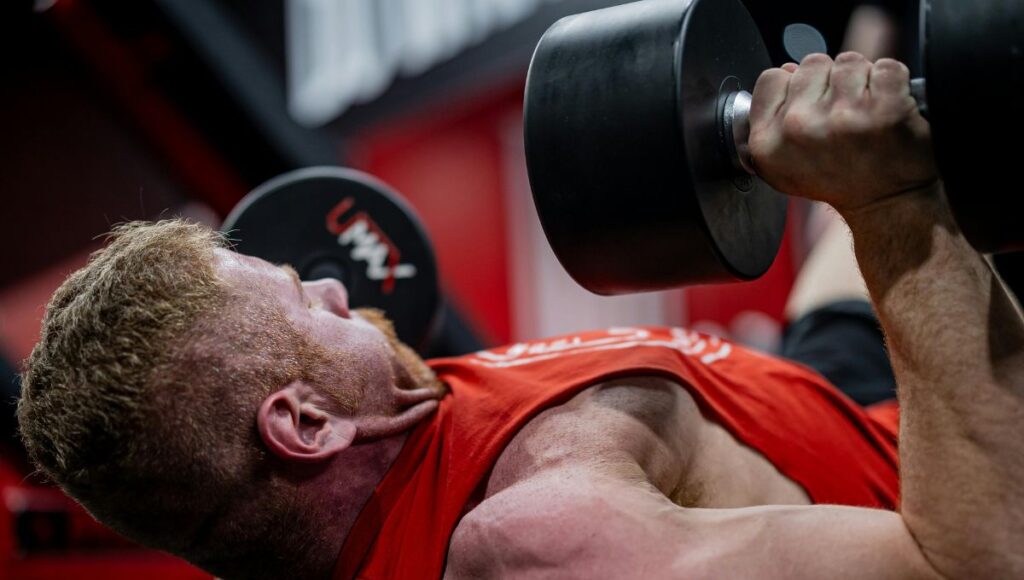
The incline dumbbell press is an excellent exercise for targeting the upper portion of the chest. By setting the bench at a 30 to 45-degree angle, you can increase the activation of the clavicular head of the pectoralis major, which is responsible for the upper chest.
This exercise also requires stabilisation due to the independent nature of the dumbbells, which recruits the pectoral muscles in a unique way compared to barbell presses.
Execution and Technique
- Adjust a bench to a 30 to 45-degree incline.
- Sit on the bench with a dumbbell in each hand, resting them on your thighs.
- Kick the dumbbells up with your knees as you lie back, positioning them directly over your shoulders.
- Lower the dumbbells slowly until they are at chest level, maintaining a controlled movement.
- Press the dumbbells back up by squeezing your chest, stopping just before lockout.
- Repeat for the desired number of repetitions.
Why It Works
The incline dumbbell press shifts focus to the upper chest region, which is essential for achieving a well-rounded look. An EMG study by Barnett et al. (1995) found that the incline press activates the clavicular head of the pectoralis major more than the flat bench press, making it an ideal exercise for enhancing the upper chest. The dumbbells’ independent nature also allows for a greater range of motion, promoting increased muscle fibre recruitment (Gentil et al., 2007).
3. Cable Fly
The cable fly is a highly effective isolation exercise that targets the chest muscles without significant involvement from the triceps or shoulders. By using cables, you can keep constant tension on the pectoral muscles throughout the movement, which is not possible with free weights. This constant tension is essential for stimulating the muscle fibres fully and achieving a good pump.
Execution and Technique
- Stand between two cable stacks with the handles set at chest height.
- Grab a handle in each hand and step forward slightly.
- Begin with your arms extended out to the sides in a wide arc, with a slight bend in your elbows.
- Bring the handles together in front of you, squeezing your chest at the peak of the movement.
- Slowly return to the starting position by allowing your arms to extend back to the sides.
- Repeat for the desired number of repetitions.
Why It Works
The cable fly is excellent for emphasising the middle and inner portions of the chest. Unlike free-weight exercises, cables maintain continuous resistance, which is beneficial for muscle hypertrophy (Schoenfeld, 2010). Research shows that isolation exercises like the cable fly can help build strength and muscle in specific regions of the chest when combined with compound movements (Gentil et al., 2007). The fly movement also increases time under tension, which has been shown to contribute to muscle growth by creating metabolic stress within the muscles (Schoenfeld, 2010).
Creating an Optimal Chest Workout
When creating a workout plan focused on chest hypertrophy, it’s essential to include a mix of compound and isolation exercises that target the muscle from different angles. A well-rounded chest workout might include three to four sets of the barbell bench press, incline dumbbell press, and cable fly, with 8–12 repetitions per set. This rep range is known to optimise muscle hypertrophy by increasing metabolic stress and mechanical tension (Schoenfeld, 2010).
Common Mistakes to Avoid
1. Overusing Heavy Weights
Lifting heavy weights without proper form can lead to shoulder strain and limit pectoral activation. To maximise muscle growth, focus on lifting weights that allow you to complete each repetition with controlled form.
2. Failing to Engage the Mind-Muscle Connection
Research indicates that the mind-muscle connection, or focusing on the muscle being worked, can enhance muscle activation (Snyder & Fry, 2012). During each exercise, consciously engage your chest muscles to improve effectiveness.
3. Ignoring Rest and Recovery
Building a muscular chest requires adequate rest. Overtraining can hinder muscle growth and increase the risk of injury (Schoenfeld, 2011). Ensure at least 48 hours between intense chest sessions for optimal recovery.
Conclusion
To develop a muscular chest, integrating the barbell bench press, incline dumbbell press, and cable fly into your workout routine is highly effective. Each exercise targets specific areas of the chest, allowing for balanced growth and enhanced muscle definition. Proper technique, the right weight selection, and understanding the science behind these movements will help you make the most of your chest workouts.
Remember to maintain a balanced workout schedule that incorporates rest days to support recovery and muscle growth. With these exercises and a strategic approach, you can achieve the muscular chest you’re aiming for.
Key Takeaways
| Key Point | Description |
|---|---|
| Barbell Bench Press | Best compound exercise for overall chest development, particularly the lower and middle chest. |
| Incline Dumbbell Press | Targets the upper chest, essential for a balanced, muscular chest appearance. |
| Cable Fly | Provides constant tension and isolates the chest muscles effectively. |
Bibliography
Barnett, C., Kippers, V., & Turner, P. (1995). Effects of variations of the bench press exercise on the EMG activity of five shoulder muscles. Journal of Strength and Conditioning Research, 9(4), 222-227.
Gentil, P., Oliveira, E., & Figueiredo, T. (2007). Muscle activation in conventional vs. complex multi-joint exercises. Brazilian Journal of Sports Medicine, 13(1), 57-61.
Schoenfeld, B. (2010). The mechanisms of muscle hypertrophy and their application to resistance training. Journal of Strength and Conditioning Research, 24(10), 2857-2872.
Schoenfeld, B. (2011). Does exercise-induced muscle damage play a role in skeletal muscle hypertrophy? Journal of Strength and Conditioning Research, 25(3), 1-10.
Snyder, B. J., & Fry, W. R. (2012). Effect of verbal instruction on muscle activity during the bench press exercise. Journal of Strength and Conditioning Research, 26(9), 2394-2400.
Trebs, A. A., Brandenburg, J. P., & Pitney, W. A. (2010). An electromyographic analysis of three chest press exercises to determine the most effective position and technique for maximizing pectoralis major activity. Journal of Strength and Conditioning Research, 24(8), 2164-2172.
Welsch, E. A., Bird, M., & Mayhew, J. L. (2005). Electromyographic activity of the pectoralis major and anterior deltoid muscles during three upper-body lifts. Journal of Strength and Conditioning Research, 19(2), 449-452.