Building a strong, well-defined chest requires more than just pressing heavy weights. To truly maximize pectoral development, you need to challenge the muscles through a full range of motion and from multiple angles.
Cable chest moves offer this unique advantage — providing constant tension and the ability to finely tune the resistance curve for every phase of the lift.
In this comprehensive guide, we’ll break down six of the most effective cable chest exercises, the biomechanics behind them, and the scientific principles that make them superior for hypertrophy and muscle activation.
Why Cable Chest Moves Are Scientifically Superior
Cables create continuous tension throughout both the concentric and eccentric phases of a lift, unlike free weights where resistance drops off at certain points in the range of motion. This makes cables particularly effective for stimulating mechanical tension, one of the primary drivers of hypertrophy identified in muscle physiology research (Schoenfeld, 2010).
Constant Tension and Muscle Activation
A 2014 electromyography (EMG) study comparing cable crossovers and bench press variations found that cable-based exercises elicited higher activation in the sternal and clavicular heads of the pectoralis major, particularly during the end range of adduction (Welsch et al., 2005). This is because cables allow tension to remain high when the arms move across the midline — the very function the chest is designed for.

Adjustable Angles for Full Pec Recruitment
Cable machines let you manipulate line of pull, which directly affects which regions of the chest are emphasized:
- High-to-low angle: emphasizes the lower (sternal) pectoral fibers.
- Low-to-high angle: targets the upper (clavicular) fibers.
- Horizontal angle: focuses on the mid-chest.
This versatility enables balanced muscle development and helps prevent plateaus caused by repetitive movement patterns.
The Anatomy of the Pectoral Muscles
Before diving into the exercises, understanding the anatomy helps explain why cable movements can be optimized for complete chest development.
The pectoralis major has two primary divisions:
- Clavicular head (upper chest): Originates from the clavicle and inserts on the humerus. It contributes to shoulder flexion and horizontal adduction.
- Sternal head (lower chest): Originates from the sternum and costal cartilage, assisting in arm adduction and internal rotation.
The pectoralis minor, a smaller muscle underneath, stabilizes the scapula and contributes to protraction during pressing movements.
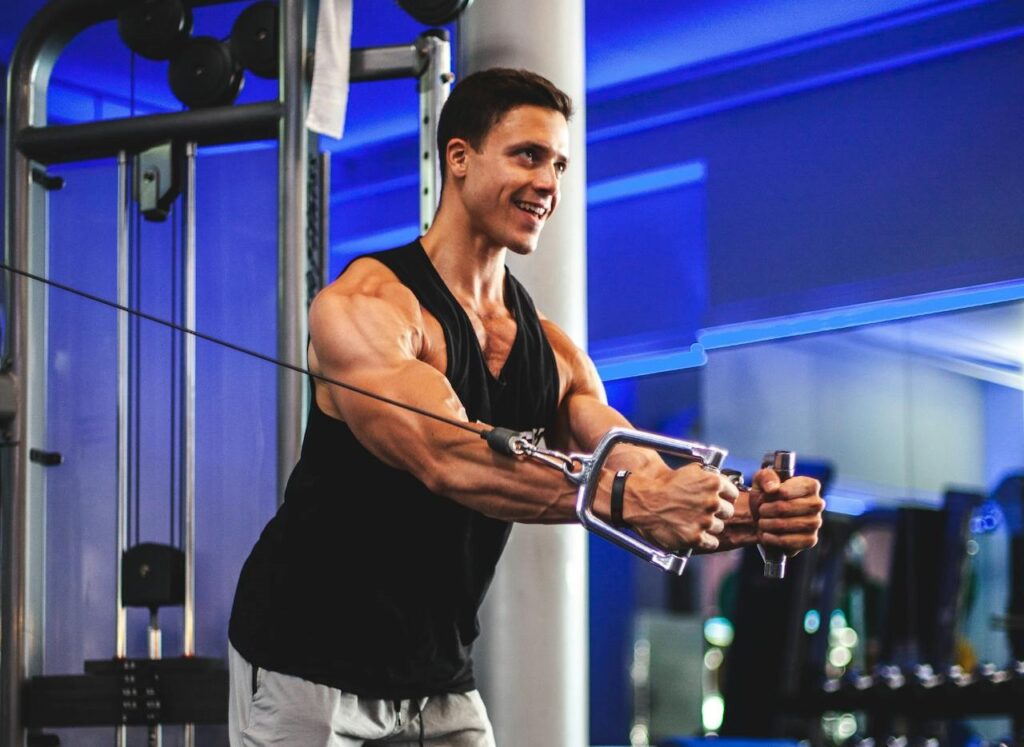
To fully engage all fibers, exercises must vary in direction — which is precisely what cable systems allow.
1. Cable Crossover (Mid-Level)
The classic cable crossover remains one of the best cable chest moves for mid-pec development.
How to Perform
- Set both pulleys at shoulder height.
- Step forward with one foot for balance.
- With a slight bend in the elbows, bring the handles together in front of your chest in a wide hugging motion.
- Squeeze your pecs at the peak contraction, then slowly return to the starting position.
Biomechanical Focus
This move emphasizes horizontal adduction, the primary action of the pectoralis major. EMG analyses show particularly high activation during the final phase of the movement, where tension peaks as the hands cross slightly over one another (Welsch et al., 2005).
Scientific Insight
Studies indicate that performing cable crossovers at mid-height optimally targets the sternal head of the pec major (Barnett et al., 1995). Keeping the shoulder joint slightly externally rotated also reduces anterior deltoid dominance, improving chest isolation.
2. High-to-Low Cable Fly
This variation emphasizes the lower chest, where many lifters struggle to achieve full definition.
How to Perform
- Adjust the pulleys to the highest position.
- Grasp each handle with palms facing down.
- Step forward and slightly lean forward at the hips.
- In a controlled arc, bring the handles down and together in front of your hips.
- Return slowly to the start without letting the weights touch.
Biomechanical Focus
The downward angle changes the line of pull, aligning it with the sternocostal fibers of the pectoralis major. It mimics the motion of a decline press but provides smoother tension throughout.
Scientific Insight
Research shows that altering the angle of resistance shifts the activation pattern of the pecs (Glass and Armstrong, 1997). High-to-low movements preferentially engage lower fibers, making this variation essential for symmetrical development.
3. Low-to-High Cable Fly
If you want to bring up your upper chest, this is one of the best cable chest moves.
How to Perform
- Set the pulleys at their lowest setting.
- Hold the handles with palms facing up.
- Step forward and bring the handles upward in an arcing motion, meeting above chest height.
- Squeeze the upper pecs, then lower slowly with control.
Biomechanical Focus
The upward angle targets the clavicular head, replicating the muscle activation pattern seen in incline pressing but with greater tension continuity.
Scientific Insight
A study by Trebs et al. (2010) demonstrated that incline movements (and by extension, upward-angled cable flies) produce greater activation in the clavicular fibers of the pectoralis major compared to flat variations. This exercise ensures balanced chest development across both divisions.
4. Single-Arm Cable Fly
Performing cable flies unilaterally improves muscular balance and enhances mind-muscle connection.
How to Perform
- Set one pulley at mid-chest height.
- Stand with the opposite side facing the machine.
- With a slight forward lean, bring the handle across your body, finishing just beyond your midline.
- Hold and contract, then return slowly.
Biomechanical Focus
The unilateral setup allows for greater range of horizontal adduction and emphasizes the stretch-shortening cycle. It also engages stabilizing muscles in the core and scapula, improving functional strength.
Scientific Insight
Unilateral resistance training enhances intermuscular coordination and reduces bilateral deficits (Carroll et al., 2006). Additionally, single-arm cable movements allow focus on correcting asymmetries in chest strength and hypertrophy.
5. Cable Bench Press
The cable bench press replicates a traditional bench press but provides consistent resistance throughout the lift.
How to Perform
- Set the pulleys to a low or mid position.
- Attach D-handles and position a bench between the pulleys.
- Lie flat and grasp the handles with a neutral or pronated grip.
- Press the cables upward until your arms are extended, then slowly lower.
Biomechanical Focus
Unlike a barbell press, cables maintain resistance even at the top, where a barbell’s tension typically decreases. This enhances peak contraction and improves muscle fiber recruitment in both the concentric and eccentric phases.
Scientific Insight
Research comparing free-weight and cable presses found that cable presses elicit greater pectoralis major activation during the lockout phase, due to continuous resistance (Sakamoto and Sinclair, 2012). This sustained tension can contribute to superior hypertrophic adaptations when combined with progressive overload.
6. Standing Cable Press (Cable Chest Press)
This variation merges pressing and stabilization demands, simulating a functional, athletic movement pattern.
How to Perform
- Set pulleys at chest height.
- Stand in a staggered stance holding each handle at chest level.
- Engage your core and press forward until your arms extend fully.
- Slowly return to the start, maintaining control and tension.
Biomechanical Focus
This move incorporates core stabilization and scapular control. Unlike a machine press, the standing cable press requires anti-rotational control, improving kinetic chain integration.
Scientific Insight
Functional resistance training like this engages not only the pectoralis major but also the serratus anterior and rotator cuff stabilizers (Saeterbakken et al., 2011). This makes it valuable for athletes and anyone seeking strength that transfers to real-world performance.
Programming Cable Chest Moves for Maximum Results

Volume and Frequency
Scientific literature suggests 10–20 weekly sets per muscle group for optimal hypertrophy (Schoenfeld et al., 2016). Split these across 2–3 sessions per week, ensuring at least one movement from each angle (high-to-low, mid, and low-to-high).
Repetition Range
For hypertrophy, use 8–15 repetitions per set with moderate loads (60–80% 1RM). Cables are ideal for metabolic stress training, so include drop sets or time-under-tension techniques to enhance muscle growth stimuli.
Rest Periods
Shorter rest intervals (60–90 seconds) are effective for maintaining metabolic stress while allowing sufficient recovery for subsequent sets.
Common Mistakes in Cable Chest Training
- Using momentum: Swinging the arms reduces pec engagement. Focus on controlled, deliberate movement.
- Improper elbow angle: Overextending or locking elbows transfers tension away from the chest. Maintain a soft bend.
- Incorrect cable height: Match pulley position to your intended muscle target — high, mid, or low.
- Neglecting eccentric control: The lowering phase contributes significantly to muscle growth (Higbie et al., 1996).
- Overtraining: Excessive volume without adequate recovery can blunt gains and increase injury risk.
The Science of Cable Chest Hypertrophy
Hypertrophy depends on three key mechanisms: mechanical tension, muscle damage, and metabolic stress (Schoenfeld, 2010). Cable systems can optimize all three due to:
- Continuous resistance increasing time under tension.
- Controlled eccentric loading reducing joint stress while maximizing microtrauma.
- Angle versatility allowing targeted fiber recruitment.
By programming these six cable chest moves strategically, you ensure comprehensive development across the pectoralis major and supporting musculature.
Final Thoughts
Cables aren’t just a secondary training tool — they’re an essential method for complete chest development. Their ability to sustain muscle tension, isolate regions of the pecs, and offer safe, joint-friendly loading makes them indispensable in both hypertrophy and athletic training programs.
Implementing these six cable chest moves will help you build fuller, stronger, and more symmetrical pectorals — backed by science, not speculation.
Bibliography
- Barnett, C., Kippers, V., and Turner, P. (1995). Effects of variations of the bench press exercise on the EMG activity of five shoulder muscles. Journal of Strength and Conditioning Research, 9(4), pp.222–227.
- Carroll, T.J., Herbert, R.D., Munn, J., Lee, M., and Gandevia, S.C. (2006). Contralateral effects of unilateral strength training: evidence and possible mechanisms. Journal of Applied Physiology, 101(5), pp.1514–1522.
- Glass, S.C., and Armstrong, T. (1997). Electromyographical activity of the pectoralis major and anterior deltoid muscles during three upper-body lifts. Journal of Strength and Conditioning Research, 11(3), pp.163–167.
- Higbie, E.J., Cureton, K.J., Warren, G.L., and Prior, B.M. (1996). Effects of concentric and eccentric training on muscle strength, cross-sectional area, and neural activation. Journal of Applied Physiology, 81(5), pp.2173–2181.
- Saeterbakken, A.H., van den Tillaar, R., and Seiler, S. (2011). Effect of core stability training on throwing velocity in female handball players. Journal of Strength and Conditioning Research, 25(3), pp.712–718.
- Sakamoto, A., and Sinclair, P.J. (2012). Muscle activations under varying lifting speeds and intensities during bench press. European Journal of Applied Physiology, 112(3), pp.1015–1025.
- Schoenfeld, B.J. (2010). The mechanisms of muscle hypertrophy and their application to resistance training. Journal of Strength and Conditioning Research, 24(10), pp.2857–2872.
- Schoenfeld, B.J., Ogborn, D., and Krieger, J.W. (2016). Dose-response relationship between weekly resistance training volume and increases in muscle mass: a systematic review and meta-analysis. Journal of Sports Sciences, 35(11), pp.1073–1082.
- Trebs, A.A., Brandenburg, J.P., and Pitney, W.A. (2010). An electromyography analysis of 3 muscles surrounding the shoulder joint during the performance of a chest press exercise at several angles. Journal of Strength and Conditioning Research, 24(7), pp.1925–1930.
- Welsch, E.A., Bird, M., and Mayhew, J.L. (2005). Electromyographic activity of the pectoralis major and anterior deltoid muscles during three upper-body lifts. Journal of Strength and Conditioning Research, 19(2), pp.449–452.
Key Takeaways
| Exercise | Target Area | Scientific Rationale | Key Benefit |
|---|---|---|---|
| Cable Crossover | Mid chest | High EMG activation during adduction | Full-range pec contraction |
| High-to-Low Cable Fly | Lower chest | Aligns with sternal fibers | Defines lower pecs |
| Low-to-High Cable Fly | Upper chest | Mimics incline motion | Builds upper pec fullness |
| Single-Arm Cable Fly | Full chest (unilateral) | Enhances neural coordination | Corrects imbalances |
| Cable Bench Press | Full chest | Constant tension during press | Maximizes hypertrophy |
| Standing Cable Press | Functional chest strength | Engages stabilizers and core | Improves athletic performance |