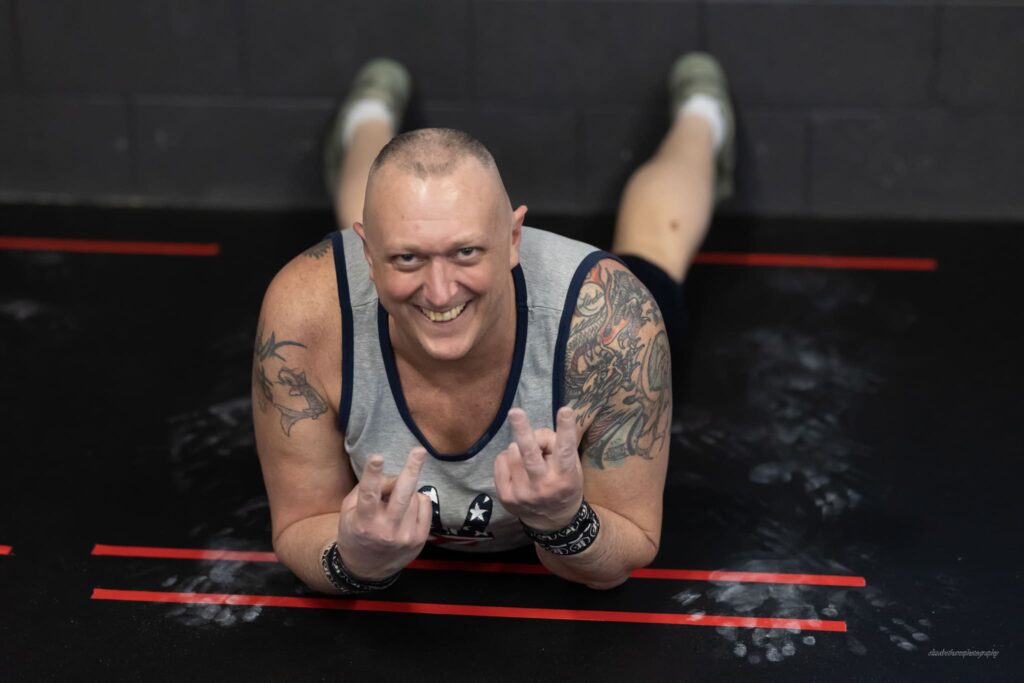
Kris Rugloski, a decorated veteran of over 30 HYROX races found a new test when she made her debut in the Barkley Marathons.
Rugloski earned her place at this year’s Barkley through a win at last year’s Barkley Fall Classic, a qualifying event held in the same rugged terrain in Tennessee. She was joined by fellow qualifier Tim Landy of England, who claimed the men’s title at the Fall Classic.
While Landy was among a select group of just 10 runners (out of 40 starters) to complete the first loop within the official time cut-off, Rugloski faced a far greater challenge. The full Barkley Marathons course proved to be a dramatic step up from the Fall Classic, testing even her considerable endurance and experience.
In the end Rugloski managed to collect about half the book pages before getting lost and heading back to camp.
Despite the outcome, Rugloski remains undeterred and has expressed her determination to return and take on the challenge once again.
Writing on Instagram she stated:
‘I thought I knew what hard was. I’ve pushed through pain, exhaustion, and difficulty before. But the Barkley Marathons exist in a realm of challenge entirely their own.’
The Barkley Marathons: The World’s Toughest Race Explained
Often described as the most brutal footrace on Earth, the Barkley Marathons has earned a near-mythical reputation in the ultrarunning world. With its secretive entry process, punishing terrain, and near-impossible completion rate, the Tennessee-based race stands in stark contrast to most running races in that it is not designed to be completed.
First held in 1986, the event rose to prominence with the 2014 release of the documentary The Barkley Marathons: The Race That Eats Its Young. Since then, interest in the race has exploded, with endurance athletes and fans worldwide captivated by its unique challenges and legendary difficulty.
And for good reason: in nearly four decades, the race has only been completed 26 times by 20 runners. Most years, no one finishes at all.
The 2024 edition proved historic. British ultrarunner Jasmin Paris became the first woman to ever finish the race, and for the first time in Barkley history, five runners completed the full course within the 60-hour time limit — the most finishers in a single year.
But what makes the Barkley so tough?
Held in Frozen Head State Park, Tennessee, the course consists of five unmarked loops of roughly 20 miles each, though many believe the total distance is significantly greater. Runners must navigate using only a map and compass — no GPS, no watches — and track down hidden books along the route, tearing out specific pages to prove they’ve followed the course. The total elevation gain across the five loops is a staggering 60,000 feet.
Here is Kris Rugloski’s Instagram Post in full:
I thought I knew what hard was. I’ve pushed through pain, exhaustion, and difficulty before. But the Barkley Marathons exist in a realm of challenge entirely their own.
There’s no way to compare it to other races when you spend almost no time on marked trails and instead navigate an extreme scavenger hunt for book pages.
I managed to collect half my pages before taking a scenic detour (I was lost) for a few hours, searching for the next one, only to end up packing it in and heading back to camp.
This isn’t just an ultramarathon—it’s a riddle, a puzzle, and an exploration of the edge of what’s possible.
I went in knowing the odds. I came out knowing exactly why they’re so low. The Barkley isn’t meant to be finished. And that’s exactly why it’s the hardest race on Earth.
Such a privilege to spend some time “out there”. Will not be the last time! #bm100