Time to add 50 pounds to your deadlift in 8 weeks.
The deadlift is one of the most effective compound lifts for building strength, muscle, and resilience. Many lifters set the ambitious goal of adding 50 pounds to their pull in a short timeframe.
With the right program design, recovery strategies, and scientific principles applied, this is an achievable target within eight weeks. This article breaks down exactly how to make it happen.
Why the Deadlift Responds Well to Rapid Progress
The deadlift is a full-body movement recruiting the posterior chain (hamstrings, glutes, spinal erectors), upper back, grip, and core stabilizers. Because it involves multiple large muscle groups, improvements in both neural efficiency and muscular adaptation can be made quickly. Research has shown that strength gains in compound lifts often come faster than in isolation exercises due to the higher systemic demand (Sale, 1988).

In particular, the deadlift benefits significantly from neural adaptations such as increased motor unit recruitment, improved synchronization, and reduced antagonist co-activation (Carroll et al., 2001). These neurological changes can be developed in a matter of weeks, making short-term strength boosts realistic.
The Science of Strength Adaptation
Add 50 Pounds to Your Deadlift: Neural Adaptations
Early-stage strength improvements are primarily neurological. Training at 75–90% of one-repetition maximum (1RM) enhances motor unit firing frequency and coordination (Enoka, 1997). These adaptations occur quickly, meaning that an eight-week training block is sufficient to exploit this process.
Muscular Adaptations
Hypertrophy, or muscle growth, is slower to develop but contributes meaningfully to long-term strength. While hypertrophy typically requires months, short-term increases in muscle cross-sectional area have been documented within eight weeks of progressive overload training (Wernbom et al., 2007). This structural change helps support new strength levels.
Add 50 Pounds to Your Deadlift: Tendon and Connective Tissue
Tendon stiffness, crucial for force transmission, adapts more slowly but shows measurable improvement after six to eight weeks of resistance training (Kubo et al., 2002). Stronger connective tissues reduce injury risk when pulling heavier loads.
Structuring the 8-Week Program
To add 50 pounds to your deadlift, programming must balance high-intensity pulling, accessory lifts, recovery, and progressive overload.
Week-by-Week Overview
- Weeks 1–2: Establish baseline technique, moderate volume at 70–80% 1RM.
- Weeks 3–4: Increase intensity to 80–85% 1RM, incorporate speed pulls.
- Weeks 5–6: Peak volume, lift at 85–90% 1RM with accessory emphasis.
- Weeks 7–8: Reduce volume, maintain intensity, prepare for testing.
Frequency
Deadlifting once or twice weekly is optimal for strength gains without excessive fatigue (Grgic et al., 2018). Accessory lifts can be performed on separate days to manage recovery.

Training Variables
Add 50 Pounds to Your Deadlift: Intensity
Training loads should progressively increase, with primary lifts performed between 75–90% 1RM. Research demonstrates that heavy loads in this range are most effective for maximal strength development (Schoenfeld et al., 2017).
Volume
Sets of 3–5 repetitions for 4–6 total working sets strike the balance between volume and intensity. High volume with low loads does not maximize neural adaptations necessary for rapid strength gains.
Rest Intervals
Longer rest periods (3–5 minutes) between heavy sets are proven to maximize performance and adaptation in strength training (Henselmans and Schoenfeld, 2014).
Accessory Exercises to Accelerate Deadlift Strength
Accessory work targets weak points, reinforces technique, and builds muscle mass.
Add 50 Pounds to Your Deadlift: Romanian Deadlifts
Emphasize the eccentric loading of hamstrings and glutes, improving posterior chain strength. Eccentric training has been shown to induce rapid strength gains (Douglas et al., 2017).
Deficit Deadlifts
Standing on a small platform increases the range of motion and strengthens the initial pull off the floor. Studies confirm that training with extended range of motion enhances strength development (Pinto et al., 2012).
Add 50 Pounds to Your Deadlift: Rack Pulls
Focusing on the top half of the deadlift strengthens lockout. Overloading in partial ranges of motion is a proven method for breaking sticking points (Anderson, 2002).
Barbell Rows and Pull-Ups
Upper back development stabilizes the spine and keeps the bar path efficient. Strong lats are associated with better pulling mechanics and reduced injury risk.
Front Squats
Build quad strength and core stability, both critical for maintaining proper hip and back positioning during deadlifts.
Technique Optimization
Improving efficiency can immediately add pounds to your lift without new muscle mass.
Add 50 Pounds to Your Deadlift: Bar Path
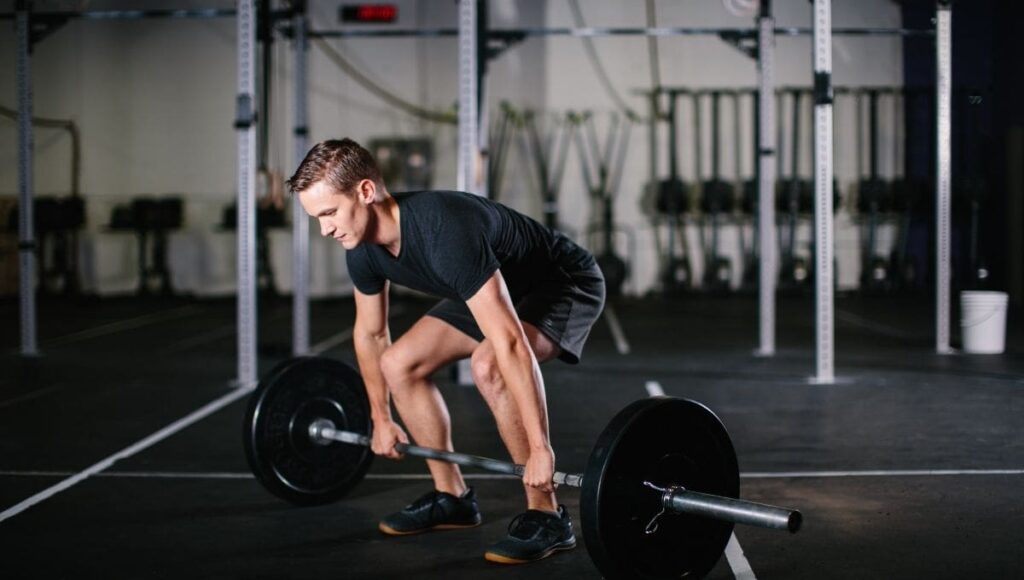
The most efficient deadlift follows a near-vertical bar path over midfoot. Video analysis shows that deviations increase torque demands on the spine and reduce lift efficiency (Escamilla et al., 2000).
Bracing
Intra-abdominal pressure created through proper bracing significantly reduces spinal loading (Cholewicki et al., 1999). Lifters should practice diaphragmatic breathing before each pull.
Add 50 Pounds to Your Deadlift: Grip
Grip failure is a common limiting factor. Using a mixed grip, hook grip, or chalk reduces bar slippage. Strengthening grip through farmer’s carries and static holds is supported by evidence for improved pulling performance (Wagle et al., 2017).
Recovery and Adaptation
Sleep

Sleep is critical for muscle recovery and performance. Research shows that sleep restriction reduces maximal strength output and recovery capacity (Reyner and Horne, 2013). Athletes should aim for 7–9 hours nightly.
Nutrition
Adequate protein intake (1.6–2.2 g/kg/day) maximizes muscle protein synthesis and supports strength gains (Morton et al., 2018). Carbohydrates replenish glycogen stores essential for high-intensity training.
Add 50 Pounds to Your Deadlift: Deloading
A deload week (reduced volume and intensity) prevents overtraining. Studies show strategic reductions in workload enhance long-term performance by allowing recovery of the nervous system (Pritchard et al., 2015).
Supplementation for Strength
Creatine Monohydrate
One of the most researched supplements, creatine consistently enhances strength and power output (Kreider et al., 2017). A daily dose of 3–5 g is sufficient.
Caffeine
Acute caffeine ingestion improves strength performance by increasing motor unit recruitment and reducing perceived exertion (Grgic et al., 2018).

Add 50 Pounds to Your Deadlift: Beta-Alanine
May delay fatigue by buffering lactic acid, though its benefits are more pronounced in endurance-strength training (Hobson et al., 2012).
Example 8-Week Deadlift Program
Day 1 (Heavy Deadlift Day)
- Deadlift: 4–6 sets of 3–5 reps (75–90% 1RM, progressive)
- Romanian Deadlift: 3 sets of 8–10
- Barbell Row: 3 sets of 8–10
- Farmer’s Carry: 2–3 sets of 30–40 meters
Day 2 (Accessory Day)
- Front Squat: 4 sets of 5–6
- Deficit Deadlift: 3 sets of 4–6
- Pull-Ups: 3–4 sets to near failure
- Rack Pull: 3 sets of 3–5 (heavy overload)
Optional Day 3 (Speed & Assistance)
- Speed Deadlifts: 6–8 sets of 2 reps at 65–75% 1RM
- Hip Thrusts: 3 sets of 10–12
- Plank Variations: 3–4 sets, 60 seconds each
Testing and Progression
At the end of eight weeks, lifters should perform a proper max test. Warm up gradually, taking 5–6 sets to reach 90–95% 1RM before attempting a new personal record. If training was followed consistently, a 50-pound increase is realistic for intermediate lifters.
Common Mistakes to Avoid
- Overtraining: Pulling heavy more than twice per week increases injury risk.
- Neglecting Recovery: Sleep and nutrition are often overlooked but are decisive in adaptation.
- Poor Technique: Strength improvements are nullified if lifting form deteriorates under load.
- Ignoring Weak Points: Focusing only on heavy pulls without accessory work leads to plateaus.
Add 50 Pounds to Your Deadlift: Conclusion
Adding 50 pounds to your deadlift in eight weeks requires a structured, science-backed approach emphasizing neural adaptations, accessory strengthening, and proper recovery. By applying principles of progressive overload, optimizing technique, and supporting training with nutrition and sleep, significant short-term strength gains are achievable.
Key Takeaways
| Principle | Action Plan | Evidence Source |
|---|---|---|
| Neural adaptations | Train at 75–90% 1RM with heavy compound lifts | Enoka (1997); Carroll et al. (2001) |
| Hypertrophy support | Accessory work like RDLs and rows | Wernbom et al. (2007) |
| Technique optimization | Focus on bar path, bracing, and grip | Escamilla et al. (2000); Cholewicki et al. (1999) |
| Recovery | Sleep 7–9 hours; eat 1.6–2.2 g/kg protein | Reyner & Horne (2013); Morton et al. (2018) |
| Supplementation | Creatine 3–5 g/day; caffeine pre-workout | Kreider et al. (2017); Grgic et al. (2018) |
| Program structure | 8-week progressive overload, deload as needed | Pritchard et al. (2015) |
Bibliography
- Anderson, C.E., 2002. The application of partial range of motion training. Strength and Conditioning Journal, 24(5), pp.33-35.
- Carroll, T.J., Riek, S. and Carson, R.G., 2001. Neural adaptations to resistance training. Sports Medicine, 31(12), pp.829-840.
- Cholewicki, J., Juluru, K., Radebold, A., Panjabi, M.M. and McGill, S.M., 1999. Lumbar spine stability can be augmented with an abdominal belt and/or increased intra-abdominal pressure. Spine, 24(7), pp.682-690.
- Douglas, J., Pearson, S., Ross, A. and McGuigan, M., 2017. Chronic adaptations to eccentric training: A systematic review. Sports Medicine, 47(5), pp.917-941.
- Enoka, R.M., 1997. Neural adaptations with chronic physical activity. Journal of Biomechanics, 30(5), pp.447-455.
- Escamilla, R.F., Francisco, A.C., Kayes, A.V., Speer, K.P. and Moorman, C.T., 2000. An electromyographic analysis of sumo and conventional style deadlifts. Medicine and Science in Sports and Exercise, 32(7), pp.1265-1275.
- Grgic, J., Trexler, E.T., Lazinica, B. and Schoenfeld, B.J., 2018. Effects of caffeine intake on muscle strength and power: a systematic review and meta-analysis. Journal of the International Society of Sports Nutrition, 15(1), pp.1-10.
- Henselmans, M. and Schoenfeld, B.J., 2014. The effect of inter-set rest intervals on resistance exercise–induced muscle hypertrophy. Sports Medicine, 44(12), pp.1635-1643.
- Hobson, R.M., Saunders, B., Ball, G., Harris, R.C. and Sale, C., 2012. Effects of β-alanine supplementation on exercise performance: a meta-analysis. Amino Acids, 43(1), pp.25-37.
- Kreider, R.B., Kalman, D.S., Antonio, J., Ziegenfuss, T.N., Wildman, R., Collins, R., Candow, D.G., Kleiner, S.M., Almada, A.L. and Lopez, H.L., 2017. International Society of Sports Nutrition position stand: safety and efficacy of creatine supplementation in exercise, sport, and medicine. Journal of the International Society of Sports Nutrition, 14(1), pp.1-18.
- Kubo, K., Kanehisa, H. and Fukunaga, T., 2002. Effects of resistance and stretching training programmes on the viscoelastic properties of human tendon structures in vivo. The Journal of Physiology, 538(1), pp.219-226.
- Morton, R.W., Murphy, K.T., McKellar, S.R., Schoenfeld, B.J., Henselmans, M., Helms, E., Aragon, A.A., Devries, M.C., Banfield, L., Krieger, J.W. and Phillips, S.M., 2018. A systematic review, meta-analysis and meta-regression of the effect of protein supplementation on resistance training–induced gains in muscle mass and strength in healthy adults. British Journal of Sports Medicine, 52(6), pp.376-384.
- Pinto, R.S., Gomes, N., Radaelli, R., Botton, C.E., Brown, L.E. and Bottaro, M., 2012. Effect of range of motion on muscle strength and thickness. Journal of Strength and Conditioning Research, 26(8), pp.2140-2145.
- Pritchard, H., Keogh, J.W., Barnes, M. and McGuigan, M.R., 2015. Effects and mechanisms of tapering in maximizing muscular strength. Strength and Conditioning Journal, 37(2), pp.72-83.
- Reyner, L.A. and Horne, J.A., 2013. Sleep restriction and performance: findings from the laboratory and the field. Sleep Medicine, 14(3), pp.215-222.
- Sale, D.G., 1988. Neural adaptation to resistance training. Medicine and Science in Sports and Exercise, 20(5 Suppl), pp.S135-S145.
- Schoenfeld, B.J., Ogborn, D. and Krieger, J.W., 2017. Dose-response relationship between weekly resistance training volume and increases in muscle mass: A systematic review and meta-analysis. Journal of Sports Sciences, 35(11), pp.1073-1082.
- Wagle, J.P., Taber, C.B., Cunanan, A.J., Bingham, G.E., Carroll, K.M., DeWeese, B.H., Sato, K., Stone, M.H. and Stone, M.E., 2017. Accentuated eccentric loading for training and performance: A review. Sports Medicine, 47(12), pp.2473-2495.
- Wernbom, M., Augustsson, J. and Thomeé, R., 2007. The influence of frequency, intensity, volume and mode of strength training on whole muscle cross-sectional area in humans. Sports Medicine, 37(3), pp.225-264.