You don’t necessarily need a barbell to develop big chest muscles. Learn how to build a perfect chest with dumbbells by following these 6 simple tips.
These 6 tips on how to build a perfect chest with dumbbells were shared by Jeff Cavaliere.
Jeff Cavaliere was the head physical therapist of the New York Mets for 3 years and is now a YouTube sensation. He delivers clear information without noise on his ATHLEAN-X YouTube channel.
See the full video, or check out the main tips below.
How to Build a Perfect Chest with Dumbbells
Read More: 15 Chest Exercises Ranked Worst to Best
The Dumbbell Bench Press Benefits
Before we got on with it, know that Cavaliere explains that one of the best exercises for chest development is the dumbbell bench press.
The dumbbell bench press is a versatile and effective strength training exercise that offers several benefits for individuals looking to build upper body strength and muscle mass. Here are some key advantages of incorporating dumbbell bench presses into your workout routine:
- Increased Muscle Activation:
- Dumbbell bench presses require stabilisation from each arm independently, leading to greater muscle activation in the chest, shoulders, and triceps compared to a barbell bench press.
- Muscle Symmetry:
- Working with dumbbells helps address muscle imbalances, as each side of the body must lift its own weight independently. This can contribute to a more balanced and symmetrical physique.
- Range of Motion:
- Dumbbell bench presses allow for a greater range of motion compared to barbell presses. This increased range of motion can enhance muscle engagement and flexibility in the shoulder joints.
- Reduced Risk of Imbalances and Injuries:
- Since each arm works independently, the risk of developing muscle imbalances or overcompensating with one side is reduced. This can contribute to better long-term joint health and injury prevention.
- Improved Core Engagement:
- Maintaining stability during dumbbell bench presses engages the core muscles. This additional core activation helps improve overall stability and strength.
- Enhanced Shoulder Health:
- Dumbbell bench presses provide a more natural movement pattern, reducing strain on the shoulders. This can be beneficial for individuals with shoulder issues or those looking to prevent shoulder injuries.
- Versatility in Grip and Hand Position:
- Dumbbell bench presses allow for variations in grip and hand positioning. This flexibility can target different muscle fibres in the chest, shoulders, and triceps, providing a well-rounded upper body workout.
- Adaptability for Different Fitness Levels:
- Dumbbell bench presses can be adapted to different fitness levels. Beginners can start with lighter weights, gradually increasing as strength improves, while advanced lifters can use heavier weights for greater resistance.
- Home Workout Option:
- Dumbbell bench presses can be performed at home with a set of dumbbells, making them a convenient option for those who prefer or need to work out at home.
- Functional Strength:
- The unilateral nature of dumbbell bench presses contributes to functional strength, which can benefit daily activities that require pushing or lifting movements.
- Variation in Training Routine:
- Including dumbbell bench presses in your workout routine adds variety, preventing monotony and keeping your training sessions engaging and challenging.
- Increased Muscle Recruitment:
- Dumbbell bench presses engage stabiliser muscles, promoting increased muscle recruitment and overall muscle development.
Incorporating dumbbell bench presses into your workout routine can be a valuable addition for those seeking a well-rounded upper body workout, improved muscle activation, and reduced risk of imbalances or injuries. It’s essential to perform the exercise with proper form and gradually increase weights as strength progresses.
How to Increase Chest Size and Strength
Why Do the Dumbbell Version Instead of the Barbell Bench Press?
Both the dumbbell bench press and the barbell bench press are effective exercises to force muscle growth on your chest, but they offer distinct advantages. Here are the benefits of incorporating the dumbbell bench press specifically for chest hypertrophy compared to the barbell bench press:
- Greater Range of Motion:
- The dumbbell bench press allows for a more extensive range of motion compared to the barbell bench press. This increased range can result in better stretch and activation of the chest muscles, contributing to improved hypertrophy.
- Individual Muscle Isolation:
- With dumbbells, each arm works independently, promoting greater muscle isolation. This isolation can lead to more balanced development of the chest muscles and help address any imbalances that may exist between the two sides of the body.
- Deeper Muscle Fibre Stimulation:
- Dumbbell bench presses enable a deeper muscle fibre stimulation, especially at the bottom of the movement. This can lead to more significant muscle growth over time.
- Reduced Stress on Shoulders:
- Dumbbell bench presses allow a more natural movement pattern and provide the flexibility for each arm to move freely. This can reduce stress on the shoulders, making it a preferable option for individuals with shoulder issues or those prone to discomfort during the barbell bench press.
- Enhanced Chest Activation:
- The stabilisation required during dumbbell bench presses enhances chest activation. As each side of the chest works independently, the muscles are forced to work harder to maintain balance, contributing to increased hypertrophy.
- Adaptability to Body Mechanics:
- Dumbbell bench presses allow individuals to adapt the movement to their unique body mechanics. This adaptability can be especially beneficial for those with long arms or other factors that may impact their comfort and effectiveness in performing the exercise.
- Prevention of Plateaus:
- Introducing variations such as the dumbbell bench press can help prevent training plateaus. Switching between barbell and dumbbell exercises can shock the muscles, promoting continuous growth and avoiding stagnation in your chest development.
- Improved Core Engagement:
- Maintaining stability during the unilateral movement of dumbbell bench presses engages the core muscles. This additional core activation not only enhances overall stability but also contributes to better control and form during the exercise.
- Reduced Risk of Overtraining:
- Dumbbell bench presses offer the advantage of working the chest without the need for an excessively heavy load. This reduces the risk of overtraining, especially in individuals who may struggle with heavy barbell loads.
While both exercises contribute to chest hypertrophy, incorporating the dumbbell bench press into your routine provides unique benefits that can enhance muscle development, address imbalances, and offer a more adaptable and comfortable training experience. It’s often beneficial to include both variations in your chest training regimen for a well-rounded and effective approach.
Read More: Barbell Bench Press vs Dumbbell Bench Press: Which is Best for Chest Gains?
Tip 1 – Leg drive
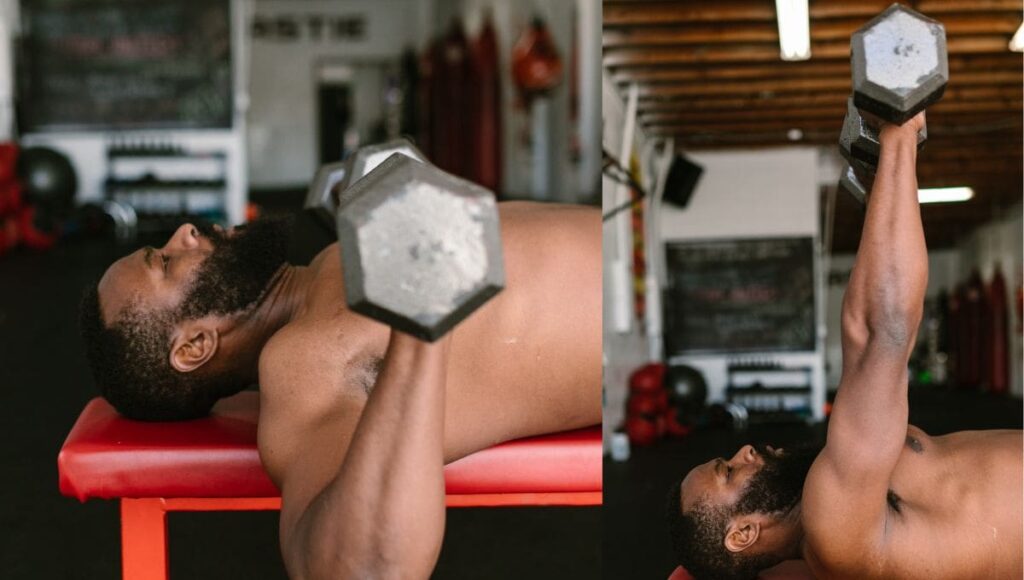
When your feet are on the floor when you are doing dumbbell bench press, you want to have them positioned as if you were sliding up the bench. Normally you do that when holding a barbell because you have a hook to leave the barbell at the end of the exercise, but you should try to mimic the movement by driving your body with your legs.
Important note: weights must be sufficiently heavy to keep shoulders pinned to the bench.
Tip 2 – Get more relevant adduction
Try to lead the dumbbells with your thumbs, rather than with your pinkies. This way you will squeeze out your chest by bringing your hands close to each other. That way your chest will get more contraction and it will pay off rep after rep.
Tip 3 – Flip the grip
If you don’t have an incline bench you can target your upper chest by simply flipping the grip on the dumbbells by performing the under hip dumbbell bench press.
Tip 4 – Drop set
Doing drop sets are helpful to build muscle and increase its size. Utilising a barbell will cost you precious seconds to take out some weight plates from the bar. However, with dumbbells, you can simply grab a lighter pair and go straight into your drop set.
Jeff Cavaliere goes even further and likes to squeeze out a few push-ups after doing a drop set to fatigue the muscle to failure.
Read More: The Ultimate Guide to Drop Sets
Tip 5 – Static dumbbell press
Lift one dumbbell at a time when pressing instead of both simultaneously. Keep one dumbbell high in the air while slowly descending one to finish one rep.
This exposes any unilateral weaknesses that you may have. You need to correct your muscle imbalances and this minor tweak you can do will provide just that.
In the end, hold both dumbbells at the bottom of the isometric position for a few seconds before finishing the exercise. You can, again, do push-ups to failure at the end.
Tip 6 – Static dumbbell press with a focus on the bottom of the movement
This is the same idea as tip 5, but this time you hold the dumbbell at the bottom of the exercise when pressing one dumbbell at a time.
“The chest is working even harder at that bottom position than it would be at the top and it makes this whole sequence that much more difficult,” Cavaliere says.
Tip 6 – Include these 3 exercises
- Dumbbell pullover – but do this exercise with your elbows close to each other and drive it with your upper chest.
- UCV raise – this gets another good contraction into adduction. Raise the dumbbell up and across from your body. It is a low to high and across movement which gives you a great upper chest contraction.
- Floor chest flye – use the floor to protect your shoulders as your arms get down the side. This way, you are able to increase the weight of the dumbbells and
Check out more chest content from BOXROX we think you are going to love (and it will help you achieve the fitness goals you are after):
The Best Home Chest Dumbbell Workout
5 Methods of Progressive Overload to Force Muscle Growth
Upper Chest Exercises Ranked (BEST TO WORSE)
10 Terrible Things To Do Before A Workout