Knowing your piece of equipment is one of the most foundational parts in any workout. Learn how to build a stronger chest with just dumbbells.
The vast amount of resources and tools in the gym can seem daunting if you are new (or even advanced for that matter), but having a solid approach on which pieces of equipment to work with should help to streamline your workout.
The content ahead looks into how to build a stronger chest with just dumbbells and how this equipment can be all you need to progress.
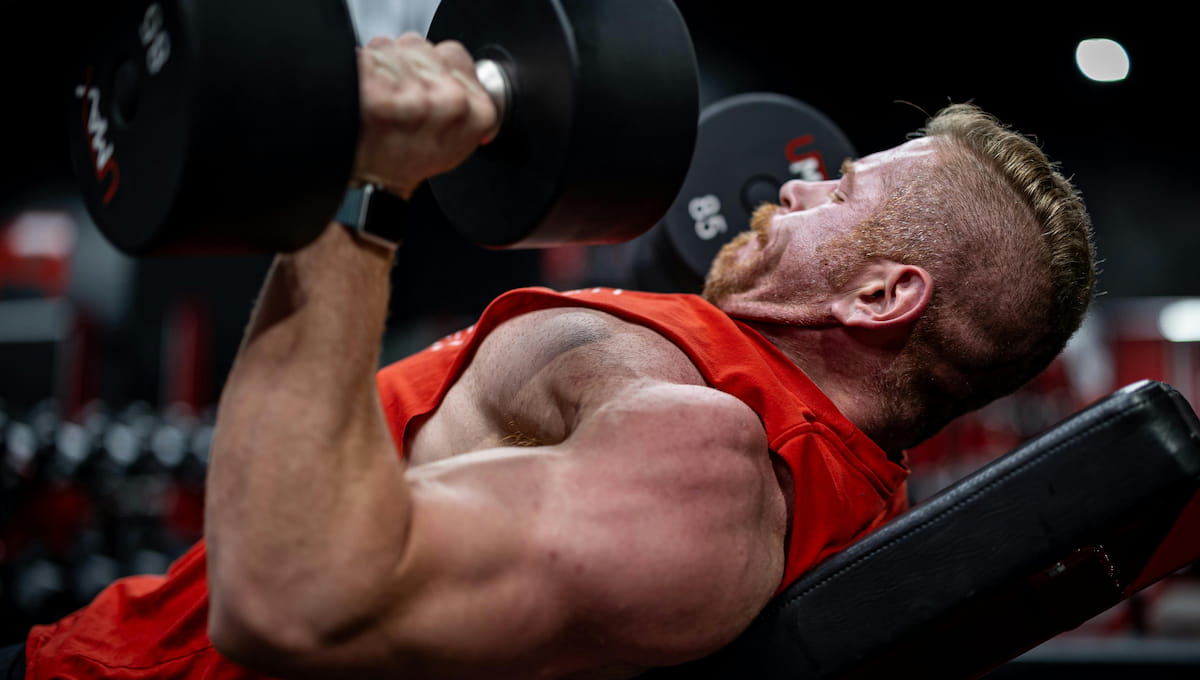
Why Work the Chest with Dumbbells?
When it comes to the wide range of equipment at the gym, why would you want dumbbells? There are machines, cables, barbells, specialized barbells, and resistance bands, so what makes dumbbells so great?
Studies have shown similar muscle activation among the Smith machine, barbells, and dumbbells, making each option worthwhile in creating chest strength. With this in mind, here are some of the best reasons to go with dumbbells to build a stronger chest, all of which can be added to any home workout.
- They’re easy to use. After all of the equipment you can select, dumbbells are pretty straight forward. You go to the rack, select your weight, get into position, and work. There is no tedious setup, no weight stacking, and definitely no machine setups, which really speaks to dumbbells ease of use.
- Better range of motion. Physically speaking, dumbbells allow you to move through any range of motion you desire. If you want to build a stronger chest by going deeper in your range of motion, you can. So long as your lifts are safe, this truly is one of the greatest parts of dumbbells.
- Various hand grip configurations. As opposed to barbells and machine work, using dumbbells allows for various hand grip configurations for different angles. Each hand configuration can work the body in a slightly different way and give the muscles new resistance. This difference is big when the goal is to build a stronger chest.
- Better balance. Sometimes the body can adjust to barbells because the weight is distributed across the bar. With dumbbells, the weight is distributed in each arm, which means the unilateral work can help to prevent and resolve imbalances.
- Core involvement. The natural feel of dumbbells means the body needs to stabilize itself. This stabilization is created from the core muscles with every lift and can secondarily provide quite good core work along the way.

Getting Familiar with the Muscles of the Chest
It will be important to understand the muscles that make up the chest and some of their functions. Let’s take a closer look at the specific muscles of the chest, so you can have a better understanding of how to work them more efficiently. Both muscles perform horizontal abduction of the arm and are affected by body position.
- Pectoralis Major. The pectoralis major consists of two primary heads that make up the upper and lower portions.
- Clavicular head: this part of the pectoralis major constitutes the majority of the muscle. It attaches to different parts of the clavicle and is responsible for creating an athletic physique.
- Sternal head: technically this is the sternocostal head because it originates from the sternum and costal cartilage of the ribs. This part of the pecs divides the upper and lower body and is important for a sculpted appearance.
- Pectoralis Minor. The pectoralis minor is a smaller chest muscle that rests just beneath the pectoralis major. It assists the larger pectoralis major muscle and also provides shoulder joint stability. Ensuring the strength of this muscle is important to help prevent injuries and can help to add additional bulk to the chest.
Learn how to maximize your reps and sets for the best results with chest training.
How to Build a Stronger Chest with Just Dumbbells
Using only dumbbells to work your chest can isolate the fibers of the chest for an incredible workout. Here are some steps to take to ensure your success.
Best Dumbbell Chest Exercises
- Select Isolation Exercises. Picking specific exercises to isolate the pecs is by far the most important way to build a stronger chest. Here are some isolation exercises that are great for building a stronger chest.
- Chest Fly
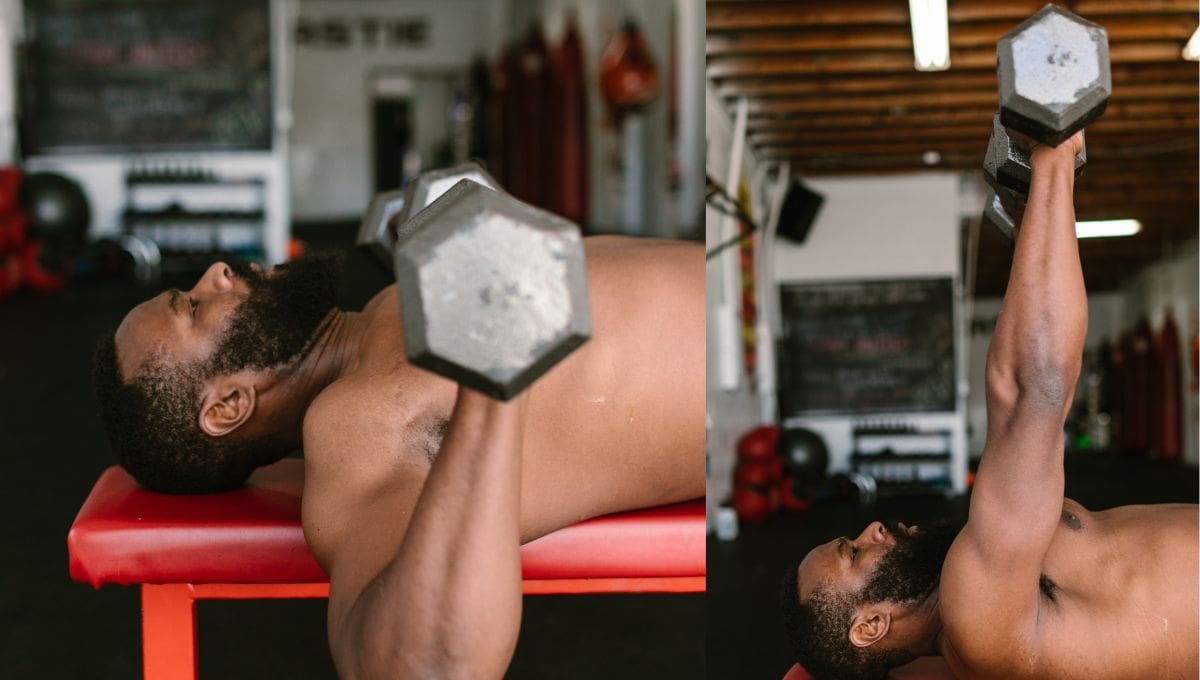
- Supine chest press
- Dumbbell push-ups
- Incline and decline chest press
- Program for Strength. Nailing down the reps and sets for strength can truly make or break success. Consider a strength program to meet your goals including the following program ahead.
- Sets: 3
- Reps: 10-15, so long as the end of each set is challenging.
- Weight: Within reason and safety, the weight should be enough to make the workout challenging, but not overwhelming.
- Program for Hypertrophy. Programming for hypertrophy is slightly different than that of strength. If you’re also looking to increase your muscle size, follow along with a hypertrophy-based program.
- Sets: 3-4
- Reps: Pyramid sets with near maximal effort on the final. Consider pyramid sets of 10, 8, 6, and 2-4 reps for next results.
- Weight: Select dumbbells that are tough to finish after every set.
- Adhere to Progressive Overload. No matter if you want to build bigger or stronger muscles, you will need to follow a progressive overload model. This just simply means adding more weight, reps, or sets to fatigue the muscles when they have fully adjusted to the current load. Here’s how to adjust your progressions to hit your goals.
- Start reasonably. Especially if you are new to dumbbell chest workouts, start with something you can control safely before making progressions. Too often, athletes think the transition from barbells or machine stacks translates seamlessly with dumbbells.
- Progress slowly. Barbell workouts allow for faster progressions, such as adding more weight. However, dumbbells unilaterally isolate specific muscles, so increasing your weight should include smaller weight gains. Move up to the next dumbbell size if there are plenty of options, otherwise just add a few more reps with each set.
Dumbbell Bench Press Alternatives
If you don’t have access to a bench, there are still plenty of effective ways to build a stronger chest with just dumbbells. One option is the floor press, where you lie flat on the ground and perform presses.
This reduces the range of motion slightly but keeps tension on the chest while protecting your shoulders. Another great variation is the standing chest press, where you hold the dumbbells at chest height and push them forward, engaging the pecs in a functional way. You can also try incline push-ups with dumbbells as handles, which mimic the bench press movement while challenging your stability and adding extra depth.
These alternatives make it easy to train your chest effectively, even without a traditional bench setup.
Build a Stronger Chest with Just Dumbbells: Conclusion
We can tell you how to build a stronger chest with just dumbbells, but it comes down to hitting your workouts and getting to it.
The information above goes into some exercises needed to get you started, how to incorporate strength or hypertrophy, and how to plan for progressions. The rest is up to you, get at it, and enjoy the gains.
Try building your chest gains with these resistance band chest workouts and
Build a Stronger Chest with Just Dumbbells: FAQs
Q: Why use only dumbbells to train chest strength?
Using dumbbells allows for a greater range of motion than barbells or machines, which means you can achieve a deeper stretch and stronger contraction in each rep. They also force each side of your body to work independently, helping to correct muscular imbalances.
Another advantage is the flexibility in grip and hand positioning, which lets you target different parts of the chest more effectively. Finally, dumbbells are simple and accessible, requiring very little equipment setup.
Q: What muscle groups are involved when using dumbbells for chest work?
The primary muscles worked are the pectoralis major and minor, which make up the bulk of the chest and assist in shoulder movement and stability. Supporting muscles such as the front deltoids, triceps, and core stabilisers also play a significant role, especially since dumbbell training requires more control and balance.
Q: How should I structure reps, sets, and weight for strength versus hypertrophy?
For general strength, three sets of ten to fifteen repetitions with a challenging weight are recommended. For hypertrophy, or muscle growth, the article suggests three to four sets in a pyramid style, such as ten reps, then eight, six, and finally two to four near-maximal effort reps.
Regardless of your goal, following the principle of progressive overload—gradually increasing weight, repetitions, or sets—is key to long-term progress.
Q: What are good exercises using dumbbells for building chest?
Some of the most effective dumbbell exercises for the chest include flyes, supine chest presses on flat, incline, or decline benches, and dumbbell push-ups. Additional variations such as single-arm presses, pullovers, and reverse grip presses can also be used to add variety and stimulate the chest from different angles.
Q: Does using dumbbells limit how much chest strength I can build compared to barbells or machines?
Not necessarily. Dumbbells can be just as effective in building strength and muscle size, and in some cases they recruit more stabilizing muscles than barbells or machines.
The main limitation is that progressing to very heavy loads can sometimes be more challenging, but this can be offset by increasing repetitions or using advanced variations. Dumbbells are not inferior; they are simply a different tool with unique benefits.
Q: How quickly should I increase weight or difficulty when using dumbbells?
The best approach is to increase gradually. Move up to heavier dumbbells once your current weight no longer feels challenging during the last few reps of your sets.
If you don’t have access to heavier weights, you can increase the number of repetitions or sets to keep pushing your muscles. Above all, maintaining good form should take priority over adding more load.
Q: What are some common mistakes or pitfalls to avoid?
A common mistake is choosing weights that are too heavy, which often leads to poor form and reduced effectiveness. Another issue is not completing a full range of motion, which prevents the chest from being fully stretched and contracted.
Many people also fail to apply progressive overload, sticking with the same weight and reps for too long. Neglecting variation in exercise angle and grip can result in uneven development, and not engaging stabilizing muscles or the core may cause imbalances or even injury.
Q: How often should I train the chest with dumbbells?
Although the article doesn’t give a strict frequency, a typical recommendation for most training programs is one to two sessions per week that target the chest directly. This allows sufficient recovery while still providing enough stimulus for growth and strength gains. More important than frequency is following a structured program and ensuring steady progression.
Q: Can I build strength and size with just dumbbells at home?
Yes, you can absolutely build both strength and size using only dumbbells at home. As long as you have weights that are heavy enough to challenge you, use correct technique, vary your exercises and angles, and follow the principle of progressive overload, dumbbells alone are sufficient to develop a strong, muscular chest.
Resources
https://pubmed.ncbi.nlm.nih.gov/21225489