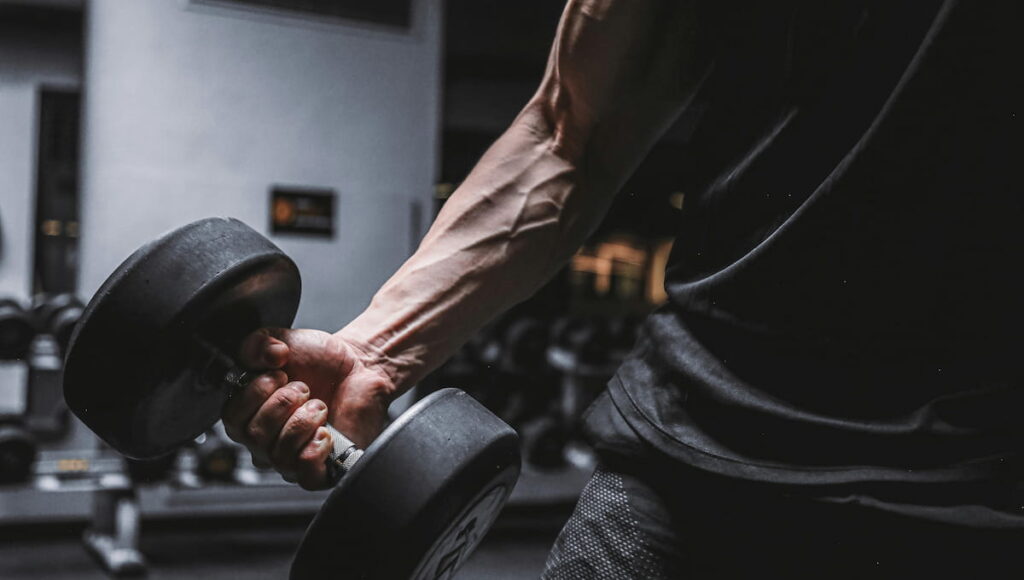
When it comes to lifting weights and getting stronger, people tend to stray towards barbells as a go-to option. While using this type of equipment is important for bigger muscles, the content ahead is going to describe how to get ripped arms without touching a barbell.
Barbells are a staple in the gym and for good reasons. They are extremely versatile, allow for heavy weights, and are just easy to use. However, the use of barbells may not be of the utmost importance when it comes to building ripped arms. Let’s take a look at how you can get ripped without touching a barbell, with exercises to help guide you through this routine. 
What Type of Equipment to Use for Ripped Arms
To figure out how to grow bigger and stronger muscles, it is important to know what options you have to utilize in the gym. Let’s take a look at some of the pizza equipment that can help you get ripped arms.
- Barbells. Barbells are a staple in the gym and are one of the most common pieces of equipment that are used. Using barbells allows for heavy weight, powerlifting, and controlled lifts to help isolate muscle groups. However, while they are typically effective, they are not an end-all be-all selection and the topic of interest here is without using any type of barbell.
- Dumbbells. Perhaps the most notorious of workout equipment, the dumbbells are ideal for singling out areas of the body and isolating muscles. While it’s tough to use heavy weight with dumbbells (unless you have a spotter), getting jacked arms can occur with a complete isolation and targeted workout.
- Cable Machine. Constant resistance through your entire range of motion can be a great way to establish ripped arms. A cable machine typically has various center points to where you can change the height and angle of resistance, which makes this an extremely versatile machine.
- Body Weight and Straps. Body weight workouts are very functional and can be performed anytime anywhere. The amount of bodyweight exercises are endless and adding straps such as the TRX system can definitely make this the hardest workout you’ve ever had.


Muscles to Work for Ripped Arms
Focusing on the arms is fun and rewarding. The muscles to focus on when working towards ripped arms includes the following:
- Biceps. Focus on both the long and short heads by changing your grip. A wide grip isolates the short head whereas a narrow grip focuses more on the long head.
- Triceps. With three parts of the triceps muscle, focus on the medial, lateral, and long heads. Mix overhead and press downs to work different heads of this posterior muscle.
- Brachioradialis. Often this muscle is overlooked for some of the larger arm muscles, but the brachioradialis muscle can help to add bulk. It remains under the biceps muscles and can help to add needed bulk to the arms.
- Deltoids. While the deltoids are shoulder muscles, they can help assist arm motion, stability, and aid in helping you to achieve big arms. Don’t skip on the deltoids if you’re dedicated to getting ripped arms.
Top 5 Arm Exercises for Ripped Arms that Don’t Need a Barbell
[wpcode id=”229888″]The exercises here are designed to steer you in the right direction on arms day. Consider the exercises ahead as a replacement for barbells workouts.
- Bicep Curls. This is a standard exercise that can be performed in various ways. Change your grip configuration to work different muscle heads and to help target the brachioradialis muscle.
- Variations: Consider a neutral grip, palms facing forward, palms facing down of prone, concentration curls, and hammer curls.
- Equipment: Dumbbell curls, cable curls, TRX curls, or resistance bands all can help to target the biceps.
- Tips on Form: When fatigue sets in on the last few reps, rocking backwards or leaning forward becomes common. If possible try to remain in a ready position with a slight knee bend even when it gets challenging.
- Triceps Extensions. The primary function of the triceps is to extend the elbow joint. This can be accomplished with different angles and equipment.
- Variations: The triceps extension can be performed through a pushdown, overhead extension, and skull crusher. Each variation also works a different head in the triceps muscle.
- Equipment: The cable machine will be important for targeting the triceps, dumbbells for overall extensions and skull crushers.
- Tips on Form: The elbows should be close to the body during pushdowns and remain in during an overhead extension. Placement of your elbow will be vital to having impeccable form with this muscle.
- Push-Ups. Alright, so push-ups primarily work the pecs. However, they definitely work the arms, taking aim at both the biceps and triceps. While you’re not likely to do endless push-ups for the sake of growing your arms, they are great in the big picture.
- Variations: Since the arms are the focal point here, consider a close hand placement and diamond configuration. Diamond push-ups work the triceps in a way that is unquestionably great.
- Equipment: None. You could add a bench or TRX straps to add resistance, but otherwise only your bodyweight is needed here.
- Tips on Form: Diamond push-ups are in a league all of their own. Typical push-ups require a strong core and straight back, but the diamond variation allows for slight glutes in the air to help you lower down with each rep.
- Pull-Ups. The exercise everyone loves to hate, the pull-up targets the forearms, biceps, and definitely back.
- Variations: Performing chin-ups with the palms facing body is for sure a great exercise for the biceps. Pull-ups that allow for palms facing each other is also another option, as this is highly specific to the biceps.
- Equipment: A pull-up bar to where you can perform chin-ups. If your gym has a pull-up bar with different hand grip configurations, this is even better.
- Tips on Form: The kipping pull-up is a common practice in HIIT exercise. Stray away from kipping if you can and focus on a true form.
- Reverse Curls. A completely different variation of the standard curl, the reverse curl is an important lift for developing ripped arms.
- Variations: None, this lift is highly specific and involves palms facing downward.
- Equipment: Dumbbell reverse curls are great for isolating muscles on each arm. Consider concentric and eccentric training using cables or resistance bands with this exercise.
- Tips on Form: Start with light weight. Since the palms face down the entire time, the biceps are not being used (maybe only slightly used). Start light and don’t overdo it, as this can cause brachialis muscle issues.
How to Get Ripped Arms Without Touching A Barbell
The exercises above are intended to help guide your journey to ripped arms. These exercises are common in the gym, but finding ways to perform them without a barbell can bring great results. Developing ripped arms can be possible with the following programming:
- Days of the week: Arms day on Monday, Wednesday, and Friday.
- Sets: Perform 3-4 sets of each. If you are experienced in these lifts, then aim for four sets.
- Reps: Utilize a pyramid stack, dropping reps at each set to 12, 10, 6-8 reps.
- Weight: Aim to add weight with each set, adding about 10% of your one-rep max each time. Every set should be challenging to complete and if it’s easy, add more weight.
Wrapping It Up
Achieving ripped arms without using a barbell is can really expose the body to many alternative exercises. The programming above should give you a great start to working your arms in case a barbell is not available. If you go to the gym during busy hours and then barbells aren’t available, consider swapping to a two-week program and see how it works for you.
Resources
https://pmc.ncbi.nlm.nih.gov/articles/PMC8296276
https://pubmed.ncbi.nlm.nih.gov/29503079
https://pubmed.ncbi.nlm.nih.gov/30725741