HYROX and the CrossFit Open attract hundreds of thousands of athletes worldwide, yet they test fitness in very different ways. Both are demanding, motivating, and grounded in measurable physical capacities.
Choosing between them is not about which is “harder,” but about which better aligns with your physiology, psychology, training background, and long-term goals.
This article compares HYROX racing and the CrossFit Open using exercise science, sports psychology, and performance research. Every claim is backed by peer-reviewed evidence. The goal is to help you make an informed decision based on how your body adapts to stress, how you prefer to train, and how competition affects motivation and health.
Understanding the Two Competitions

What Is a HYROX Race?
HYROX is a standardized indoor fitness race combining running and functional workouts. Each race follows the same structure globally: 8 x 1 km runs, each followed by a functional workout such as sled pushes, wall balls, or lunges. The consistency of the race format is central to its appeal.
From a physiological perspective, HYROX is a prolonged high-intensity endurance event. Race times typically range from 60 to 90 minutes for most participants, placing it squarely in the domain of aerobic-dominant exercise with repeated anaerobic surges.
Energy production during events of this duration relies heavily on oxidative metabolism, with significant contributions from glycolysis during high-force tasks such as sled pushes and wall balls. Research on hybrid endurance events shows that athletes require both high maximal oxygen uptake (VO₂max) and muscular endurance to perform well (Joyner and Coyle, 2008).
What Is the CrossFit Open?
The CrossFit Open is a multi-week online competition consisting of several workouts released weekly. Athletes submit scores from their gyms or home setups. Workouts vary widely year to year and can include heavy barbell lifts, gymnastics, monostructural cardio, and mixed-modal tasks.
Physiologically, the Open tests a broader range of fitness qualities. Depending on the workout, demands may emphasize maximal strength, power, anaerobic capacity, aerobic endurance, or skill acquisition. Studies examining CrossFit-style workouts show extremely high cardiovascular strain, often exceeding 90 percent of maximum heart rate, alongside high blood lactate levels (Drum et al., 2017).
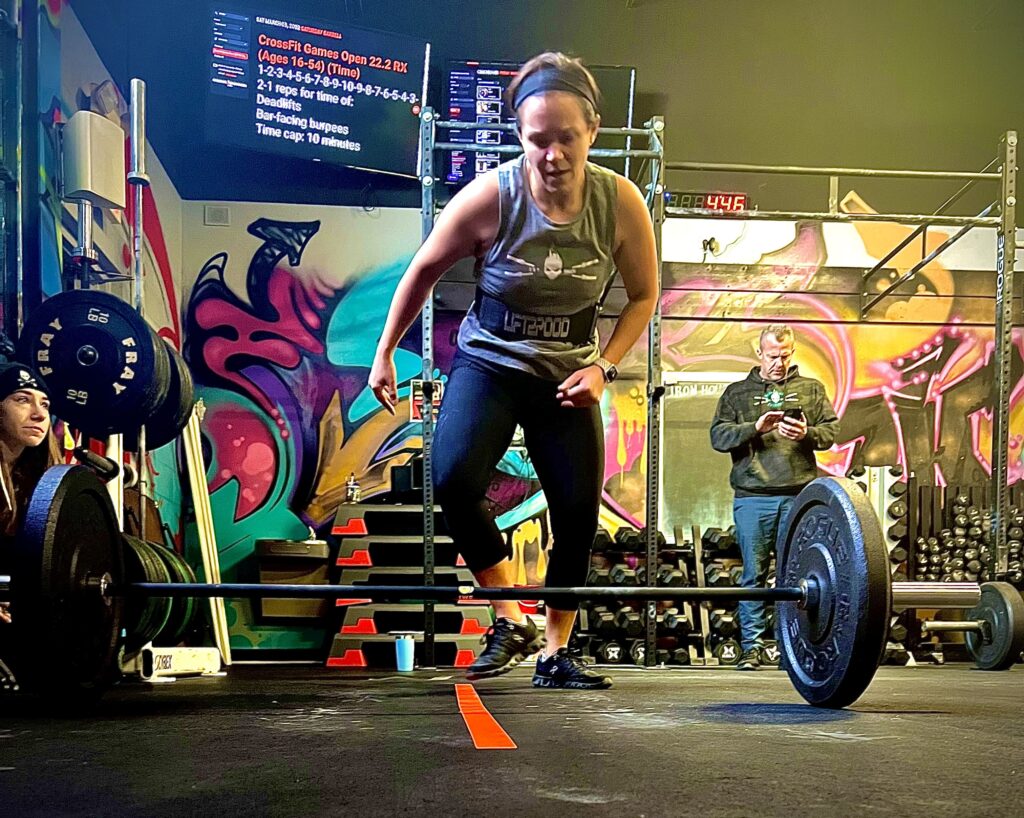
The variability of the Open means athletes must be generalists, capable of adapting quickly to unknown demands.
Physiological Demands Compared
Aerobic Capacity and Endurance
HYROX places a greater absolute demand on aerobic capacity than the CrossFit Open. Continuous running totaling 8 km, combined with functional work, requires sustained oxygen delivery and efficient energy use. VO₂max is a strong predictor of performance in endurance-dominant events lasting longer than 30 minutes (Bassett and Howley, 2000).
Training for HYROX typically involves high volumes of zone 2 and tempo running, which improve mitochondrial density and capillarization in skeletal muscle. These adaptations increase fat oxidation and delay glycogen depletion (Holloszy and Coyle, 1984).
In contrast, the CrossFit Open includes aerobic elements, but rarely demands continuous endurance at this duration. Research on high-intensity functional training shows improvements in VO₂max, but typically less than those seen in traditional endurance training (Heinrich et al., 2015).
Strength and Power
The CrossFit Open consistently tests maximal and near-maximal strength. Heavy lifts such as snatches, deadlifts, and thrusters place high demands on neuromuscular coordination and motor unit recruitment. Strength is governed by neural factors and muscle cross-sectional area, both of which respond to heavy resistance training (Suchomel et al., 2016).
HYROX, by design, limits maximal strength demands. Loads are fixed and submaximal relative to bodyweight. This shifts the emphasis toward strength endurance rather than peak force production. While stronger athletes may move loads faster, excessive maximal strength provides diminishing returns compared to aerobic efficiency.
Anaerobic Capacity and Lactate Tolerance
Both competitions involve repeated bouts of high-intensity work. CrossFit Open workouts often push athletes into severe metabolic acidosis, with lactate concentrations exceeding 15 mmol/L (Drum et al., 2017). Tolerance to lactate and hydrogen ion accumulation becomes a key performance limiter.
HYROX also induces high lactate levels, particularly during sled pushes and wall balls. However, the presence of running intervals allows partial clearance of lactate, favoring athletes with efficient lactate shuttling mechanisms (Brooks, 2018).

This difference means the Open rewards athletes who can repeatedly produce power under extreme fatigue, while HYROX rewards those who can manage fatigue over longer durations.
Musculoskeletal Stress and Injury Risk
Impact Loading and Repetitive Stress
HYROX includes 8 km of running, often on hard indoor surfaces. Repetitive impact loading increases stress on the lower extremities, particularly the knees, ankles, and Achilles tendon. Running-related injuries are strongly associated with training volume and abrupt load increases (Nielsen et al., 2012).
CrossFit Open workouts involve less repetitive impact but include high-load lifts and gymnastic movements. These place greater stress on the shoulders and lumbar spine. Epidemiological studies show CrossFit injury rates comparable to Olympic weightlifting and gymnastics, with shoulders and lower back most affected (Weisenthal et al., 2014).
Overuse vs Acute Injury Risk
HYROX athletes are more susceptible to overuse injuries due to the high volume of cyclical movement. Tendinopathies and stress reactions are common in endurance-dominant sports (Magnusson et al., 2010).
The CrossFit Open carries a higher risk of acute injuries related to technical errors under fatigue, particularly during complex lifts. Fatigue has been shown to degrade motor control, increasing injury risk during high-skill movements (Benjaminse et al., 2018).
Your injury history and movement proficiency should strongly influence your choice.
Psychological Demands and Motivation
Predictability vs Variability
HYROX offers complete predictability. Athletes know the race format in advance, allowing precise pacing strategies. Predictable tasks reduce cognitive load and anxiety, which can improve performance under pressure (Sweller, 1988).
The CrossFit Open thrives on uncertainty. Not knowing the workouts in advance creates psychological stress but also excitement. Research shows that moderate stress can enhance motivation and performance, but excessive uncertainty can impair execution, especially in less experienced athletes (Yerkes and Dodson, 1908).
Competitive Environment

HYROX races are mass-participation events with head-to-head competition. Social facilitation theory suggests that the presence of others performing the same task can enhance performance, particularly in well-learned activities (Zajonc, 1965).
The CrossFit Open is asynchronous. Athletes compete via leaderboards rather than direct races. This appeals to individuals motivated by social comparison and ranking. Studies show leaderboard-based competition can significantly increase training adherence and intensity (Patel et al., 2019).
Training Time and Lifestyle Compatibility
Weekly Training Volume
Preparing for HYROX typically requires higher weekly training volume, especially for running. Endurance adaptations are dose-dependent, meaning improvements correlate with total training time (Seiler, 2010). Most successful HYROX athletes train 6–10 hours per week.
CrossFit Open preparation can be effective with lower total volume, as high-intensity functional training produces adaptations efficiently. Studies show meaningful fitness gains with as little as 3–5 hours per week of high-intensity training (Gibala et al., 2012).
Skill Acquisition Demands
HYROX movements are relatively simple. Running, sled pushes, lunges, and wall balls require minimal technical skill compared to Olympic lifts or gymnastics. Motor learning research shows simpler tasks are easier to retain and perform under fatigue (Schmidt and Lee, 2011).
The CrossFit Open demands continuous skill development. Movements such as muscle-ups and Olympic lifts require years of practice to master. If you enjoy learning complex skills, this challenge can be deeply motivating.
Body Composition and Anthropometrics
Ideal Athlete Profiles
HYROX favors athletes with higher aerobic efficiency, moderate muscle mass, and good strength-to-weight ratios. Excess body mass increases the energy cost of running, negatively affecting endurance performance (Saunders et al., 2004).
The CrossFit Open rewards broader anthropometric diversity. Larger athletes may excel in heavy lifting workouts, while lighter athletes may dominate gymnastics-heavy events. Research on CrossFit competitors shows wide variability in body composition among top performers (Mangine et al., 2020).
Weight Categories and Accessibility
HYROX includes divisions by age and gender, but bodyweight is not scaled. This inherently advantages lighter athletes in running segments.
CrossFit offers scaled divisions, making the Open accessible to beginners and athletes of all sizes. Scaling reduces injury risk and increases participation without compromising fitness benefits (Feito et al., 2018).
Long-Term Health Considerations
Cardiovascular Health
Endurance-based training, such as HYROX preparation, is strongly associated with reduced cardiovascular disease risk, improved lipid profiles, and enhanced insulin sensitivity (Warburton et al., 2006).
High-intensity functional training also improves cardiovascular health, but evidence suggests combining high-intensity and moderate-intensity aerobic exercise provides optimal benefits (Ross et al., 2016).
Hormonal and Recovery Considerations
High training volumes can increase the risk of relative energy deficiency and hormonal disruption if nutrition and recovery are inadequate (Mountjoy et al., 2018). This is more common in endurance-dominant sports.
CrossFit-style training, while intense, typically involves lower total volume, potentially reducing chronic energy deficits. However, excessive intensity without recovery can elevate cortisol and impair immune function (Meeusen et al., 2013).
Which One Is Right for You?

Choose HYROX If:
You enjoy endurance challenges, predictable race formats, and mass-participation events. You prefer simple movements performed under sustained fatigue and are motivated by pacing and personal bests. Your background includes running, triathlon, or endurance sports, and you are willing to commit to higher training volume.
Choose the CrossFit Open If:
You enjoy variety, technical skill development, and testing all aspects of fitness. You thrive under uncertainty and are motivated by leaderboards and rankings. You value strength and power alongside conditioning and prefer a competition that evolves every year.
Final Thoughts
Both HYROX and the CrossFit Open are legitimate, science-backed tests of human fitness. Neither is inherently superior. They simply reward different adaptations. Understanding the physiological, psychological, and lifestyle demands of each allows you to choose the competition that aligns with your goals, minimizes injury risk, and maximizes long-term enjoyment and health.
References
- Bassett, D.R. and Howley, E.T., 2000. Limiting factors for maximum oxygen uptake and determinants of endurance performance. Medicine & Science in Sports & Exercise, 32(1), pp.70–84.
- Benjaminse, A., et al., 2018. Fatigue and motor control: implications for injury prevention. Sports Medicine, 48(10), pp.2161–2171.
- Brooks, G.A., 2018. The science and translation of lactate shuttle theory. Cell Metabolism, 27(4), pp.757–785.
- Drum, S.N., et al., 2017. Acute physiological responses to CrossFit workouts. Journal of Strength and Conditioning Research, 31(2), pp.321–328.
- Feito, Y., et al., 2018. CrossFit injury rates and risk factors. Orthopaedic Journal of Sports Medicine, 6(12), pp.1–8.
- Gibala, M.J., et al., 2012. Physiological adaptations to low-volume, high-intensity interval training. Journal of Physiology, 590(5), pp.1077–1084.
- Heinrich, K.M., et al., 2015. High-intensity functional training improves fitness in adults. Journal of Strength and Conditioning Research, 29(3), pp.673–681.