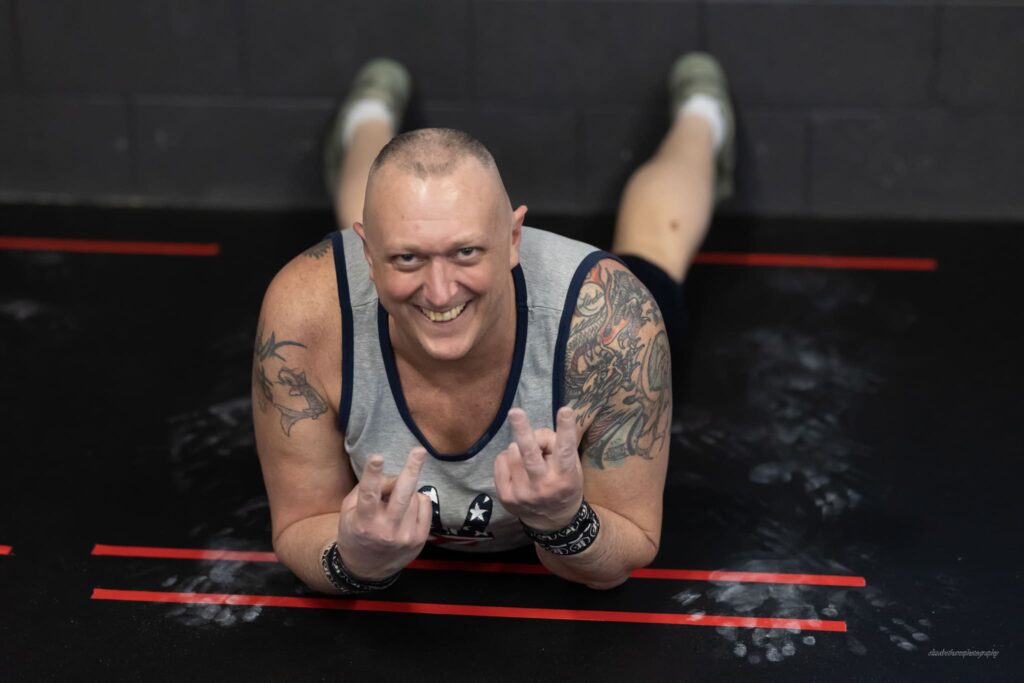
With a trip to the Netherlands coming up I took a quick look at the HYROX Find My Race page to see if any events would fit into my schedule. BOXROX’s increasing coverage of this fast-growing fitness sport had caught my attention and I wondered if I had what it takes to actually compete.
HYROX Heerenveen was taking place two days before I was due in Eindhoven. I can’t say I was overly familiar with Heerenveen but countless sessions scrolling through the Dutch Eredivisie on FIFA meant I knew it was in the Netherlands.
Time to register and commit. I had a month to get ready for my first HYROX race. And find out exactly where Heerenveen is.
For those not in the know, HYROX is a running race interrupted by functional workout stations that systematically fatigue you and make you worse at running. I don’t really like running but fear of failure is a powerful motivator and off I went on my first training run for a couple years. I was reasonably pleased with a 5K at 5:20 per kilometer.
Maybe I was fitter than I thought… I do swim a lot and at 6 foot 2 and 90kg I assumed I would have the strength (weight) for the heavier workout stations.
I would definitely need new shoes though. Running in my day-to-day trainers left my toes numb and my ankles sore.
Feeling in need of some structured training I downloaded the Centr App. Centr is the official equipment provider for HYROX and although the app is well done, it is difficult to follow the workouts at home without having lots of specific kit available to you. So that got deleted and off I went in search of a SkiErg and rowing machine.
Then I got sick. My dreams of flying through the race and humblebragging at the finish line that ‘HYROX is not actually that hard if you swim a lot’ might have to be tempered. I called Robbie, BOXROX’s editor in chief, for advice and he recommended just focusing on the running to build a bit of a base before the race.
Even without much preparation, I at least had a plan: Start slow, aim for consistent pacing, and don’t blow up at the workout stations.
The math seemed straightforward – 5 minutes per kilometer, 5 minutes per station, 10 minutes fumbling around in transition zones. That should get me to my 90-minute goal. Perhaps a little ambitious but with the extra atmosphere and adrenaline on the day, why not aim high?
It has been reported that the growth of HYROX has led to it boosting the economies of entire cities and signs of its growing clout were evident before we even got to Heerenveen. All hotels were completely booked up and we ended up staying 10 miles away in the little town of Joure.
One non-race related tip I received was to really enjoy the whole HYROX weekend, especially if you are in a place you wouldn’t normally visit. I doubt I’ll ever go back to Joure but it was very nice and had great pancakes.
With a start time of 11.40 on Saturday morning I decide to get to the venue early and find out the answers to some nagging questions – like how do you know when you’ve completed a one kilometer lap? And would I be able to push a 153kg sled?
At 9am the car park of the Thialf Arena is already overflowing. Luckily HYROX has seemingly booked up every field and park within a few miles and we find a spot nearby.
Registration is smooth with lots of encouragement from the staff and quickly I am free to check out the race from the stands.
Looking down at the track I still can’t make out how athletes know when they complete a kilometer so I stop by a tent full of volunteers and learn that you enter the Roxzone the third time you reach the big inflatable ‘IN’ gate.
The Roxzone itself, with all the workout stations, looks like a bit of a maze but I could see arrows marking which way to run and the volunteers are taking care to usher everyone in the right direction.
With 30 minutes to go until my start time I drop my bag off and head to the warm up area. Finally I am going to push a sled for the first time. To my extreme relief, it moves! My shoes grip the carpet firmly and, while heavy, I know this station is doable. I hop over to the sled pull and that moves too. My confidence soars and I spend the next 15 minutes on the exercise bike until it’s time to head down to the start line.
Opening the doors to walk down to the starting tunnel I am met by a wall of pumping electronic music. Surrounded by competitors bouncing up and down, I can feel my heart rate rising. Start slow, I remind myself. The countdown begins and then we’re off.
I run the first kilometer in 04:56 and feel… pretty good. Now it’s time for the SkiErg, a vertical cable machine that mimics double polling on skis. I’d used this machine a couple of times and found that I could comfortably maintain a pace of 2 minutes per 500 meters when feeling fresh. Playing it safe, I settle into roughly a 2.15/500m pace and finish in 04:33. A solid start.
On the second run my legs feel fine but my arms are already tired. I try to track another competitor just ahead of me who I recognise from my starting group and keep out of the way of the much faster athletes who seem to be sprinting around the inside of the track. HYROX may be accessible to all but there are serious levels within it.
Next up, the sled push. I try to copy the ‘Full Contact’ technique I saw a pro recommend on Tiktok. Wrapping my forearms around the back of the sled I push hard and the sled moves forward, but also up.

I persevere but obviously I’m doing something wrong and switch to pushing through the shoulders.

The simpler technique works better and step by step I get to the end of the exercise. Sweat is now pouring off but I’m a quarter of the way through my first HYROX and holding the pace needed to hit my goal of finishing in 90 minutes.
By now though, running is little more than active recovery. My pace drops to 05:40 for the next kilometer and the finish feels a long way away.
Workout station number three is the sled pull. I grab the rope and it is much stretchier than I expected. Initially it barely moves but thankfully the closer it gets the easier it is. I opt for the ‘Backwards Walk’ technique: Minimal arm movement, step back into your weight, and drag. It’s effective until the rope bunches up beside me and I have to watch my footing.
The judges are watching closely, and suddenly I am very aware of the limits of the two-meter-long box within which I can move. Step outside it and you get a penalty. I shuffle carefully, pull by pull, and make it to the end clean.
No penalties. Another station down. Time to run again. The laps pass in a blur and soon I’m at the Burpee Broad Jumps.
You might be surprised to hear my confidence is high for this station. I once did 600 burpees in a day (don’t ask), so I come with some muscle memory. I make good progress but soon I am boxed in by slower competitors in front and to the sides. This was not a problem I was expecting! I slow my pace, recover a little, and then jump ahead as the track turns a corner.
My heart rate is soaring but I feel pretty good and push forward to the end. I’m halfway through the race but as I switch from the burpees to running my legs are jelly. It takes me a few hundred meters to switch into something that even resembles running.
My aim of averaging 5 minutes per run and 5 minutes per workout is beginning to slip but I know a good performance in the row and the farmer’s carry can get me back on track. More laps of the track pass by and soon I am sitting on the rowing machine, fumbling with the foot straps. Once in, I try to maintain a pace of 2:30 per 500 meters and enjoy the chance to sit down for a bit. I finish in 5.07 and head back out to the track.
My pace has been steadily declining over the first 5 kilometers, but I manage a slight improvement in run number 6. Maybe my 90-minute goal is still doable. I get to the farmer’s carry and crank out this station in just over 2 minutes. My forearms are burning but my legs feel ok and my pace increases again in kilometer 7.
Next up: 100 meters of sandbag lunges. I have been racing for just under 1 hour and 15 minutes. A strong finish and I will hit my goal!
One thing I’ve learned from doing various endurance challenges over the years is that your weaknesses will eventually surface. And it might be something you didn’t even know was a weakness. This time, it’s my forearms. The sled pull, 1000 meter row, and farmer’s carry have fried my arms from elbow to finger tip.
As I pick up the sandbag and throw it over my shoulders it doesn’t feel too heavy, but I know just holding on to it would be a massive challenge. A judge hovers nearby and reminds me that the sandbag cannot touch the floor during the exercise. Great. Time to dig deep. Lunge by lunge I slowly make progress, stopping every now and again to shift my grip and search for a bit of strength in my arms. In the end the best distraction from my burning arms becomes my burning legs. After a little over 7 minutes I am done and stumble back onto the track.
I am now exhausted. No longer just from elbow to finger tip but from head to toe. Just one kilometer and one workout station left though.
My last run is my slowest at 6:43 for the kilometer and I arrive at the wall balls with just 2 minutes left if I am going to finish in under 90 minutes.
Along with the sled push and sled pull, the wall balls is a workout I have never done before going into this race. I am quite confident in squatting and assumed just doing that 100 times would be the hard part. In hindsight that was a big mistake as I definitely underestimated the coordination needed to complete each repetition properly.
My first throw misses the target completely and my judge sends a sharp ‘no rep’ my way. This could take a while. I squat down again, rise up and hit the target. 99 to go in less than two minutes. My goal was not going to happen.
Apparently this exercise should all be ‘one motion’. At least that’s what my judge keeps shouting in between ‘no rep’ and occasionally actually counting a successful rep. I gradually get a bit of a rhythm and reach 20 before dropping the ball.
Picking up the ball to start again I hold it to my body before going into a squat. It is now covered in sweat. Struggling to hold the thing, let alone catch it, I launch it up to the target and my reps creep up.
My judge seems genuinely thrilled when I hit several clean reps in a row and shouts encouragement. Every 10-15 reps I stop and she urges me to keep going. Finally I get to 90 reps and push through the last 10 in a sweaty, breathless blur. I stumble to the finish line and a time of 1:38:46 greets me on the big screen.
I filter into the recovery zone and start filling my face with electrolytes and protein snacks. My immediate disappointment at needing more than 10 minutes to complete the wall balls recedes slightly and there is a sense of accomplishment.
Looking back it’s easy to see why HYROX is growing so rapidly. As a physical test it is a formidable challenge, but doable. Less obviously, it is extremely well-organised and doesn’t hijack your entire weekend in the same way that a lot of endurance events do. I was done by 1.30pm, had a relaxing afternoon and Sunday, before getting back to work on Monday feeling (almost) fine.
I will definitely do another one. Next time with better prep and my eyes firmly on that 90-minute mark.