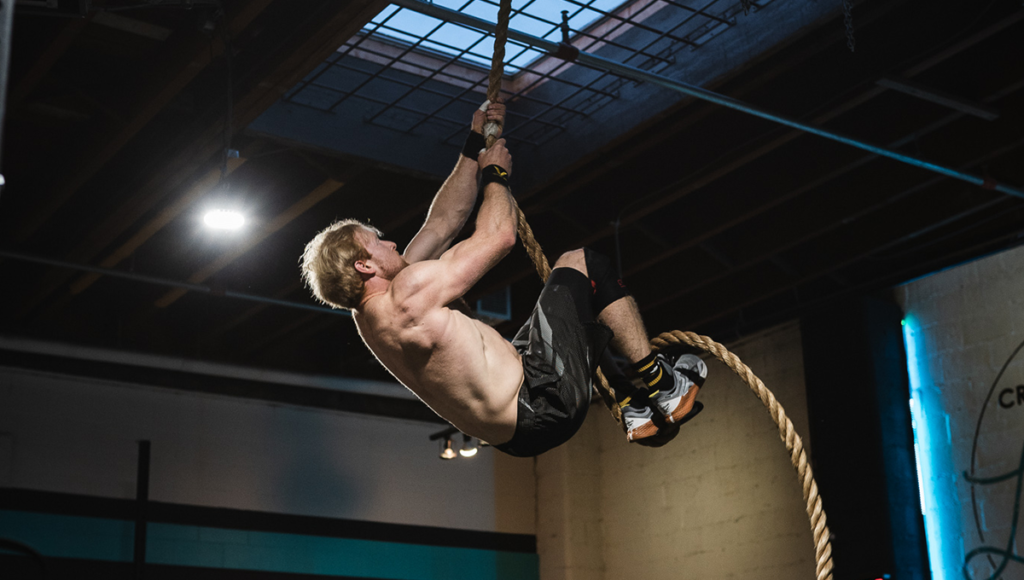
When the buzzer sounded at the Aromas Farm to announce the start of Event 1 of the 2020 CrossFit Games; there was no cheering, no commentary, and no music. A notable difference from the thundering sound of the colosseum a year prior.
For some of the athletes this was incredibly off-putting; suddenly you’re left with your own thoughts, and all you can hear is your laboured breath and that of your competitors.
“I was aware that there was no music,” says Katrin Davidsdottir after Event 1 in the 2020 Games movie Resurgence. “I was aware that there were only five of us there. I think I was anything but present on the floor.”

But this is not the opinion of 5x CrossFit Games Fittest on Earth Mat Fraser, who explains that this is exactly what he trains for.
“I fucking love it. I fucking love it. It’s how we train every day dudes. No one else listens to themselves out of breath. No one else listens to the thoughts in their head, they always have something to distract them. Not Tia [Toomey] and I.”
When the two best CrossFit athletes of all time train in complete silence, perhaps there is something to this. It might not seem like a huge difference, but training without distraction is harder than you think.
Benefits of Training With Music
I’m the kind of person that will not do any physical activity without music, an audio guide, or anything that will distract me from thinking about how hard the moment is or how tired I am, and I want to preface this article by saying that there is absolutely nothing wrong with listening to music while you train. In fact, research has shown that music with a temp higher than 120bpm can actually help you work out harder and longer.
Working out for the sake of working out is a very modern phenomenon, and it’s pretty boring if you think about it; especially when the benefits are not seen or felt right away. Music helps make it more exciting, more manageable.
Listening to music helps improve performance, and sometimes helps you work even harder without noticing it. Studies have shown that particularly in repetitive endurance activities, music helps keep you motivated and on track, and can push you harder when you need to go hard. Scientists aren’t 100% sure why this is; perhaps because music distracts from pain, or because of the metronomic effect that helps you keep pace.
In fact, one study found that music deemed “motivational” (120-140bpm) enhanced affect and enjoyment of sprint interval training, with heart rates and peak power output both higher than when participants listened to a podcast or no audio whatsoever.
In CrossFit, however, you usually work out in an environment surrounded by other people, and music may or may not be part of the atmosphere during your workouts. In these kinds of environments, you have other factors to push and distract you; other athletes, your coach, the clock.
Music might not play such an important role. So perhaps it isn’t simply music per se, but outside factors that both distract and motivate you to go hard.
Lastly, especially in my case, music has a phycological effect on whether or not I can workout at all. If I can’t find my headphones or my phone dies, I might opt to not workout, for fear that the workout won’t be as effective or I won’t be able to give it my all.
While I know that this is not a valid excuse to skip a workout, perhaps this is a good reason why you should get comfortable working out in silence.
Should You Train Without Music?
Obviously, no one knew a deadly global pandemic would disrupt daily life, no one knew that the CrossFit Games would be on hold indefinitely, and no one could have known that the top 5 men and 5 women would be able to compete at the 2020 CrossFit Games with zero atmosphere.

But this is why Tia-Clair Toomey and Mat Fraser are the best in the world; they’re prepared for anything, and so we can definitely learn a thing or two from how they train.
In Triathlon, triathlete’s are also required to compete without any distractions that could hinder performance. One triathlete wrote about his experience training in silence, saying:
“Without music, I’ve discovered I can better focus on my breathing and foot strikes to help control my pace. What’s more, I don’t get ahead of myself. I’m able to maintain a steady pace that makes breathing feel more natural and less like sucking air through a straw.”
Furthermore, he found the overall experience of running more enjoyable. He was more aware of his surroundings and felt more connected to his body and mind.

The same can be said for BOXROX’s own Ultrarunner Caro Kyllmann, who started running with music until she got into trail running:
“I got into trail running, and it felt more like a distraction than an improvement to my runs so I stopped.”
“Now I run with people and love to chat and catch up (especially with lockdowns) so music, even if I liked it, wouldn’t feel appropriate and I think it has to do with my fitness getting better. The more comfortable you are the less distractions you need and the more you enjoy it.”
But what about sports that aren’t running? Well, The Art of Manliness advocates for renewal through silence, the idea that our lives are so full of noise, and “workouts are an excellent time to carve out rare interludes of silence. To be present and alone with your thoughts, with the only sound the clanging of weights and the rhythm of your breath.”
Being alone with your thoughts, alone with the grind, can be a great way to connect with your mind and be present in your body; whether you’re lifting weights, working on your toes-to-bar, or completing 7 minutes of intense burpees.
Tips for Training in Silence
- Practice mindfulness
Mindfulness is the technique of being fully present and aware of where we are and what we’re doing. Mindfulness can be achieved in a variety of ways; through meditation, yoga, or even running. It helps us stay calm and relieves stress, allowing the chaos of daily life to disappear. If you practice mindfulness, you can bring this to your training. You’ll seek the peace of mind that comes with the silence, and it will help you stay present and focused on the task at hand, no matter how hard it gets.

- Don’t worry
Working out without your usual vices isn’t easy to start with if you’re not used to it. You might not have the best run, or you might start to overthink when you hit a wall. If you want, you can use music in the same way you might use coffee — as a boost to keep going when you start to hurt. You have no one to push you but yourself.
- Breathe
It might seem obvious, but conscious breath is one of the most important things to focus on when you’re struggling through a tough set of reps or a hard sprint. By concentrating on your breathing you’ll be able to focus on the task at hand, and it will help calm any anxious or negative thoughts you might have.
Ultimately, whether you train with music or without is a matter of choice and personal preference. However, you never know what might happen in your day-to-day life, and maybe it’s good to get comfortable with things that make you uncomfortable — after all isn’t that is that what CrossFit is all about?
Read More on BOXROX Pro: Should You Transition to Calisthenics?