Mobility refers to the ability of a joint to move actively through a range of motion with control and strength. It combines flexibility with strength, stability, and neuromuscular control. Rather than merely stretching muscles, mobility encompasses how joints function dynamically in movements such as squatting, reaching, or twisting.
Scientific literature distinguishes mobility as an active characteristic. According to a study published in the Journal of Bodywork and Movement Therapies, mobility requires both the range of motion and the ability to control that motion under dynamic conditions (Page, 2012).
In practice, mobility exercises often look like dynamic movements—deep lunges with a rotation, squatting while maintaining an upright torso, or shoulder pass-throughs with a band. These activities ensure that not only is the joint flexible, but it is also stable and capable of controlled movement across its full range.
Defining Flexibility
Flexibility is the ability of a muscle or muscle groups to lengthen passively through a range of motion. This is what most people think of during static stretches, like touching your toes or performing a hamstring stretch. It is purely passive; there is no requirement for strength or control.
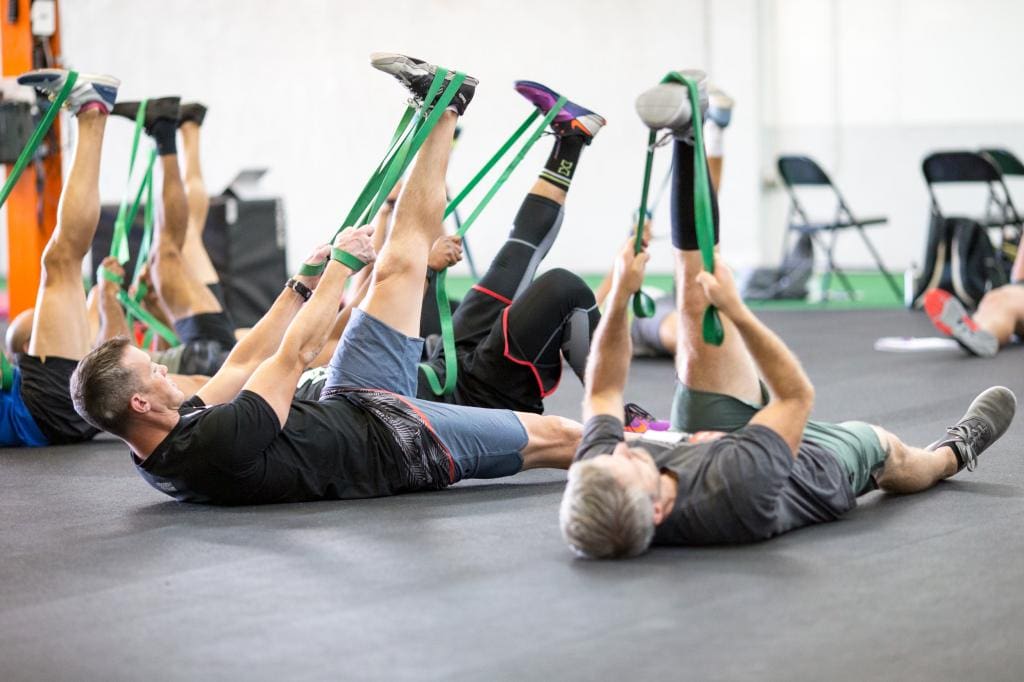
The American College of Sports Medicine defines flexibility as “the ability to move a joint through its complete range of motion” (ACSM, 2014). Flexibility is important for basic physical function, yet by itself, it does not guarantee effective or safe movement patterns.
The Relationship Between Mobility and Flexibility
While related, mobility and flexibility are not interchangeable. Flexibility is a component of mobility. Adequate flexibility is required for full mobility, but high flexibility alone does not ensure a joint can be moved effectively and safely through its range of motion.
For example, a gymnast may be extremely flexible, performing full splits passively. However, if the gymnast lacks strength and control at the end range, they are prone to injury during dynamic movements. Conversely, a powerlifter may have excellent shoulder mobility for pressing heavy weights overhead, even if they cannot perform extreme passive stretches.
Research in Sports Medicine emphasized that joint mobility requires both passive and active components, integrating flexibility with muscle strength and motor control (Behm, Chaouachi, 2011).
Why Mobility May Matter More Than Flexibility
Injury Prevention
Mobility is more predictive of injury risk than flexibility alone. A study in the British Journal of Sports Medicine showed that athletes with poor hip and ankle mobility were significantly more prone to lower limb injuries, regardless of their passive flexibility (Malliaras et al., 2015).
Mobility deficiencies often lead to compensatory movement patterns. For instance, limited ankle mobility during a squat can cause knees to cave inward or hips to compensate, increasing injury risk. Improving mobility, therefore, enhances joint function and reduces compensations that lead to chronic pain or acute injuries.
Athletic Performance
Athletic activities require coordinated, powerful, and controlled joint movements. According to research in the Journal of Strength and Conditioning Research, dynamic joint mobility correlates strongly with sprint performance, agility, and vertical jump height (Behm et al., 2011).
Without sufficient mobility, athletes may struggle to reach positions that optimize force production, efficiency, and mechanical advantage. An inability to express strength through a full range of motion limits athletic potential far more than a simple lack of flexibility.
Functional Fitness and Daily Life
Mobility impacts daily movements—squatting to pick up a box, reaching for a shelf, or rotating the trunk to check a blind spot. Poor mobility leads to movement restrictions that accumulate stress across the body over time, contributing to degenerative joint diseases.
A longitudinal study in Arthritis & Rheumatism indicated that joint mobility loss significantly correlates with higher risks of osteoarthritis progression (Felson et al., 2000).
Enhancing mobility ensures functional independence, particularly important as individuals age. Functional mobility training preserves joint health, supports balance, and reduces fall risk among older adults.
How to Train Mobility Effectively
Dynamic Stretching
Dynamic stretching involves moving parts of the body through a full range of motion repeatedly. This type of stretching has been shown to improve joint mobility more effectively than static stretching alone (Behm et al., 2011).
Examples include:
- Arm circles
- Walking lunges with torso twists
- Leg swings
Controlled Articular Rotations (CARs)
CARs are exercises that isolate joints and move them actively through their maximum range. Research from Physical Therapy in Sport emphasizes that CARs improve joint capsule health, enhance neuromuscular control, and mitigate degenerative changes (Pigeon et al., 2017).
Loaded Mobility Work
Applying resistance to mobility drills—such as performing a goblet squat to work on hip and ankle mobility—builds strength at end ranges. Loaded stretching has been found to yield superior long-term flexibility and mobility adaptations compared to passive stretching alone (Simic et al., 2013).
Movement Integration
Incorporating mobility work into full movement patterns (e.g., Turkish get-ups, deep squat holds with kettlebells) ensures transferability to athletic and daily activities. Integrated movements are more effective for building “usable” mobility rather than isolated joint improvements.

When Flexibility Training Is Still Necessary
There are scenarios where pure flexibility work is critical:
- Post-surgical rehabilitation: When muscles and connective tissues are shortened due to immobilization
- Sport-specific demands: Activities like gymnastics or ballet that require extreme ranges of passive flexibility
- Chronic muscle tightness: Some individuals benefit from targeted static stretching to address persistent tightness before progressing to mobility work
Flexibility improvements often lay the foundation for mobility gains in individuals with severe restrictions. Therefore, in practice, mobility training programs typically integrate both static and dynamic approaches depending on individual assessments.
Assessing Your Mobility vs Flexibility Needs
Functional assessments, such as the Functional Movement Screen (Cook et al., 2006), can help identify whether a limitation is primarily a flexibility issue or a mobility control issue.
If you can achieve a position passively (e.g., your coach can push you into a deep squat), but you cannot achieve it actively under your own control, you have a mobility deficit rather than a flexibility one.
Conversely, if you cannot achieve a range of motion even passively, you need to address flexibility first.
Personalized assessment and programming are critical. A general approach—”everyone needs more flexibility”—is outdated. Modern training recognizes the nuanced interplay between mobility, flexibility, and stability.
Conclusion
While flexibility remains a key component of physical fitness, mobility often matters more for health, performance, and injury prevention. Mobility ensures that joints move safely and powerfully through required ranges, integrating flexibility, strength, and control. Smart training approaches address both elements, prioritizing dynamic and functional improvements that translate to real-world movements.
References
- American College of Sports Medicine (ACSM) (2014) ACSM’s Guidelines for Exercise Testing and Prescription. 9th ed. Philadelphia: Lippincott Williams & Wilkins.
- Behm, D.G., Chaouachi, A. (2011) ‘A review of the acute effects of static and dynamic stretching on performance’, European Journal of Applied Physiology, 111(11), pp.2633–2651.
- Cook, G., Burton, L., Hoogenboom, B. (2006) ‘Pre-participation screening: the use of fundamental movements as an assessment of function – part 1’, North American Journal of Sports Physical Therapy, 1(2), pp.62–72.
- Felson, D.T., Lawrence, R.C., Dieppe, P.A., Hirsch, R., Helmick, C.G., Jordan, J.M., et al. (2000) ‘Osteoarthritis: new insights. Part 1: the disease and its risk factors’, Arthritis & Rheumatism, 43(5), pp.953–962.
- Malliaras, P., Cook, J.L., Kent, P. (2015) ‘Reduced ankle dorsiflexion range may increase the risk of patellar tendon injury among volleyball players’, British Journal of Sports Medicine, 49(17), pp.1238–1242.
- Page, P. (2012) ‘Current concepts in muscle stretching for exercise and rehabilitation’, International Journal of Sports Physical Therapy, 7(1), pp.109–119.
- Pigeon, W.R., Bishop, T.M., Titus, C.E. (2017) ‘The role of controlled articular rotations in joint health’, Physical Therapy in Sport, 28, pp.71–77.
- Simic, L., Sarabon, N., Markovic, G. (2013) ‘Does pre-exercise static stretching inhibit maximal muscular performance? A meta-analytical review’, Scandinavian Journal of Medicine & Science in Sports, 23(2), pp.131–148.
Key Takeaways
| Key Concept | Details |
|---|---|
| Mobility | The active ability to move a joint through a range with strength and control. |
| Flexibility | The passive ability to stretch muscles through a range of motion. |
| Why Mobility Matters More | Mobility enhances injury prevention, athletic performance, and functional fitness. |
| Training Mobility | Incorporates dynamic stretches, CARs, loaded mobility work, and integrated movement patterns. |
| Flexibility Still Important | Necessary for extreme ranges, rehabilitation, and severe tightness conditions. |
| Assessment is Key | Personalized assessments determine whether focus should be on flexibility, mobility, or both. |