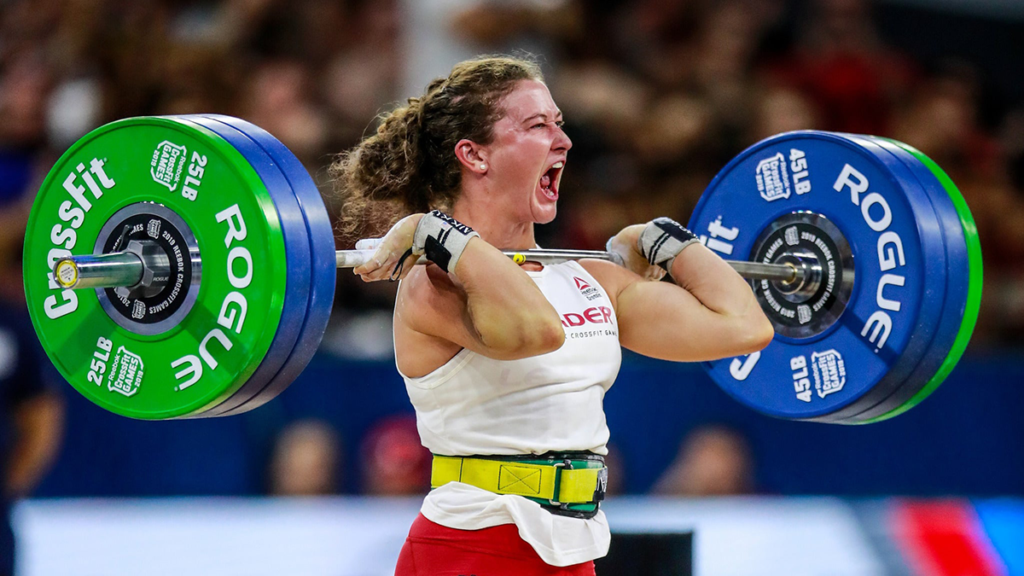
In May 2016, Thuri Helgadottir became the first woman to finish Regionals Nate. A total of 229 women before her had tried to complete the 10 rounds of four strict muscle ups, seven strict handstand push ups and 12 one-handed kettlebell snatches without success.
Yet Helgadottir turned an astounding time of 18:54:38 at the Meridian Regional, a feat never achieved before. At the end of the season, out of all the women who participated at the 2016 Regionals, only Thuri Helgadottir and Kari Pearce finished that workout.
https://www.instagram.com/p/BF6ngwwxxuh/
In an interview later in the year, Helgadottir recounted she’d gone into Regionals Nate with a solid strategy. She had a set pace which she followed from the start:
“I made sure I didn’t go too fast in the beginning and I did singles in the muscle ups from the start, as well as breaking the handstand push ups into threes and twos,” she explained. She had had ample time to practise the workout and come up with a strategy before Regionals, but this wasn’t unusual. Helgadottir strategizes for every workout.
“I feel like it’s better to have some kind of plan, even if it doesn’t work out perfectly, than to have no plan at all,” she said.
Helgadottir has gone as far as to cover her hand with times it should take her to finish each round of a workout so she keeps to her plan.
https://www.instagram.com/p/BF6hPreitXm/
Athletes around the world use strategy to lesser or greater degrees, and many would argue that strategy in CrossFit is the key to success.
Yet with CrossFit presenting such an immense variety of loadings, time domains, rep ranges, exercises, pieces of equipment and many other factors, where do you even start strategizing?
We’ve compiled some handy tips you should look out for to form a solid strategy for any CrossFit workout.
CONSIDER THE WORKOUT’S PURPOSE AND DESIRED STIMULUS
When approaching a workout always take the “desired stimulus” into consideration. Ask yourself exactly what it is the WOD is designed to test and how it was intended to make you feel. You can always ask your coach if you’re unsure.
“The stimulus often determines the pace with which we attack a workout or decide how to scale a workout,” writes Invictus Athlete Josh Littauer.
Pace is indeed the single most important aspect to consider when forming a strategy. Yet pacing a workout takes some strategic thinking before the timer begins.
Pacing = employing the best strategy to maximise power output in any workout and over any given time domain
If a workout is designed to be a sprint-like event – such as Fran – an athlete will have to go all in as there is little point in sparing energy for the end.
Because of this very reason, if you struggle with the pull ups or the RX weight, you should consider scaling. For Fran to deliver its intended stimulus, it should be tackled as a sprint.
On the contrary, a 20-minute long workout like Mary is intended to work a different system in your body (your aerobic system) and therefore should be approached differently.
Workouts are also designed to tax specific parts of your body with the combination of movements involved.
Many athletes at the 2019 CrossFit Games were surprised about the difficulty of handstand walking after a row and relatively light kettlebell jerks. The workout Second Cut seemed “easy” on paper, yet an 800m row combined with 66 KB jerks had an impact even on the most trained shoulders.
Yes, most athletes could sprint the 800m row. Yes, the kettlebell jerks had a high rep range, but the weight (12/16kg) was relatively light. Yes, on a normal day most Games athletes can handstand walk 132ft. without a second thought. But when you combine all these exercises, the workout becomes a completely different beast.
When you look at a workout, think about the body parts that will be taxed by the movements involved, and speed up or slow down accordingly.
LENGTH OF WORKOUT
CrossFit includes workouts across variable time domains and it isn’t always advantageous to go “all in” from the start. Sometimes the best idea might be not to sprint at all.
“Find out if the workout is supposed to be a sprint, medium length, or long, then you can determine how you approach each movement and the time frames you’re looking at,” Littauer writes.
Humans can only sustain a very high level of intensity for a short period of time. Therefore, shorter duration workouts typically produce a higher power output than their longer counterparts.
When rowing for example, your 500m split will be different if the workout lasts five minutes, versus thirty minutes.
As the intensity of exercise increases, so do the by-products of exercise in your muscles and blood. These by-products are then detected by your body and send signals to the brain, asking it to slow down to protect the body.
Continuing to work hard means these by-products stick in the body for longer than they have to, thus limiting you to perform to your best potential.
One of the by-products of exercise is CO2 concentration in your blood.

Going all in at the start will quickly elevate the CO2 concentration in your blood.

Meaning your power output will drastically reduce over time (example A). By starting at a lower power output, you can avoid the drastic increase in CO2 concentration, meaning you overall average can be higher (example B).
For a short workout – think a sprint or Grace – it won’t matter that you hit the maximum level of effort early on as you won’t require the same power output for an extended period of time – which would be impossible to hold.
Short workouts allow athletes to exert much higher force than they ever could in a longer workout.
For a long workout like Filthy 50, the intensity at which you can work efficiently will drop dramatically. As the length of the workout increases, your power output should decrease to ensure you can continue to push hard instead of “blowing up” early on for starting too fast.
“It’s about pacing,” Bill Grundler said about Regional strategy. “It’s not letting yourself go into that red line zone […] where you have no option and no choice but other than to stop and totally recover; and it’s going to take a longer time to recover.”
The length of a workout should give you clues as to how fast you should be moving in each part, and what your effort level should be. Your power output potential – how quickly you can move and how long you can operate at high intensity – will depend on your fitness level and come into consideration when devising your workout strategy.
With workouts with a specific time frame – any AMRAP, EMOM or Tabata – knowing how long you can sustain a consistent pace per round, how long each movement might take you, and considering breaks and transition time between movements is invaluable information.
Establish your goal first – set number or rounds, specific pace or target time – and then execute. Calculating the time it’ll take you to finish a workout (or the amount of rounds/reps you want to accomplish for an AMRAP) will dictate what strategy to follow.
BREAK DOWN THE WOD – OR DON’T
The best strategy approaching workouts will deliver the best time and results. Some workouts are thought out for athletes to do their best to go unbroken, others will be best broken up for optimal results.
“Break before you’re broken” reads a CrossFit Journal article by Pat Sherwood, where he highlights that going unbroken isn’t always possible or smart. “Doing something unbroken does not necessarily mean you will do it faster,” he explains.
When the goal is to accomplish the overall task as efficiently as possible, breaking up the reps might be the only answer for most CrossFit athletes.
“If you cannot do something unbroken, please do not feel pressure to do so,” concludes Sherwood. “Managing your personal tolerance of work-to-rest ratio will yield the greatest results for you.”
Another common mistake athletes make is looking at rounds or exercises in a workout in isolation. You ought to look at the complete picture.
A single round or movement might seem easy, but added up over many rounds will be harder to hold. You might know you can tackle 15 wall balls without breaks with fresh legs, but that strategy is likely to fall apart if the 15 wall balls come after a 400m run and 10 calories on the assault bike.
With workouts with a high number of reps, it’s important to have a plan going in and implement strategic breaks throughout.
In a WOD like Kalsu, which involves 100 thrusters and five burpees every minute until the thrusters are completed, the obvious strategy might be to do a maximum number of thrusters every minute between the burpees.
Yet this will most likely lead to that maximum becoming three thrusters as fatigue takes over your joints.
Instead, plan to do a specific number or sets or set number of reps every minute and give yourself a few seconds to recover every round. A steadier pace will most likely be a faster pace in the end.
EXERCISES AND MOVES
All athletes have weaknesses and strengths. To aim to be the best at everything is a excellent goal, yet despite this every athlete will feel more comfortable performing certain moves than confronting others.
When the exercises in a workout are something you’re comfortable with there’s two strategies you can utilise: use these movements to challenge yourself to speed up and gain time or tackle these exercises at a steady pace so as to spare your strength for the ones you struggle with.
The same applies for high-skill movements or heavy lifts involved: decide whether it’s best to push harder on the movements you find easier or take down your speed to ensure you’re fresher for the more difficult movement.
Keeping bigger sets and moving quickly on low-skill movements such as kettlebell swings is usually the answer for an optimal workout time. With high-skill movements such as muscle ups or handstand push ups, the best idea might be to break up the reps early on to maintain a good pace throughout the workout.
This will obviously depend on your skill level and whether you’re comfortable and confident performing the prescribed movements. Even if a movement is within your wheelhouse, consider whether you have the fitness to continue to perform the exercises that come after it before settling on a strategy.
MENTAL GAME
Athletes are known for their grit and determination; it’s something sport ingrains in their minds.
Athletes often speak about the “dark place” high intensity workouts take them, where they dwell in the discomfort of intense physical effort.
Having the ability to push through that intense discomfort will establish a part of your strategy. Consider how much mental and physical pain you can/want to endure, and devise a strategy from there.
Planning breaks in your workout is a common strategy for mentally staying in control too.
By planning short, strategic breaks, the mind has something to look forward to and will help you push harder until you reach that milestone, instead of hindering you or begging you to go slower.
Nevertheless, breaks should be timed. Guessing your resting time will usually result in breaks too short at the beginning and too long towards the end.
Learn from past workouts and pacing strategies. The more you work out, the better an understanding you’ll have on the impact workouts have on your systems. You can take this information forward to your next workouts and know whether you should push harder next time or whether you were already working hard enough.
Sometimes your initial strategy might fly out of the window as you realise how you feel. Maybe it was the combination of movements, maybe the number of reps, maybe you overestimated your fitness.
If your strategy failed before the halfway point of a workout, you can safely say it was too ambitious. If this happened towards the end, make a few tweaks (reduce the load, decrease the pace, shorten the unbroken reps) and try again. If the strategy felt good, try challenging yourself a little bit more by reducing rest, performing larger sets or moving quicker in the future.
You can shave off seconds, and sometimes even minutes, of your workouts not by being fitter but by tackling them smarter. The more you work out, the better you’ll get to know your strengths and the more you’ll be able to judge how to approach every workout.
COMPETITION VS TRAINING
When tackling a workout, consider whether it is intended to test you or if it’s simply training. While intensity is a major aspect of CrossFit, most workouts are performed as training.
Going all out every workout will overtax your systems and worsen your performance over time. You will also miss opportunities for lower-intensity work that could help improve your efficiency and skills.
Your strategy outside of competition will depend on your goals.
CrossFit aims to improve your capacity across 10 domains: cardiovascular and respiratory endurance, stamina, strength, flexibility, power, speed, coordination, agility, balance, and accuracy.
Is your goal to become stronger to improve your aerobic capacity? Is it to perfect a skill or become faster? While every CrossFit workout has an intended stimulus, you can (maybe even should) scale it to accommodate your personal goals.
In competition you’ll always want the fastest time or the most reps, yet in training you might want to improve your mental game instead. Which might mean doing more reps unbroken to test your mental strength, even if that results in a slower overall time.
Above all, whatever strategy you decide on, make sure you maintain proper movements standards throughout the workout.
image sources
- crossfit-strategy: BOXROX